The skin that inhabits me

A long, long time ago

i woke up on the bank of a river

i got up trying not to fall

stumbling

i looked for the nearest tree

two parts of me clung to that log, holding me.

A sound came from within me at that contact

accompanying me

i was body

When everything stopped moving around me

i knew i could be like that tree

so i stayed in front of it

until a tickle made me know that i could move those two limbs in contact with the ground

as i raised them i let out a sound

that trilled with the wind

to be voice and laughter

i knew that by moving I could leap to reach the lower branches of that tree

i plucked the yellow fruits bringing them towards me to smell them,

to taste them, to satiate something i felt i was missing,

sweet taste stopping the slight tremor of hunger

i was food 

i could touch the leaves, feel their smoothness or roughness,

i listened to the torrential sound of the water in its trunk, in its branches, in every leaf

as well as in my trunk, in my blue, green and red ramifications that i heard flowing in me

i was consciousness of stream and dew.

Night came and i felt cold

no matter how many leaves i managed to cover myself, 

no matter how many trees i hugged for warmth,

for more sustenance that conciliated the inner trembling,

no matter how much fire i created to protect myself

no matter how many songs and dances that lulled me to sleep and pleased me

nothing succeeded in sheltering me

i woke up lying on the ground

in the midst of ashes, leaves and tubers

buzzing were a pair of dragonflies

as old as me,

with precise movements

undulating, careful

they were threading with their fine needles

fluttering up and down

creating latent sutures

closing a line drawn on my belly

finishing its stitching with a button

for navel.

Protected from the inside out

and backwards

woven double face

on the face of the earth.

And then I was a thought

with this skin that inhabits me,

feeling what I think

and touching what I feel.
Nature-led Architecture: Biophilic Design

If this your first time hearing the term “Biophilic design” then I’m excited to be the one to share it with you! This is one of my core passion and sincerest beliefs; architecture should not only be inspired by nature but designed to benefit it. We as humans are a part of nature, not something outside of it. If we were, wouldn’t that make us the aliens? Why do we allow ourselves to be forced into drab little boxes? This is one thread in my series of “Thought Projects” to explore the possibility of what could be and I would argue, what should be!

My introduction to Biophilic Design came eight years ago when I watched the documentary: Biophilic Design: The Architecture of Life. You can get a good idea about what Biophilic Design is by watching the trailer. There is also a book by the same name. In it Stephen Kellert offers a personal vision of what our cities could look like. I enjoyed those parts of the book. Since then I’ve looked to Stephen Kellert, Edward O. Wilson and Judith Heerwagen as role models. Sadly, Stephen Kellert passed away of cancer on Nov. 27th , 2016. I will always be grateful for his passion on this subject.

http://www.biophilicdesign.net/film-trailer.html

Now when I look at a building I look at it with new eyes. I think about what’s been done right and what could be improved to make it more welcoming to people and nature. It should be noted that biophilic design doesn’t always follow sustainability practices. I would like to see a more cohesive model that encompasses both. While this term “Biophilic Design” may be relatively new, the pursuit of working with nature is not. In fact, I believe it is one of our most innate traits when not suppressed by greed. The lowest bidder wins the contract, the developer that can squeeze the most amount of people per square footage at an affordable rate gets to make blocks upon block of housing units. I’ve looked upon street after street of uniform single-family homes and apartments complexes and wanted to weep. In my darkest thoughts it feels there’s nothing left to build except Jeremy Bentham’s panopticon in the center of it all. We’re left constantly overwhelmed, falling blithely into the role of prisoner in the name of capitalism, safety, and convenience.

Is the design inherently wrong? No, but architecture is like the clothes we choose to wear. It makes a statement about who we are as a people and what we value. There are a lot of sustainable buildings being built by Scandinavian architects and while I want to like them; I find the clean lines, muted colors and sparse, low furniture too cold. I prefer the warm colors and arches of Latin American architecture and the clever, functional designs of East Asia architecture.

Elements of Design include: Natural materials, natural shapes, colors, lighting and space.

  • A source of water and a source of fire or a representation of these elements through color or texture
  • Air or airflow; ventilation, temperature control or represented by light “airy” textures and elements (subjective)
  • Earth is represented by wood, concrete, rock or rammed earth
  • Metal commonly in doorknobs, hinges and railing. Uncommon ways to use metal include textured metal pictures.
  • Glass, wonderful glass, sand heated in the fire until its molten, worked with air and cooled with water. Gives us the windows we need to see the environment around us and beyond.
  • Mirrors or other reflective surfaces are great for bringing light into interior rooms by enhancing lighting sources already present.

Feng shui and Ayurvedic or Vastu Shastra practices are types of biophilic design, but biophilic design is not a religious or spiritual belief in itself.

Biophilic Design at home:

Author’s Living Room

The skylights have a light fabric covering (hand sewn by me) to diffuse the daylight, add softness to the wood ceiling and hide whatever grime or water spots are on the glass. I can peek to the edges to see if its raining or not. The downside is that skylights are noisy during heavy rains and you do lose some insulation value as a trade off for all the natural light. One alternative would be Clerestory windows, which are high sheltered windows that allow the light without being directly impacted by the weather. This would be an a better solution especially in areas that receive a lot of snow.

When we moved into this house the wood on the sides of the fireplace were a very dark wood stain. It made the whole wall heavy in an otherwise light-filled room. By painting the horizontal boards a light green the room became more balanced and brightened the color of the wood and brickwork with warmer tones that you couldn’t see before.

Inside plants, only cacti and succulents can survive me because I often forget to water.

More to Explore:

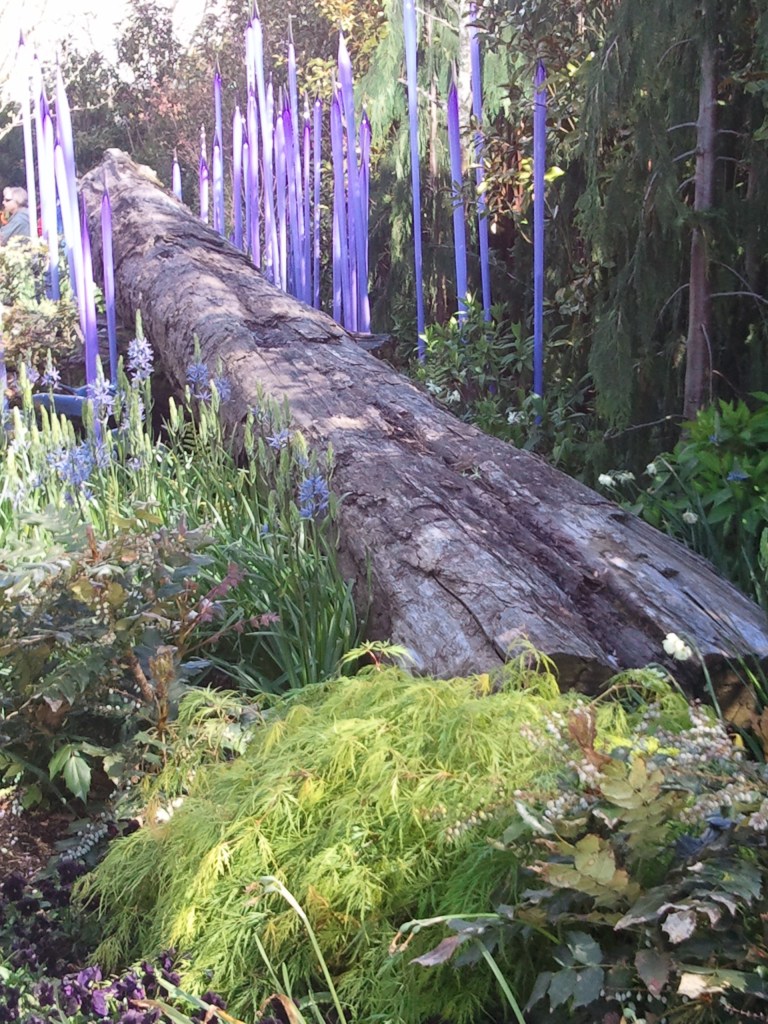
Chihuly Garden and Glass: https://www.chihulygardenandglass.com/about/exhibition

Little Boxes Written and Performed by Malvina Reynolds (1900-1978) American Folk/Blues Singer-Songwriter and Political Activist. (Not related to this Author.) Song rediscovered by younger generations when it was used for the intro of the American hit show Weeds by Jenji Kohan. Link: malvina reynolds – little boxes – YouTube

A panopticon is a building design where a guard/observer has a 360 view of prisoners in an institutional setting. It always make me think of the Tower of Mordor in Lord of the Rings by JRR Tolkien. Link: https://en.wikipedia.org/wiki/Panopticon