Book Review: The Well-Tempered City

Hello Nature-Led Friends!

Sometimes life is rough. We just have to do the best we can. Through dark times I have two mantras to help get me through it: “It won’t always be like this.” For better and for worse, change is inevitable. The second thing I remind myself of is “As long as there is another day, it is a chance to make things better.” Sometimes, you just have to put a bad day to rest and start anew the next day. If you are going through tough times right now, believe me when I say that I care about you and that I wish you the best.
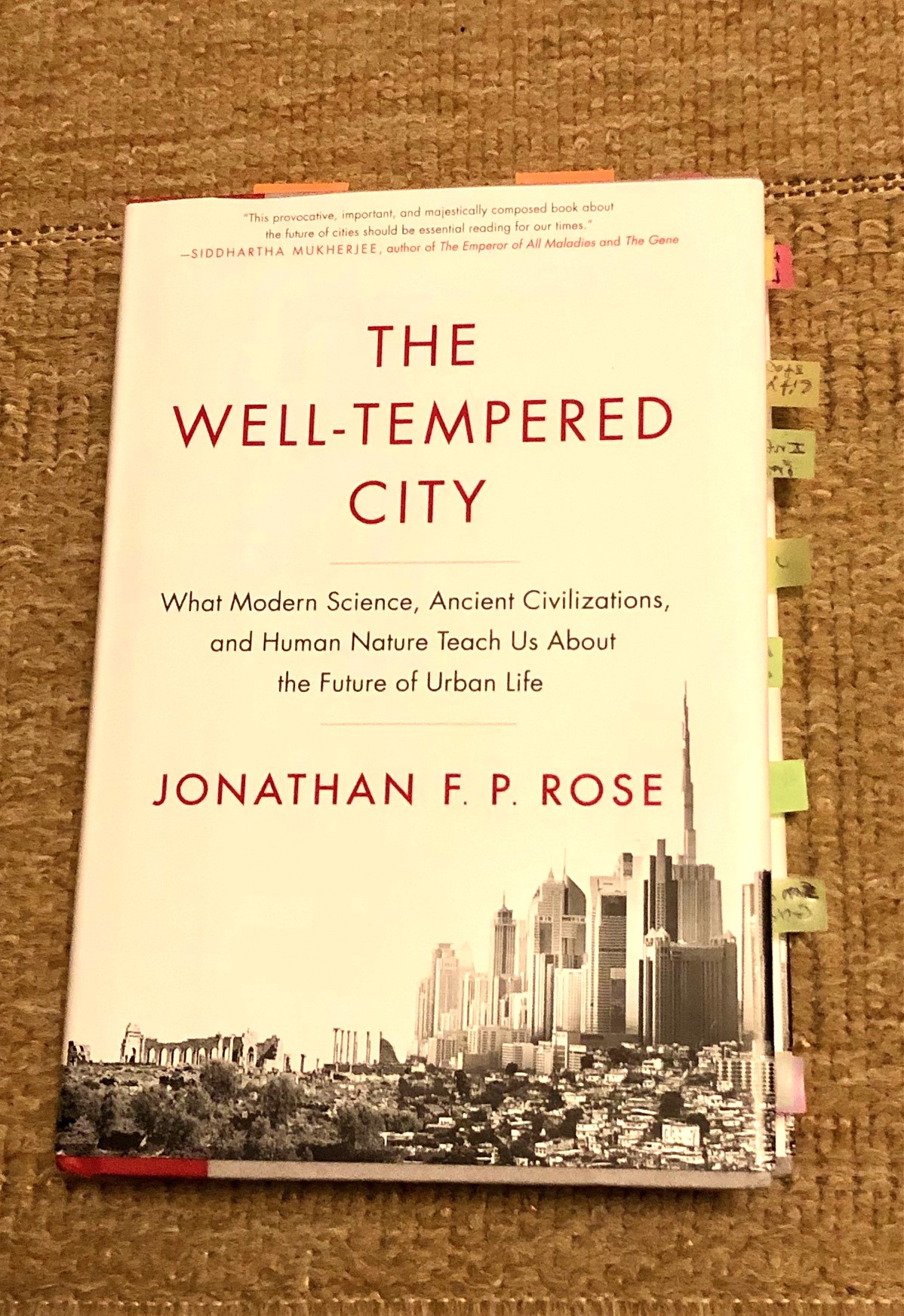

The Well-Tempered City: What Modern Science, Ancient Civilizations, and Human Nature Teach Us About the Future of Urban Life By Jonathan F.P. Rose, Printed 2016

Book Review: The Well-Tempered City: What Modern Science, Ancient Civilizations, and Human Nature Teach Us About the Future of Urban Life by Jonathan F.P. Rose

This book starts with an introduction into what we can learn about ancient civilizations and includes a concept called meh, loosely translated as “an activating energy and the source of rules that guided the spiritual, social and moral basis of [what was] the Ubaid culture” allowing it to become the first society to develop a framework of integrative systems that we now call Urbanism.

I smiled every time I read the word meh, because I have a friend who’s a one-word guy most of the time and that word is “Meh.” Intonation of the word could imply that a proposed idea is good enough that he is willing to do it (i.e. go to a specific restaurant or movie.) He is neither excited nor unexcited about the idea. If you ask him how something was, and he says “Meh.” that usually means it could have been better. If you are fortunate enough to propose an idea that he really likes you are rewarded not with a “Meh.” but with a “Definitely.”

I feel that a lot of urban initiatives these days are met more with the kind of “meh” my friend prefers, a “wait-and-see” energy of approach then an “activating energy” for integrative social rules. Maybe it’s a bit of both. Anyone whose had more than a few rotations around the sun learns to approach things with cautious optimism.


Photo by Pixabay on Pexels.com

The five qualities of a well-tempered city (p.20):

  1. Coherence – an integrated framework that unifies a city governing sections of departments, programs and goals.
  2. Circularity – transforming linear systems into regenerative ones.
  3. Resilience – the ability to navigate forward when stressed.
  4. Community – social networks that strengthen the individual in mind, body, and spirit.
  5. Compassion – creating a healthy balance between individuals and the collective well-being of the community at large.

Folded within these key qualities is how they relate to the nine “C’s” that made early human evolution to civilization possible:

Cognition, cooperation, complexity, culture, calories (food), commerce, control, concentration and connectivity.


Overall, a really good book that offered relative case studies to make each point. I learned so much! It felt like a college course wrapped in a book. I took a lot of notes and tabbed a lot of key sections that pertained to areas I was most interested in as you can tell from the book picture above.

Here are three things I learned about that really interested me:


Photo by Pixabay on Pexels.com

The Traffic Paradox (p.235)

More lanes create less efficiency, not more due to the Braess Paradox and the Nash equilibrium theory.

The basis of this is that drivers have a self-serving interest to take the shortest route possible from point A to B until so many people take that route that it is no longer shorter for anyone.

For a three-minute visual explanation of how this works visit this YouTube link: https://youtu.be/O8Wi1ZC_yL8?si=0HUdAC7tfLoHfcZx


This paradox is an excellent reason for why cities need to provide alternate means of transportation for city infrastructure. I’ve never been the kind of person interested in fancy job titles. It was always important to me to find a tolerable job with a tolerable commute. I spent the first half of my working life commuting to jobs that I could do by walking or taking a bus that rivaled or beat the commute time of a single passenger vehicles. Given the option, a safe walking route is always my preferred method of travel. One need not expend a lot of time or money working exercise and fresh air into their day when it’s imbedded into their daily routine. It also increases the opportunity for social interactions outside of school or work.


Photo by Eva Bronzini on Pexels.com

From Entropy to Emergy (p.238)

Eugene Odum and his brother Howard wrote the first Ecology book in 1953 describing ecosystems as communities of organic and inorganic elements. In this kind of closed circular system, the eventual entropy of one thing leads to the emergy or creation of newly stored information. “While entropy is always wearing down a system, emergy helps build it back up.”


Gardeners know this process well by gathering dead plant matter and wood chips to decompose, thereby releasing there nutrients as “newly stored information” in the form of compost to spread around young or existing plants.

Humans have learned to do this with paper products such as cardboard, but we need to do better at incentivizing more circulatory systems that benefit both humans and nature. My personal opinion is that one our biggest failings as modern societies is allowing plastics to be extracted and used so excessively for a lot of things that ultimately end up being cheap pieces of crap that can’t be recycled. The oil and plastics industries have powerful lobbying groups that allow our shared future resources to be exploited for meaningless crap. As a consumer, you speak with your purchasing power. In a market economy founded on supply and demand use your money as your voice wisely. If you don’t like something, make it unprofitable to support. It’s clear we can’t wait for governments to regulate appropriate solutions.


Photo by John Guccione http://www.advergroup.com on Pexels.com

Easterlin Paradox (p.345)

Richard Easterlin a USC Professor wrote “The Economics of Happiness” in 1974 which found that more money increased happiness in those previously in low income or poverty situations, but that more money does not increase happiness for the affluent.


I’ve witnessed this firsthand having grown up low income and later working in an exclusive member-only club where members were required to make no less than $80,000/year (in 1998) and be sponsored by two existing members of the club. I started the job in 1998 at the height of the dotcom bubble in Seattle, WA where tech was making new millionaires seemingly overnight. The “new money” were often young tech entrepreneurs launching their first IPOs and expecting everyone to know who they were and have people cater to their every whim. They were loud, obnoxious and often travel entourages. The “old money” were people who were more often born into wealth. They were polite and reserved. Time was a luxury. If they couldn’t be bothered to wait for your assistance they would come back later or have someone else take care of it on their behalf. They had no need to yell.

The club had hotel rooms, and I worked the front desk. The rooms often sold-out months in advance especially during Huskie football season. I was handing one of our long-time members his morning paper when a young techie came up expecting my full and immediate attention. I asked the long-time member if he needed anything else. The young guy huffed impatiently. I gave him a sharp look and said, “You will wait your turn.” The older guy chuckled, tucked his paper under his arm and told me to have a nice day as he walked away. The young guy didn’t even last a year at the club. The dotcom bubble burst not long after. Nearly every new member that year was purged from the member roles before New Year’s. The young guy had no idea he’d rudely interrupted one of the richest men in the world and one of our longest-standing members.

I’ve had the opportunity to ask multiple people with famous names; “What bothers you most about being rich and famous?” They’ve all said in some variation that it’s hard to trust people. They said that everyone wants or expects something from you all the time. You can go anywhere in the world, but you can’t trust that anyone genuinely cares about you as a person. It seems reasonable to assume then that what you gain in monetary significance can cost you in a kind of spiritual deficit (i.e. honest connections with other people.) Some people aren’t bothered by the tradeoff, but it would bother me.

Final Thoughts:

I definitely recommend this book! There’s really so much to it that what I’ve provided here is only a small sampling. If you’ve read this book, I would love to hear your thoughts on it!


Thank you for visiting!

Science Fiction to Science Reality: The Post Apocalypse Edition

Photo by Rodrigo Souza on Pexels.com

Last year I read a lot of newly published books on Climate Change and Psychology. This takes patience on many levels, not least of all due to the fact that I have mild dyslexia. While I may not read as fast as most people, in some ways it feels like a secret superpower because I retain the majority of what I read and can expand upon it endlessly.

By the time this past holiday season rolled I was burnt out on real life doom and gloom and petty manipulations. I needed a return to a familiar space, Science Fiction, but more specifically, Octavia Butler’s familiar writing. I consider Octavia Butler “light reading” much to the amusement of my spouse. Her writing style is crisp and clean. She has the ability to say a lot in so few words and I feel her presence in her words. I get her. I get where she is coming from. I discovered her writing much too late though. If I had found her sooner, I could have potentially met her in person, she only lived 20 minutes away from where I live now.

She’s one of the few dead people allowed to life rent free in my brain. She sits at the kitchen table writing and thinking while William Morris paces back and forth on an ornate blue and cream rug practicing his speeches in the adjoining living room. High up in the corner of a bookcase Ryunosuke Akutagawa curls up like a cat watching everything below and taking notes. My brain is a proper Craftsman-style house. Writers, artists, thinkers, historians, and long-dead family and friends pass through for a visit now and then. Occasionally, the random stranger wanders through too.  Only Ryunosuke is amused.

It’s always a party when Kurt Vonnegut shows up. Pat Frank and George R. Stewart prefer coffee on the veranda, but I’m getting carried away.

Photo by Janko Ferlic on Pexels.com

Where were we?

Oh yes, what can we learn from fiction and in particular Science Fiction. Well, who isn’t familiar with Gene Roddenberry? George Lucas? Or Stephen Spielberg? Can you seriously say their scripts, movies and show have had no influence on the art of science? That they do not act as muses for scientists and engineers? Many of us are still waiting for hyperdrives and holodecks! Do you want to make a Computer Engineer swoon? Discuss The Moon is a Harsh Mistress by Robert Heinlein or the short stories of Isaac Asimov.

When considering the offerings of Robert Heinlein one has to chew through the sexism. I’m not going to excuse it on the faulty argument that he was “a man of his era.” He wrote The Moon is a Harsh Mistress in 1966 and there were plenty of men “of his era” that were not so blatantly sexist. Still, putting that aside we have a framework offered to us on how to build a resistance movement with minimal causalities and disruptions. By working in “cells” what is similar to creating “partitions” in a computer to keep data corruption and bugs from causing a full-scale shutdown. Redundancy in technical writing is bad, but redundancy in organized systems is good. What else works with cells, bugs and partitions? Trees! Let’s say a branch gets broken and damaged in a windstorm. If the tree cannot adequately thicken the cells in that area to help heal it over, it effectively self-amputates or “partitions” the branch from the rest of the body to prevent the spread of infection by cutting off supplies to the affected area. By reserving its strength, the tree lives another season and regrows the start of a new branch the next Spring.

I once read an article in an Architectural e-zine where an Architect proposed that perhaps the best way to “save” a building in a major earthquake might be by designing rooms(cells) of it to fail. (Presumably, this would help dissipate the force of energy produced by the earthquake upon the total surface area of the structure.) I appreciate the “out of the box” thinking, but how big is this man’s house? How many people have “spare rooms” to let collapse in the event of a major earthquake? I think if you have a bunch of unused rooms in your house it’s too big, and you should consider downsizing.

Octavia Butler imagined our current climate crisis in a book published in 1998 called Parable of the Sower and the sequel Parable of the Talents. Her story takes place in the early 2020’s and fortunately our here-and-now is not as terrifying as the one she wrote about, but some of the themes are eerily similar. We’re all aware of how politics impact our lives. What I focus on though is how individuals and communities shape the impact they have on the world around them. We have within the psyche of the American mind this image of “Rugged Individualism.” It’s represented in the notion “survivalist man” who can do everything and brave all challenges alone. I used to work very hard towards the idealism of the survivalist (wo)man but reading Science Fiction helped me understand that no person can be an island unto themselves for very long. In the end, it doesn’t matter how much of an introvert or anti-social being you thought you were. By the end of any lengthy stay alone in the mountains or in your head you’ll find yourself ready to make friends with anything not trying to eat you.

Science Fiction at its root is a cautionary tale of the successes and failures of individuals and groups. A forest and it’s trees. Sometimes the people are represented as alien races or other types of lifeforms, but it is in our human nature to find commonalities in order to relate to things no matter how alien it may appear on the surface. Octavia Butler worked hard to push this boundary to see where our tolerances might lie. Read her short stories Blood Child, Amnesty or the book Lilith’s Brood (Xenogenesis 1-3). Whenever I think my writing or ideas are getting “too weird” Octavia Butler challenges me to make it weirder.

Pat Frank wrote Alas, Babylon in 1959 and gave us an alternative history novel before all the cool kids started doing it. He showed us what living in Florida might have been like had the cold war been a hot one. Like Octavia Butler his writing is crisp and clean. A lot said in so few words. The imagery from some of the scenes in this book still put a smile on my face. I love this book so much that in the twenty years I have been with my spouse only once have I ever threatened him with a tomato, no sorry, ultimatum. “Read this book or divorce me.” He read the book in an afternoon. I made brownies and coffee. Crisis averted.

Finally, let’s close this post with an honorable mention, Earth Abides by George R. Stewart published in 1949. Yes, I know all the books and authors I’m mentioning here are old and dead, but that’s part of the beauty of it. To survive the future, you have to understand the past! A serious disruption in our ability to maintain our resources can put us back by ages. Fictional stories give our minds a playground to explore different theories and ideas of how to solve problems. Some of those solutions are found by going back to the basics and other solutions require us to unhinge our brains like a snake’s jaw and consume ideas we once thought too big to swallow.

There’s a scene in Earth Abides that made me laugh out loud and that is a very rare feat for any book! (I also dare you to make me cry too, while reading David Brin’s The Postman I was mad that I wasn’t more upset about a particular death.) What’s interesting about Earth Abides though is that there is an interracial relationship and a character with Down’s syndrome. It’s the only fictional novel where I can distinctly remember a character with a developmental disability and again, this book was published in 1949!

Whether it’s a Science Fiction, Romance or any other genre the one thing I can’t abide is when an author takes over two pages to describe a computer console or a room. I’m looking at you George RR Martin.


Photo by Castorly Stock on Pexels.com

Links:

https://www.scientificamerican.com/article/how-a-virus-exposed-the-myth-of-rugged-individualism/ (March 2022 Issue)

A24 Is Adapting Octavia Butler’s Parable of the Sower | Tor.com (July 26, 2021)

Nature-Led Black Americans

February is Black History Month here in the United States, so I’m excited to introduce to you a handful of Black American who exemplify what it means to be “Nature-Led” and by doing so strengthen the communities in which they live.

Photo by Pixabay on Pexels.com

Alexis Nikole Nelson, the Black Forager

I first saw one of her TikTok videos on Facebook and immediately fell in love. Who is this? She has so much energy and she’s talking about foraging! Wow! Foraging is something no one talks about in modern American society—well, until now. I l learned a little foraging when I was younger but I never thought much about it. It wasn’t something we talked about. If you had asked, “What are you doing?” I would have said “picking berries” or “picking greens.” “Foraging” sounds like something herbivores do when talking about animals in a Science class.

Now here we are in the post-computer revolution and a young Black woman is excited about foraging and sharing her knowledge with others in a way they can relate too. It gives me hope for the future. We’re all going to need this knowledge if things continue as they are with our current trajectory towards climate change. Octavia Butler, Sci-Fi Author of Parable of the Sower & Parable of the Talents, would be proud of Alexis Nikole Nelson.

I encourage you to follow Alexis Nikole Nelson on TikTok, Facebook or whatever your preferred social media is. To learn more about her read this great interview found on NPR:

Meet Alexis Nikole Nelson, The Wildly Popular ‘Black Forager’ : Code Switch : NPR

Photo by Craig Adderley on Pexels.com

Ron Finley, aka Gangsta Gardener

I first heard about Ron Finley’s garden in South-Central Los Angles years ago as part of tv news segment. He started his garden revolution in 2010. Having stayed in the community he grew up in he fought and won the opportunity to garden in the parking strips throughout his neighborhood. A neighborhood that has for years been a food dessert/food prison for people of color. This is how it starts, this is how you change things for the better in your community. You can’t wait for City officials or someone else to do it, you have to be willing to step up and take action yourself. If something is important, you make time for it.

Ron Finley: A guerrilla gardener in South Central LA | TED Talk

The Ron Finley Project

Photo by Svetlana Obysova on Pexels.com

Aaron Shepard, Robotics Engineer, Scuba Diver, & NASA intern

I literally just discovered Aaron Shepard while watching a short Brut video on Facebook about how animal responses perceived as being “cute” are actually responses to stress and a terrifying ordeal for the animal. There’s nothing “cute” about terrorizing any living lifeform for amusement.

Aaron Shepard on Twitter: “Repeat after me people : “I will not touch ocean animals unnecessarily for social media clout” Thank you… https://t.co/wKsorJi983″ / Twitter


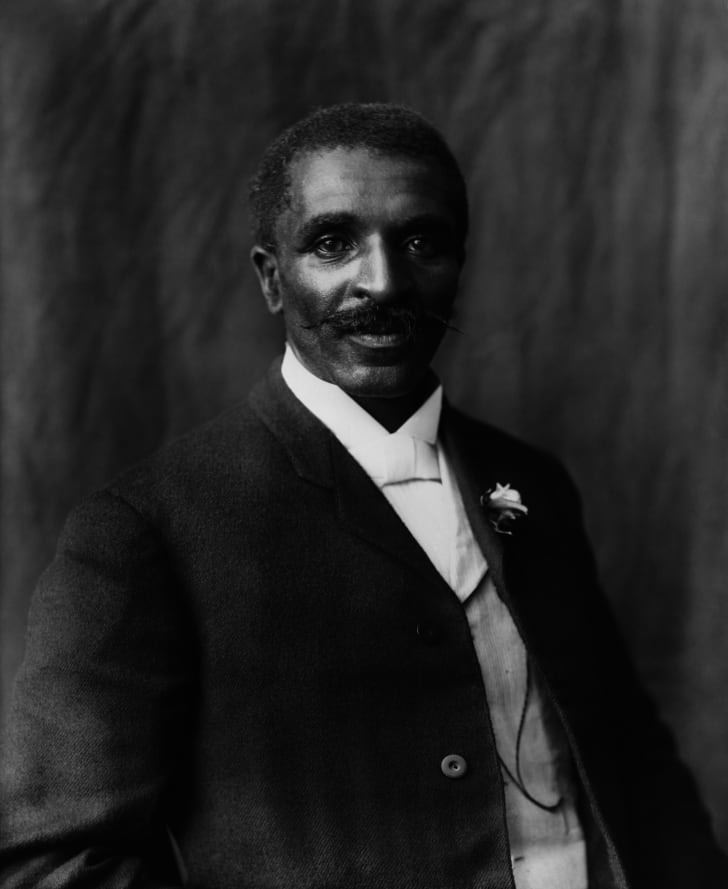
Portrait of John Washington Carver, Tuskegee Institiute

John Washington Carver, Agricultural Scientist

Finally, when it comes to historical contributions, the work of John Washington Carver (c 1864- Jan 5th, 1943) simply CANNOT be overlooked by a site such as this. He was born a slave, persevered through multiple hurdles to get himself college educated and became one of America’s most distinguished Scientists. He introduced us to the idea of crop rotations and compost to improve depleted soils. In tandem with helping the environment, he also worked to improve the lives of poor farmers by recommending highly nutritious rotation crops such as peanuts and sweet potatoes at times when the fields needed to rest from cotton production. He also provided recipes for his food recommendation through “Bulletins.”

History & Culture – George Washington Carver National Monument (U.S. National Park Service) (nps.gov)

Biography books on John Washington Carver are available at most U.S. libraries.


More to Explore:

Gardening while Black: How some are redefining relationship to land (usatoday.com)

7 Contributions of Black Farmers to Agriculture — Poughkeepsie Farm Project

In their own words. A booklist:

10 Outdoors Books by Black, Indigenous, POC Authors | Field Mag


My sincerest thanks goes out to any and all persons, living or dead, who endeavor to restore the health and well-being of their communities; be they human communities, animal communities, plant communities, soil communities or water communities. We are all part of a greater community, the sum of life itself on planet earth. We can choose to nurture that which is around us or we can destroy it with our indifference.