Adaptation & Transition: Climate Change Is Here

It is not the strongest of the species that survives, nor the most intelligent that survives. It is the one that is the most adaptable to change, that lives within the means available and works co-operatively against common threats.

Charles Darwin

A common theme among Science Fiction novels and the apocalypse genre in general is that few people can rarely survive alone for any great length of time. I plan to expand on this notion in a future post citing some of my favorite novels and how they provide the “burden of proof” in a future blog post. The settings may be fictional and fantastical, but often times, the behaviors of those that walk within the worlds are not.

For decades we have talked about how human-driven climate change was speeding up global warming. That future is here now. I’m tired of seeing articles claiming this or that event is “unprecedented.” It’s time to adapt to radical shifts. You can do it. I believe in you. Anyone can be an agent for positive or negative change in our societies. I’m asking you to fire up your neurons and muscles to be a catalyst. You don’t need permission. We must break out of bystander shock. We, myself included, have been waiting for someone else to be in charge and take the lead because there are so many climate issues. It’s time to pick one and get to work. We can’t wait for “experts” in any given sector to make the changes we need done now. It will take all of us. What legacy do you want to leave behind?

Photo by Pixabay on Pexels.com

Somebody should do something.

You should do something.

You are not too old. –  The entrepreneurs over 70 taking the business world by storm | Winning new business | The Guardian

You are not too young. – 6-year-old makes history as Georgia’s youngest farmer – ABC News (go.com)

You are capable of great things. – 12 Disabled Scientists Who Made the World a Better Place | Mental Floss

What you do now matters.Why your ‘personal infrastructure’ decisions actually do affect the cl (fastcompany.com)


This post was originally supposed to be an exciting review about a book I bought called:
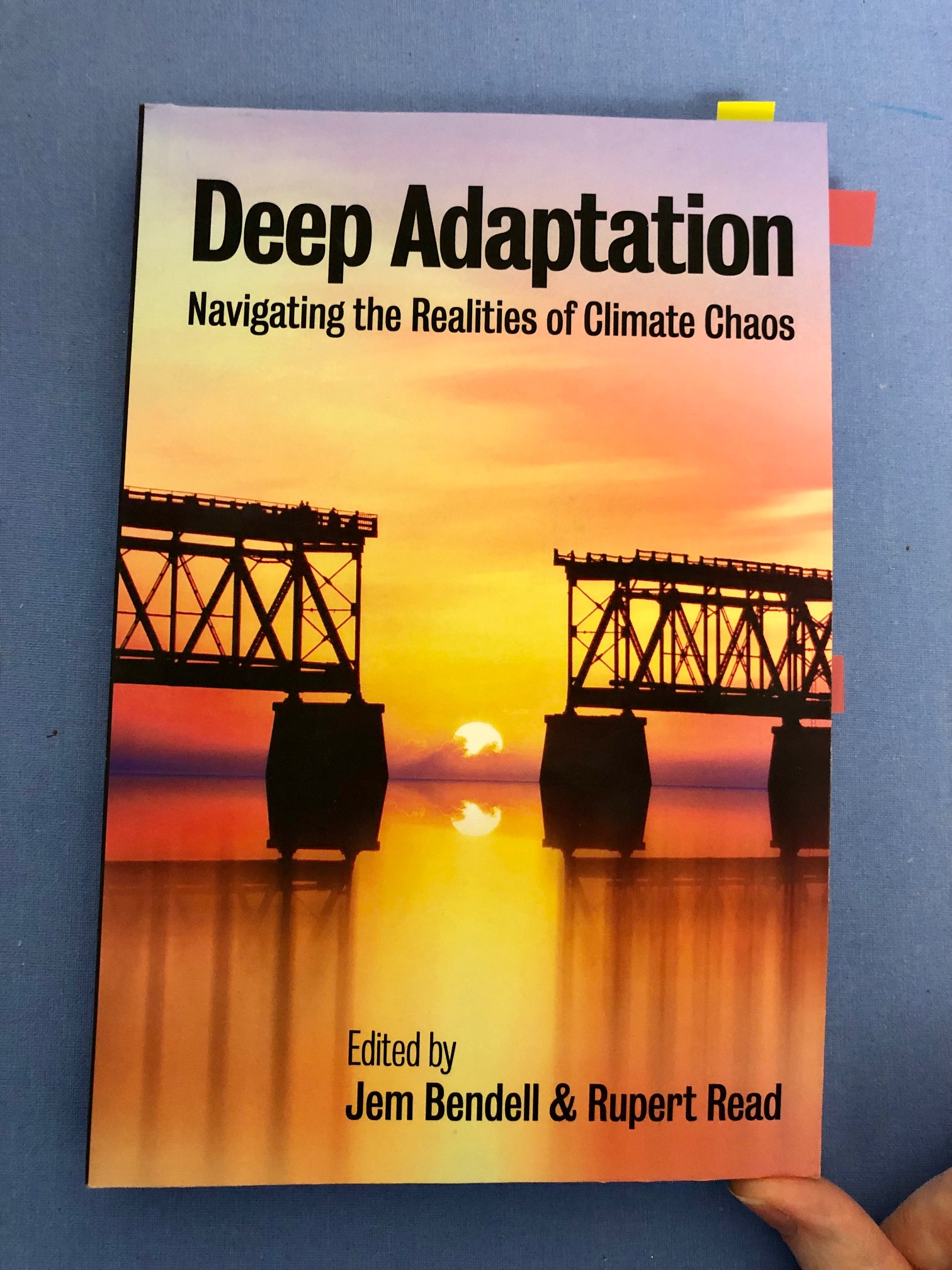
Deep Adaptation: Navigating the Realities of Climate Chaos By Jem Bendell & Rupert Read

I tried to plow through it until the end, but eventually gave up. It’s dense reading with a lot of footnotes. When you write a book you have to know who your audience is. I wish the Authors had focused on whether they were writing for a General Audience or people already in the field of Climate Science., otherwise you risk alienating one and offending the other. They would have greatly benefitted by hiring an outside Editor improve the format, organizational structure and style. A good book engages readers. It’s about more than proper spelling and grammar. They clearly have expertise in their field of study, but I don’t have time or patience to be lectured by a book.

The Premise – A Snapshot

We can agree that climate change is already here and that global societies need to stop arguing about its existence and severity and start planning to transition into more adaptive societies. I like the framework of the 4R’s on page 73. That Deep Adaptation requires:

Resilience – “How do we keep what we really want to keep?”

Relinquishment – “What do we need to let go of in order to not make matters worse?”

Restoration – “What can we bring back to help us with the coming difficulties and tragedies?”

Reconciliation – “With what and with whom can we make peace as we face our shared mortality?”

Part of what made this book so hard for me to read is that I couldn’t get in the right headspace for it. I’m preparing to jump into action mode. I’ve been researching climate-related issues since 1997. It’s only recently that I’ve asked myself, when is enough researching, enough? Am I going to keep “researching” until I’m dead? Then it would have all been nothing! I’m ready to move from research phase to action station. I want to start making a bigger impact starting now.


Two good books have recently helped me take the next steps:
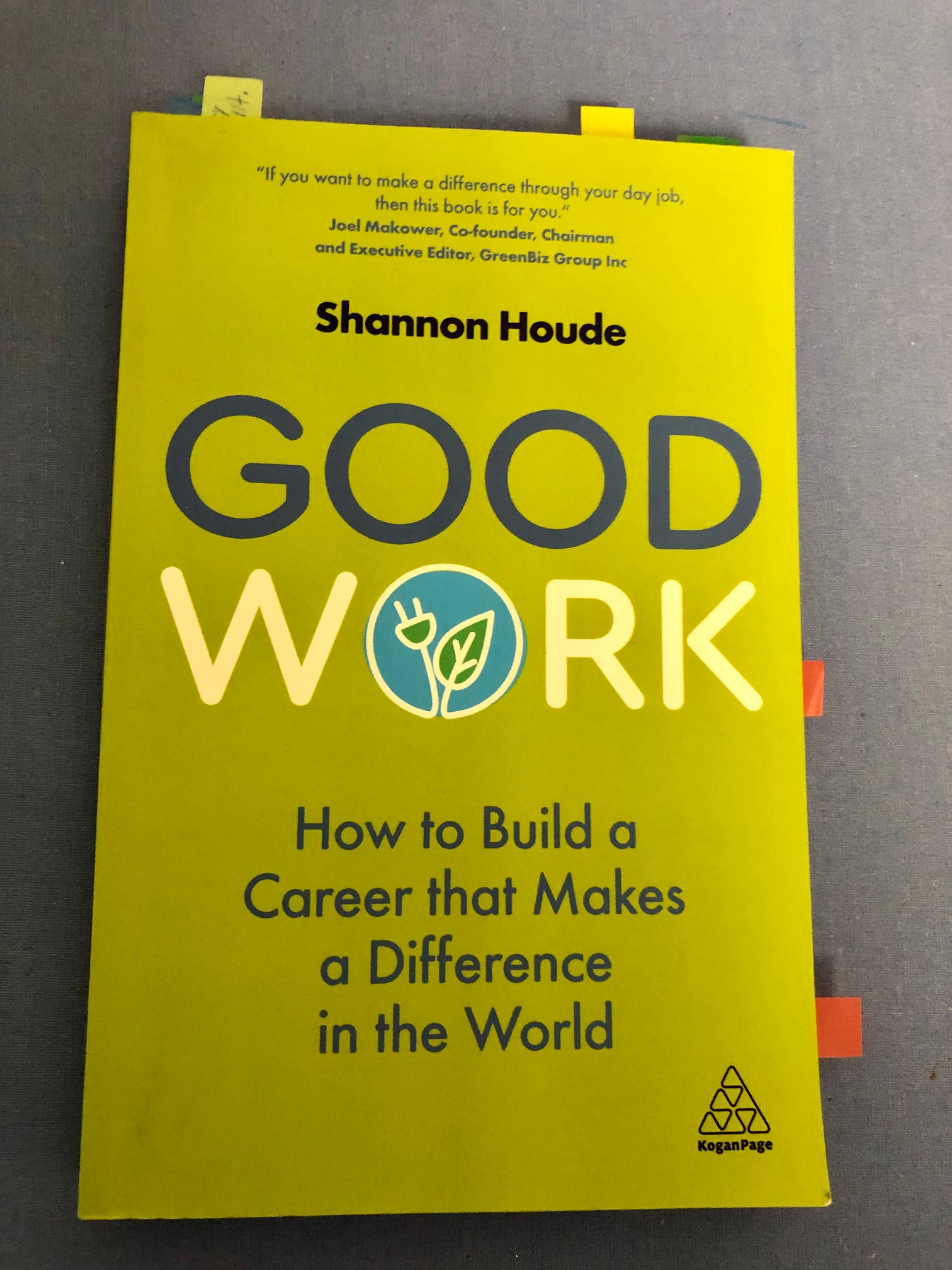
Good Work: How to Build a Career that Makes a Difference in the World By Shannon Houde

This book will give you ideas on how to make your current job more sustainability-focused or reassess and rewrite your resume into finding a career within the field of sustainability.

Any job can be a Nature-Led job and any career can take on issues of sustainability and climate action. You don’t have to throw your existing life in a dumpster and start over. Transition and adapt in a way that works for you. Work with the skillset, networks and opportunities you currently have. Pick up new skills as needed. Turtles can be surprisingly fast when they’re in the their element. Don’t burn yourself out trying to be a hare.

My only gripe about this book is its heavy reliance on using LinkedIn as a tool.


Climate Action Challenge: A Proven Plan For Launching Your Eco-Initiative in 90 Days By Joan Gregerson (And Optional Workbook)

This book gives me so many ideas I can hardly write them down fast enough in my eagerness to get to the next chapter. This book will ask you to build a team in order to succeed in your goal. At first I was intimidated by the idea, but then I thought about all the wonderful people I already network with that I would want to join me and that would be willing to join me. Some of them have already helped me branch out into meeting other ideal candidates. I had so many “coffee dates” in September and October I felt like I was peeing straight caffeine. Then the holidays hit and slowed everything down. Now I need to map out my next steps and proceed.

For four years I’ve tried working with my local City government on issues of Sustainability and Disaster Preparedness and Response only to be ignored. I’m done being nice and asking for permission. I’m fed up with the lack of action and transparency. I’m planning to build a nonprofit organization that applies pressure from the outside forcing them to respond. It seems I’m not the only one unhappy with the performance of my local City Council though. We just had an election in November and nearly every incumbent Council Member was voted out. I will address the new Council Members in an effort to work together, but I’m ready and willing to proceed with or without them. I’m planning to document my successes and failures in hopes that they might help others.

Special Note: I‘m not able to visit each and every person’s blog as often as I would like, but please know that I’m inspired by many of you in a variety of ways! Thank you for being you, for being here and for all the big and little things that you do!

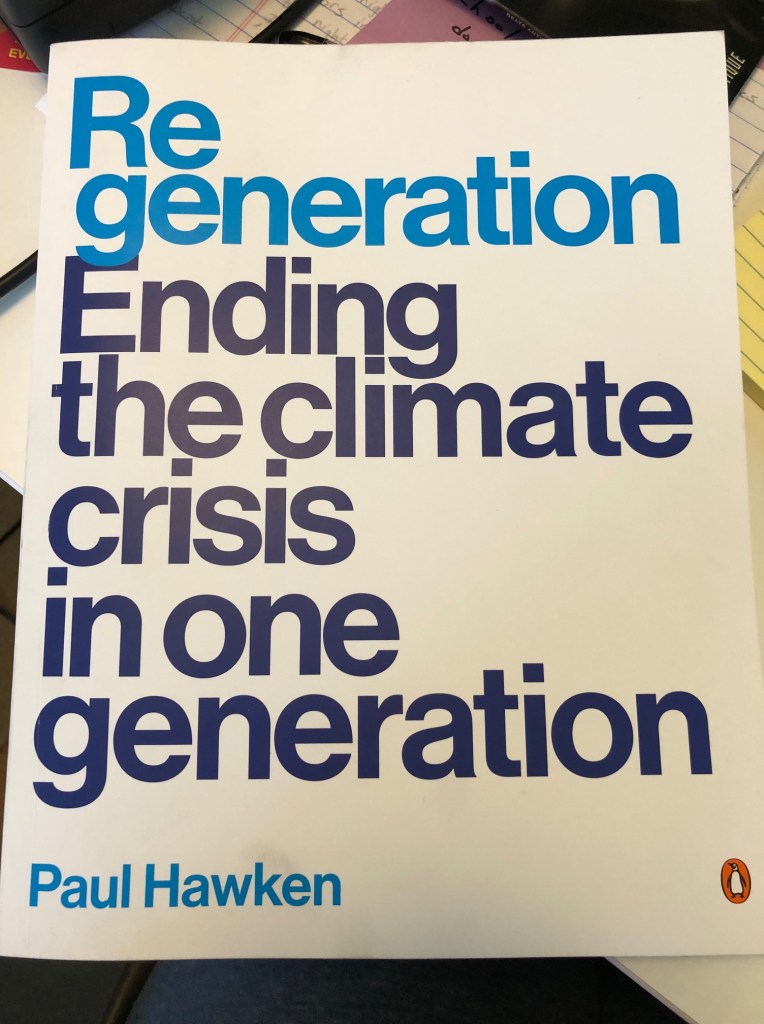
Photo by How Far From Home on Pexels.com

Book Review: Regeneration: Ending the climate crisis in one generation

I picked up this book after reading a review of it, although I would say the review was more about the Author’s body of work more than the book itself. I’m currently in a phase of looking for books and websites that are action-oriented when it comes to climate change and global warming. I know what the problems are. Nearly all of us have some grasp about the issues because it now makes the news on a daily basis. Global Warming and Climate Change have finally become mainstream issues happening now instead something to contemplate in the distant future.

Here are three quick pictures I took of the first three pages. (My apologies for the poor quality on the latter two.) For more and better quality images see the Amazon link below and use the “Look Inside” feature.

From the cover I expected a standard book written by one author, but upon opening the book I find a attribution page similar to what I would normally see as a Certified Technical Writer. This book is essentially a report compiled by subject matter experts for the public as the end user. Traditionally, “white papers” as they’re called, are used as manuals for specific topics or items in government and business. Most white papers are written by science and technology-related businesses to market and educate other businesses and/or government agencies how to use their service or product. For my certification program I wrote a white paper on how to install a living roof system as my final project.

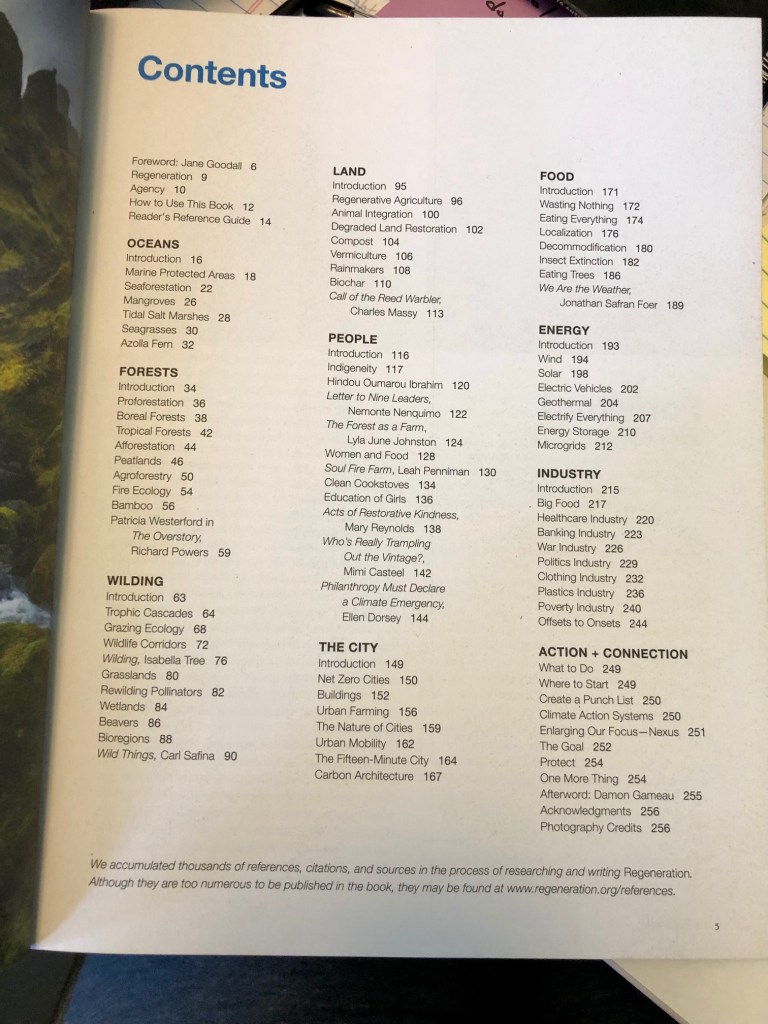
The second page is the table of contents page. I don’t judge a book by its cover, I judge a book by its index and table of contents (TOC) page. This book has no index, so the TOC has to do the work for both. Overall, I give this book an 8/10. In a list at the end of the book they mention the “Azolla Fern” as an important place for carbon sequestering. When I went back to find it in the TOC I didn’t see it, so I went online to understand that it’s an aquatic plant that can cover the surface of ponds, lakes and slow moving rivers. Going back, I now see the plant listed under “Oceans.” After reading the way the topic is covered in the book, “Wilding” or “Food” would have been a better place for it.

What really caught my eye about the contents page is seeing “Poverty Industry” under the Industry heading. I’ve never thought of poverty as an industry. I would have expected to see it under the People heading. After reading the section my first thought is, “How to talk about greed without using the word greed.” If we boil the subject down to its primal essence, aren’t we really talking about greed?

Pro:

Layout – Each topic gets a gorgeous picture representing the topic and about two pages of text on average. Its like a modern, limited encyclopedia of climate issues. This makes it easy to pick up and browse the topics that interest you the most.

Con:

Title – The title implies action items we can do to make a difference in one generation. I was expecting a “how-to” book that tells the reader what they can do to start combating climate change issues now. This is not the heart of the book though. The action section of the book is seven pages and relies heavily on encouraging the reader to visit the website. The website is beautiful and worth a visit.

Ironically, the final paragraph entitled “One more thing” within the Action + Connection Chapter starts with: “It’s not your job to save the planet.” Followed a few sentences later with: “We cannot do this [end the climate crisis} if we believe or assume others will do it for us.”

So we were off the hook, only to be put back on the hook all in the span of a paragraph.

I’m making it my job to help save the planet. I think it should be part of everyone’s job as a human being to do better. I know we’re capable of taking on complex challenges when we work together and put in the effort. I also know I’m not alone in this growing concern and frustration. This blog and so many others are rising up to give a voice to our climate change anxieties and seeking out solutions. We know in our hearts things have to change.

Book Website: Welcome to Regeneration | Project Regeneration

https://www.amazon.com/Regeneration-Ending-Climate-Crisis-Generation/dp/0143136976/ref=sr_1_1?crid=15LGNP2HB0X67&dchild=1&keywords=regeneration+paul+hawken&qid=1633134952&sprefix=Regenerati%2Caps%2C279&sr=8-


If you’ve read the book, what did you think about it?

While my reading list is currently backlogged, I’m always open to recommendations. Is there a book you think I should read?


Thank you for stopping by for a visit!

5 Apocalypses and counting…

My apologies to the Paleontology bros. I thought you were boys that wanted to play with dinosaur bones and never grow up. Maybe that’s true for some, but like most things, it’s a broadly overstated stereotype. I had no idea how interesting and diversified paleontology could be until I read The Ends of the World: Volcanic Apocalypses, Lethal Oceans, and Our Quest to Understand Earth’s Past Mass Extinctions By Peter Brannen. I came about reading this book because I’m a connoisseur of Apocalypses; personal, local, regional, global. I pick them apart and study the bones. Why does one species suffer an Extinction Level Event (ELE) while others adapt and survive?

On a personal level this boils down to the difference between surviving and eventually thriving beyond a catastrophic event or stepping off the ledge. What’s defined as a “catastrophic event” depends on the person. One person’s chaos is another person’s status quo. How do you survive, psychologically? Through resilience. How do you become resilient? By changing your perspective. How do you change your perspective? Through education and observation. What is the reward? Adaptability. Adaptability encourages resourcefulness which increases your survivability…in a nutshell.

You can take that last paragraph and replace person with society, business, or organization.

What I like about Peter Brannen’s book is that it lays out what the earth endured long before humans ever walked upon it. We weren’t even a speck on the geological timeline of anything resembling Homo Sapiens! Dinosaurs, three Extinction Level Events, but it was the last one that eventually did them in. When we think of the dinosaur’s extinction we think; “Oh, an asteroid hit the earth and boom! The dinosaurs instantly died.” This doesn’t appear to be the case though. Neither dinosaurs nor their food sources were completely obliterated during the event. Some survived, but over time their numbers could not be replenished and eventually they did die out. We know this because some fossils have been found indicating that the dinosaur died 700,000 years after that event.

Can you guess what animal is alive today that some dinosaurs used to eat as a source of food? Sharks! Crazy right!?!?! The shark was known as Carcharocles megalodon and is the very enormous ancestor to the great white shark. I’ve changed my mind, paleontology is actually pretty cool. I’ve always had a soft spot for the Saber-Toothed Tiger and that’s part of paleontology too, because the definition is simply “the study of fossils.”

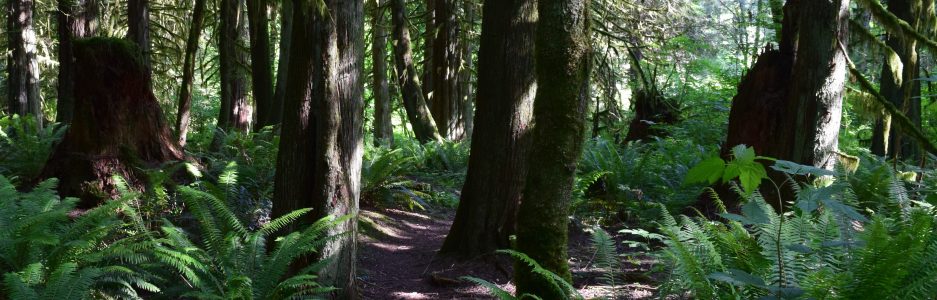
I’ve been educating myself about plants, particularly Pacific Northwest native plants, over the last several years, so it was really interesting to read about the importance of paleobotany in Mr. Brannen’s book. I’ve always loved ferns and mosses. To me, they are the embellishments of what makes a stand of trees a forest. There is nothing more magical to me than having my eyes greeted by long green corridors carpeted in mosses and masses of ferns.

I hope you’ll give this easy-to-read science book a try. It felt effortless the way he weaved the present and past. I’ve read through a lot of dry science book out of a sense of duty, but this one I read for fun. I borrowed it from the library and loved it so much I bought a copy. I only do this with less than 3% of the books I borrow in a year. Another book that made the list was Rule Makers, Rule Breakers: How Tight and Loose Cultures Wire Our World By Michele Gelfand who’s a cultural psychologist. (Another cool subbranch of something I didn’t know I wanted to be when I grew up!) Her analysis helps us understand how different personalities and cultures adapt to the world around them.

There’s no wrong or right way in learning how to adapt to an ever-changing world, only variances in approach.


Books:

The Ends of the World: Volcanic Apocalypses, Lethal Oceans, and Our Quest to Understand Earth’s Past Mass Extinctions By Peter Brannen (2017)

Rule Makers, Rule Breakers: How Tight and Loose Cultures Wire Our World By Michele Gelfand (2018)

Interesting Links:

Test shows dinosaurs survived mass extinction by 700,000 years (phys.org) 

Living Creatures That Walked Among The Dinosaurs – WorldAtlas

The Megalodon | Smithsonian Ocean (si.edu)

About Ferns — American Fern Society (amerfernsoc.org)