Ancestral delight

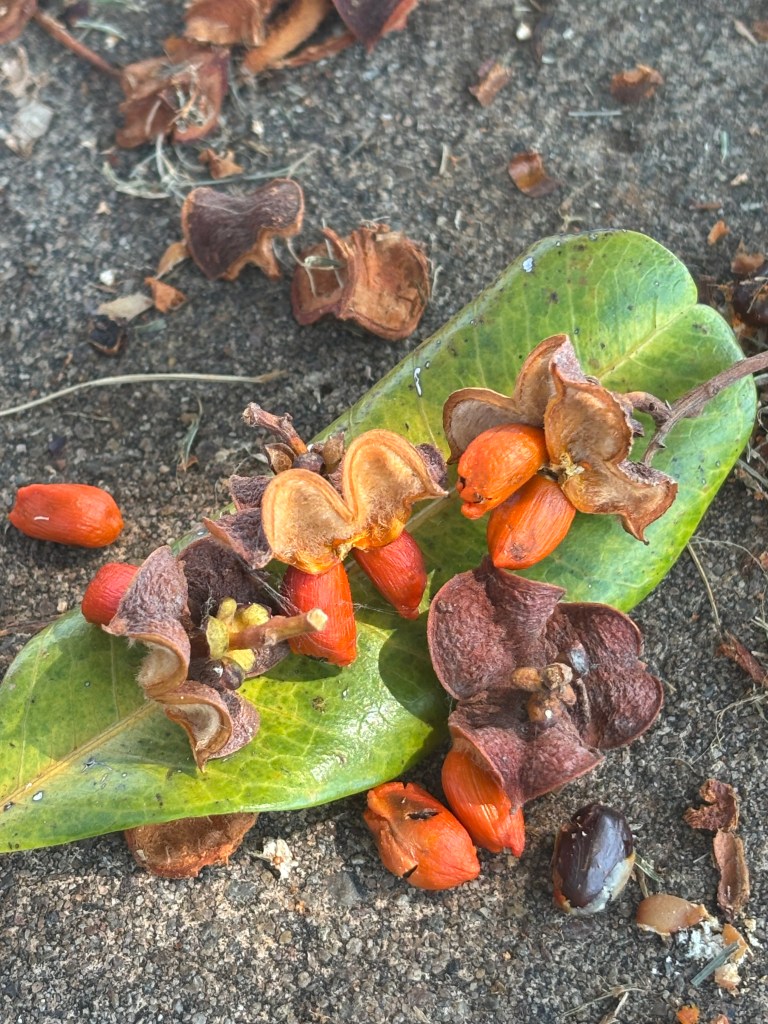
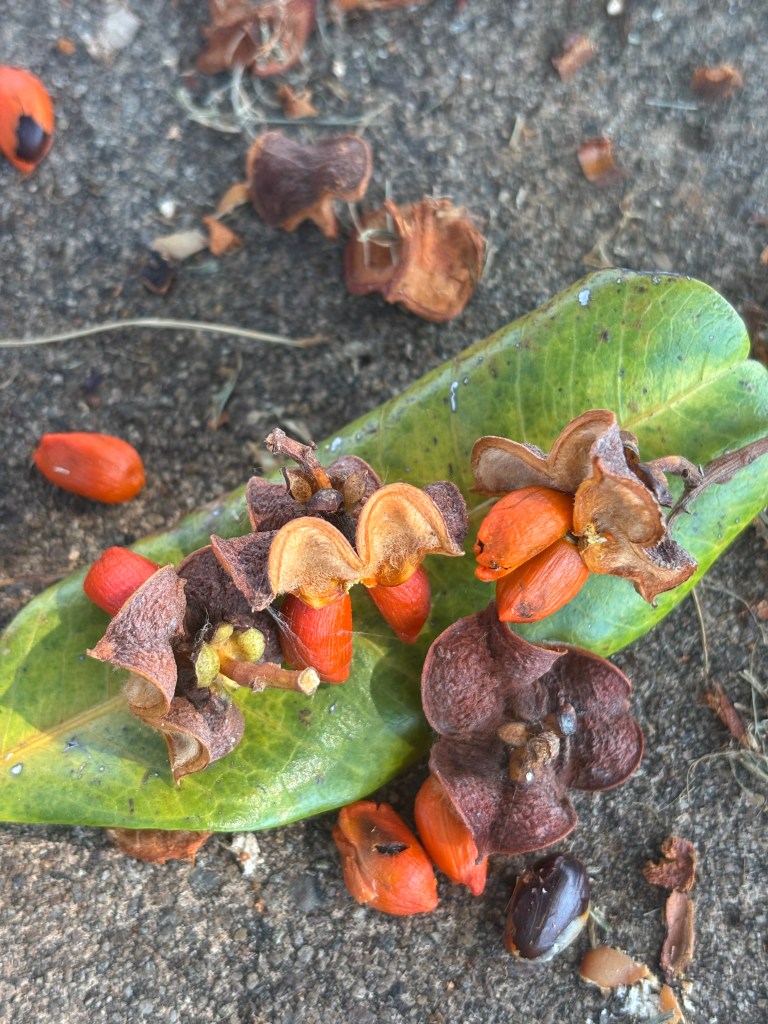
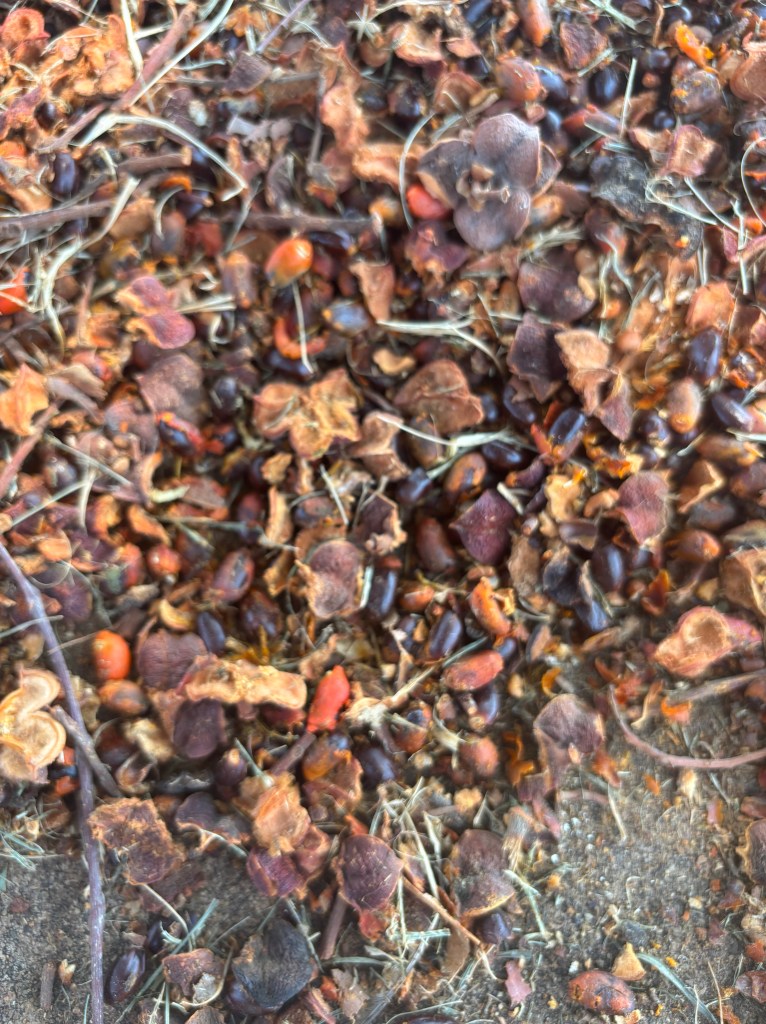
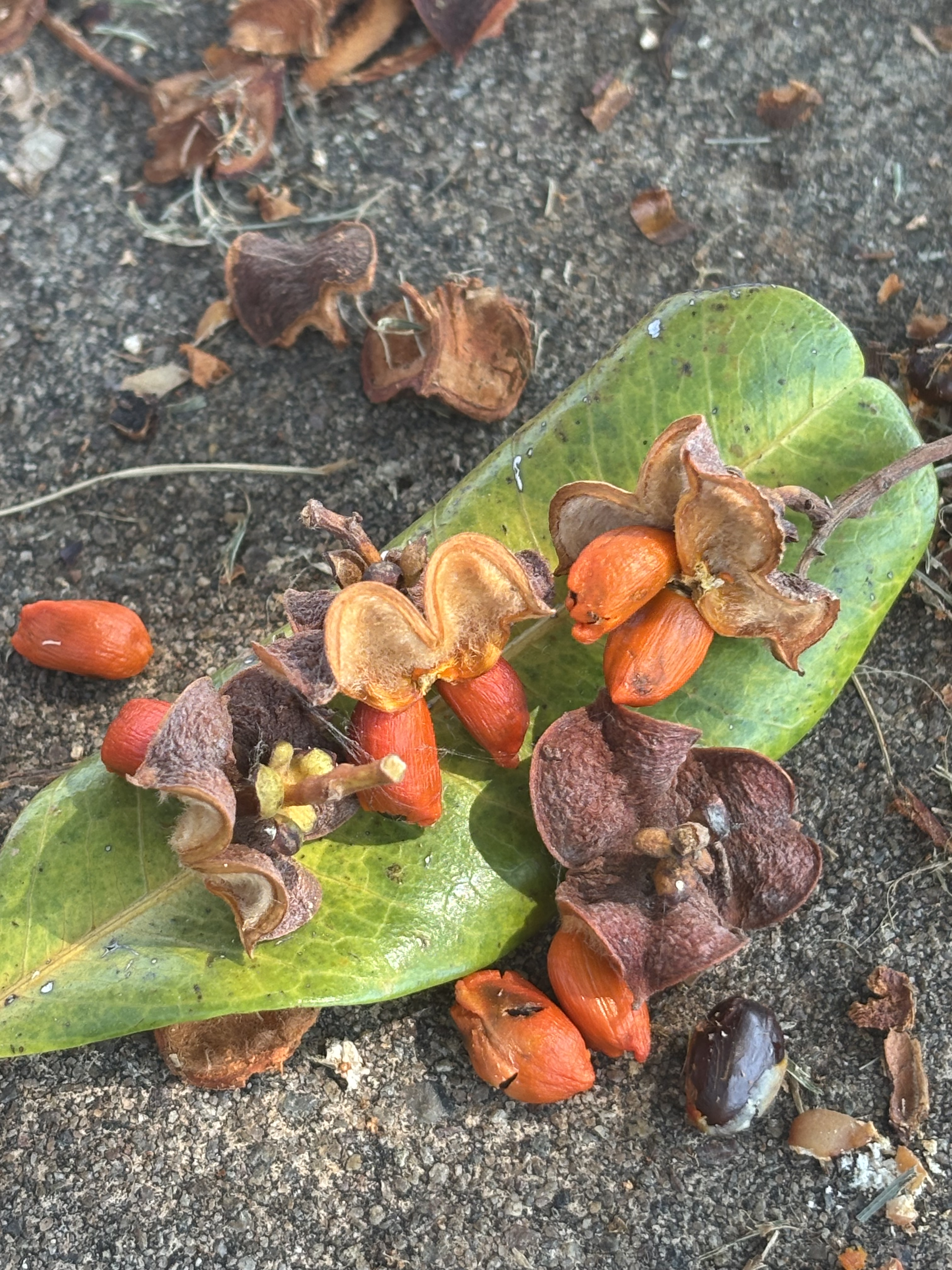
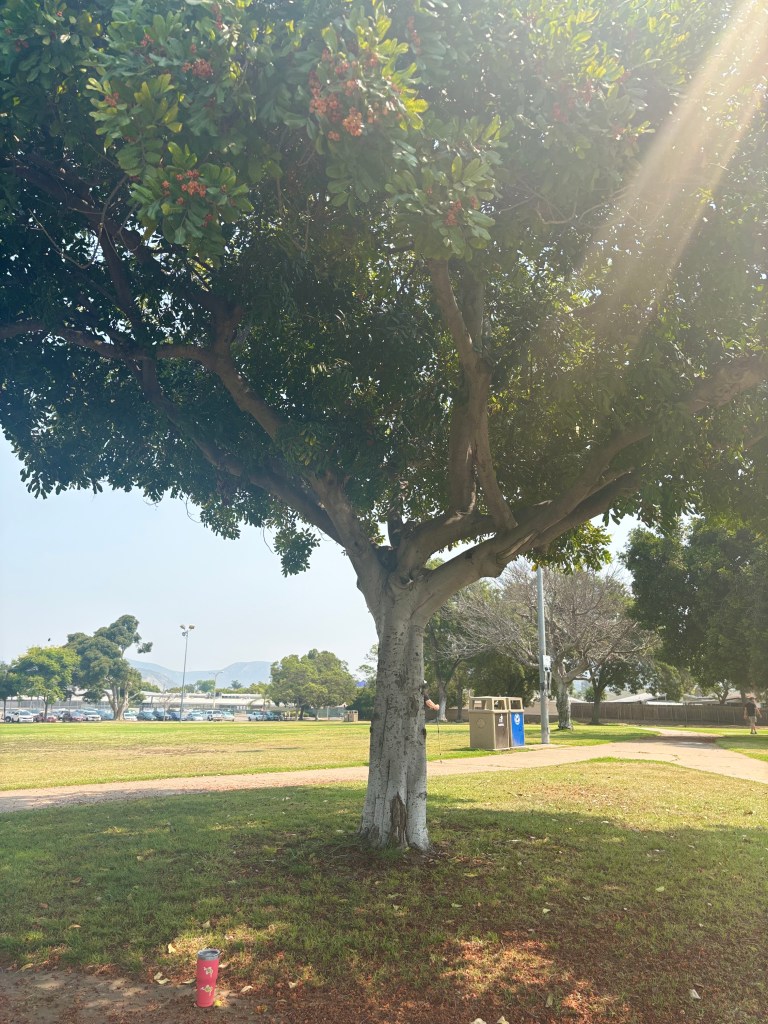
Upon seeing the seeds of this Australian tree (the carrotwood tree (Cupaniopsis anacardioides) here on American soil, I was suddenly visited by the image of the Colombian zapote: that fruit with fiery orange tones, fibrous and fleshy, shaped like a maraca with its round form and persistent stem, as if still clinging to the tree.

Four worlds meet here: Australia, the United States, Colombia… and that other elusive territory of memory, where time does not exist, but everything leaves its mark. A land with so many names, so many faces, so many sensations.
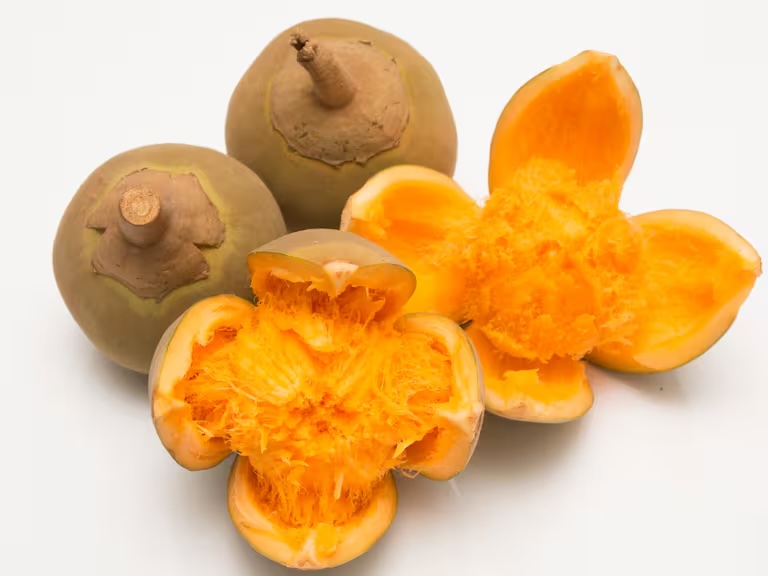
The zapote, in its many varieties—mamey, black, white, chicozapote—is native to Mesoamerica and South America. Since pre-Columbian times, it has been cultivated and revered by Indigenous civilizations such as the Maya and the Mexica, not only for its nutritional value but for its symbolism tied to fertility, abundance, and the sacred. Its name comes from the Nahuatl word tzapotl, used to refer to sweet and soft fruits. In many regions of Latin America, the zapote remains an ancestral fruit that connects generations, land, and body.

In my wanderings, these small seeds brought me great memories, honoring my father, and the zapote, his favorite fruit.

Father, you so well dressed, so serious in your reflections, so methodical in your plans and calculations. Your desk, impeccable. Your notes, exceptionally organized. I was always curious why you liked zapote (I never asked. Simple things that go unasked, as if silence already held the answer).

Zapote carries something sacred in its messiness: it smears, it stains, it invites you to eat without cutlery. You must eat it with your hands, suck the pulp from the seed, let yourself be covered in its thick, fiery colorful juice. It’s a fruit that doesn’t allow for haste or distance; it is eaten with the whole body.
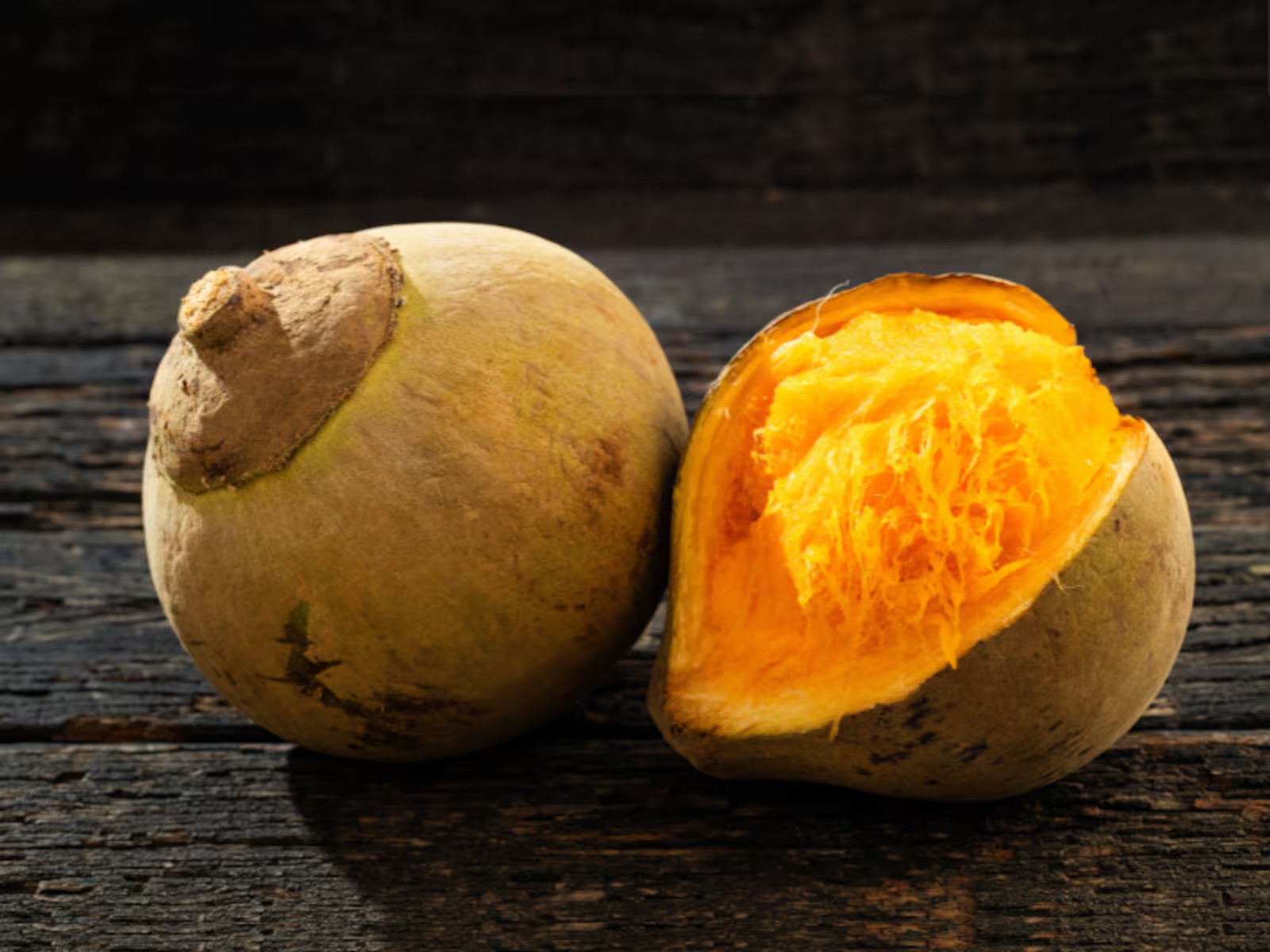
Now, as a mother, I see in its shape something like a breast; round, generous, with a nipple at the tip. The juice doesn’t come from there, but its form moves me, reminds me that everything in nature is connected. Zapotes open like a chest, and they feed us. Their exquisite pulp is a quiet pleasure that invites play, delight, and the chance to be children again.

And in that experience —licking your fingers, laughing at the juice running down your hands, tasting slowly— you give thanks. For the nourishment, for the sensing body, for the memories that return.

Thanks for this ancestral delight.
Flower Dancers

I’m reposting this post from Patricia blog from May because I love it so much! I’ve been taking a lot of pictures around the old homestead here of Fernmire that I hope to share with you soon. Until then, please enjoy Patricia’s creative expression with nature for another post. Have a lovely day! I hope you are able to get outside and explore your own thoughts and inspiration for creative expression. Remember to do it for yourself, not for the admiration of others. I know some people who don’t think they are very creative, but mostly I observe that they are afraid to try for fear of failure. Failure is learning and part of the process. How are you supposed to learn if you’re too afraid to start at all?

Think of the people you admire most, and remember that at some point, they fail at things too. If you have empathy for them, why can’t you have empathy for yourself?

(Note: Your internet browser should have a “translate” extension if you can’t read Spanish (I can’t). Try right clicking on your mouse to see “Translate to [your language])

Popcorn in Flight

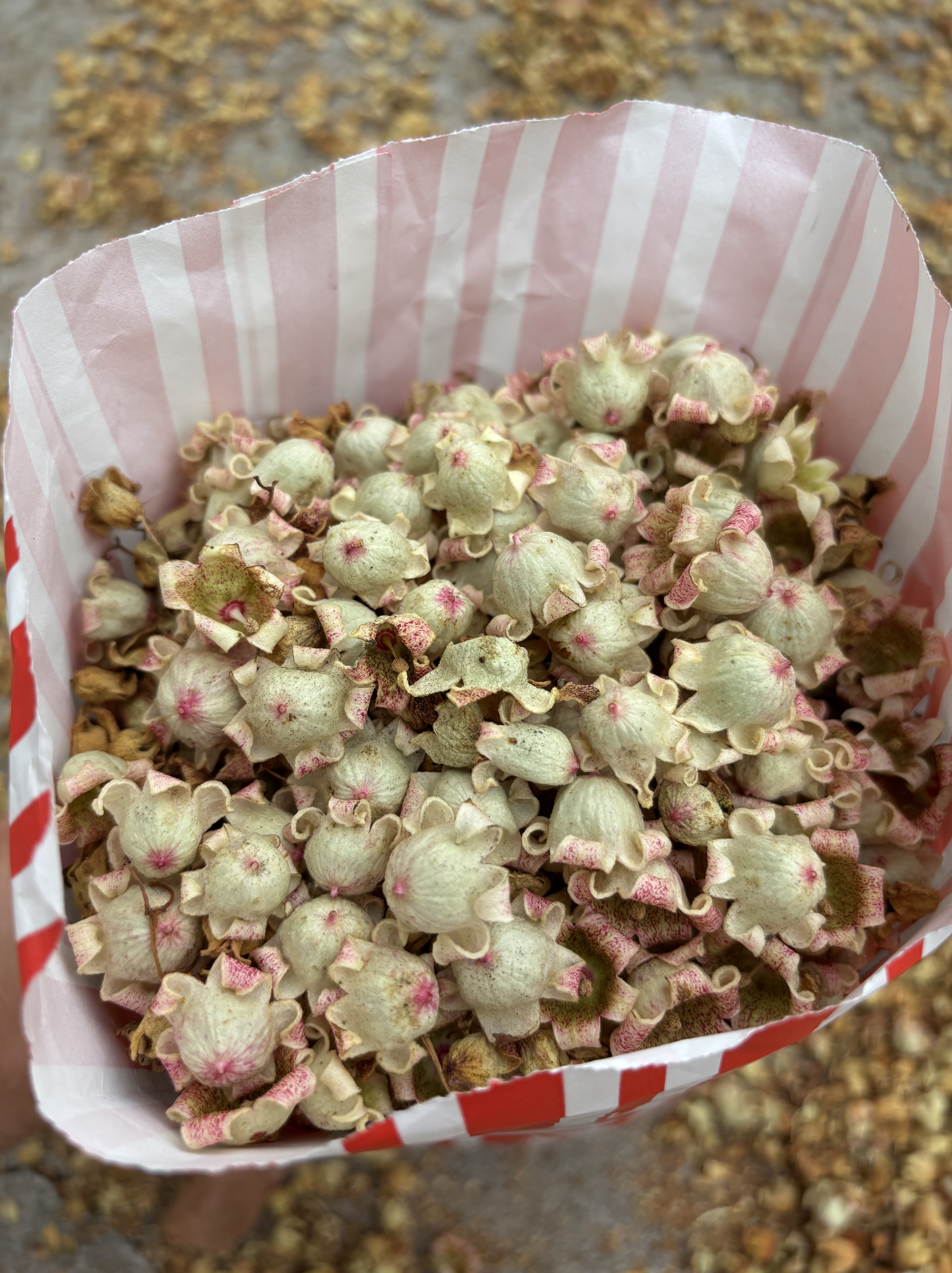
Today my wanderings brought me here, to these flowers scattered across the pavement.
By their shape, their color, and the way they floated in the air before settling on the ground, they looked like an orb of crispetas, pochoclo, or palomitas de maíz—what’s called popcorn in English.

A seed becomes a tree, blooms in spring, and in summer, with the heat, its flowers fall to nourish the earth… and also this existence. Somehow, those flowers stirred a memory and gave me a moment to be grateful and to understand that we, too, are children of corn.

In Colombia, during the power rationing era, we lived in a house with an aunt who was just as much a child as my brother and I were. While my mother and father worked, we fed ourselves, did our homework, and slept until dawn.

As children, we often forgot about keeping schedules or following routines. We knew, of course, the sound of the school bell that signaled a change of activity, but we didn’t manage time. Two hours could pass in a minute, and a fright could last a lifetime. Even now, the dimensions of time sometimes escape comprehension.

We would forget when it was time to eat. The power would simply go out, and in the darkness, we’d remember it was time for dinner. We didn’t have a gas stove or any appliances that worked without electricity. To avoid scolding, we would heat the pot with a candle and prepare our soups there. And we even dared to make popcorn.

My aunt would hide the pots so the adults wouldn’t discover the soot—our secret. One time, we were caught. They were surprised not only by our cleverness in hiding all traces, but also by our courage in cooking with fire. Without realizing it, we were doing pure physics experiments. Innocence and being out of sync with time allowed us to explore and learn.

When my parents separated and everything seemed unstable, popcorn was also a source of sustenance. We’d add sugar, salt, whatever we had. We were little scientists of flavors and moods—mixing, tasting, discovering.

Corn has always fascinated me. How can a single kernel expand to feed humans and animals, and turn into flour, arepas, tamales, lifelines? Long live popcorn, which, in the warmth of a candle, opens its wings to arrive here, blooming, leaping through memories…

The memories of that time are happy. I never felt like we were going hungry or had an unbalanced diet. For us, each day was like being in a great movie. What greater joy is there for a child than to eat something always associated with happiness? We played at tossing it into the air and catching it with our mouths. Getting it right was a celebration.

I don’t know if my mother intended it or if my aunt simply made it because it was the most fun. But that gesture became an anecdote with lasting meaning.

In many ways, I’ve been like that kernel—tiny, naïve, subtle… that upon contact with fire, dances, leaps, expands, and transforms into something wonderful, something that sustains and nourishes other lives.

Thank you, mother and aunt.
Thank you, flowers.
Thank you, corn.

Brachychiton belongs the family Sterculeaceae, and all the species are native to Australia.