It is not the strongest of the species that survives, nor the most intelligent that survives. It is the one that is the most adaptable to change, that lives within the means available and works co-operatively against common threats.
Charles Darwin
A common theme among Science Fiction novels and the apocalypse genre in general is that few people can rarely survive alone for any great length of time. I plan to expand on this notion in a future post citing some of my favorite novels and how they provide the “burden of proof” in a future blog post. The settings may be fictional and fantastical, but often times, the behaviors of those that walk within the worlds are not.
For decades we have talked about how human-driven climate change was speeding up global warming. That future is here now. I’m tired of seeing articles claiming this or that event is “unprecedented.” It’s time to adapt to radical shifts. You can do it. I believe in you. Anyone can be an agent for positive or negative change in our societies. I’m asking you to fire up your neurons and muscles to be a catalyst. You don’t need permission. We must break out of bystander shock. We, myself included, have been waiting for someone else to be in charge and take the lead because there are so many climate issues. It’s time to pick one and get to work. We can’t wait for “experts” in any given sector to make the changes we need done now. It will take all of us. What legacy do you want to leave behind?

Somebody should do something.
You should do something.
You are not too old. – The entrepreneurs over 70 taking the business world by storm | Winning new business | The Guardian
You are not too young. – 6-year-old makes history as Georgia’s youngest farmer – ABC News (go.com)
You are capable of great things. – 12 Disabled Scientists Who Made the World a Better Place | Mental Floss
What you do now matters.– Why your ‘personal infrastructure’ decisions actually do affect the cl (fastcompany.com)
This post was originally supposed to be an exciting review about a book I bought called:
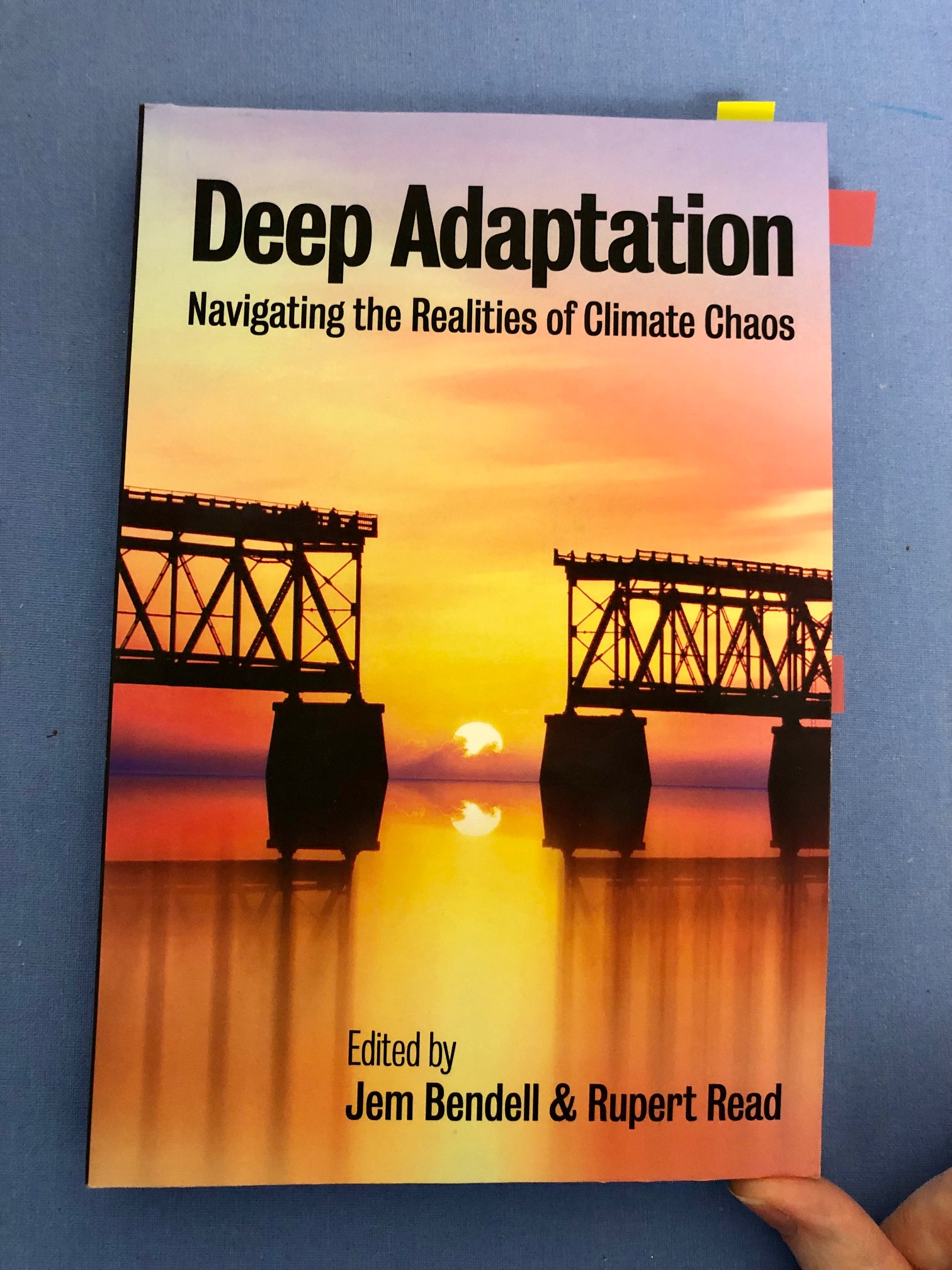
Deep Adaptation: Navigating the Realities of Climate Chaos By Jem Bendell & Rupert Read
I tried to plow through it until the end, but eventually gave up. It’s dense reading with a lot of footnotes. When you write a book you have to know who your audience is. I wish the Authors had focused on whether they were writing for a General Audience or people already in the field of Climate Science., otherwise you risk alienating one and offending the other. They would have greatly benefitted by hiring an outside Editor improve the format, organizational structure and style. A good book engages readers. It’s about more than proper spelling and grammar. They clearly have expertise in their field of study, but I don’t have time or patience to be lectured by a book.
The Premise – A Snapshot
We can agree that climate change is already here and that global societies need to stop arguing about its existence and severity and start planning to transition into more adaptive societies. I like the framework of the 4R’s on page 73. That Deep Adaptation requires:
Resilience – “How do we keep what we really want to keep?”
Relinquishment – “What do we need to let go of in order to not make matters worse?”
Restoration – “What can we bring back to help us with the coming difficulties and tragedies?”
Reconciliation – “With what and with whom can we make peace as we face our shared mortality?”
Part of what made this book so hard for me to read is that I couldn’t get in the right headspace for it. I’m preparing to jump into action mode. I’ve been researching climate-related issues since 1997. It’s only recently that I’ve asked myself, when is enough researching, enough? Am I going to keep “researching” until I’m dead? Then it would have all been nothing! I’m ready to move from research phase to action station. I want to start making a bigger impact starting now.
Two good books have recently helped me take the next steps:
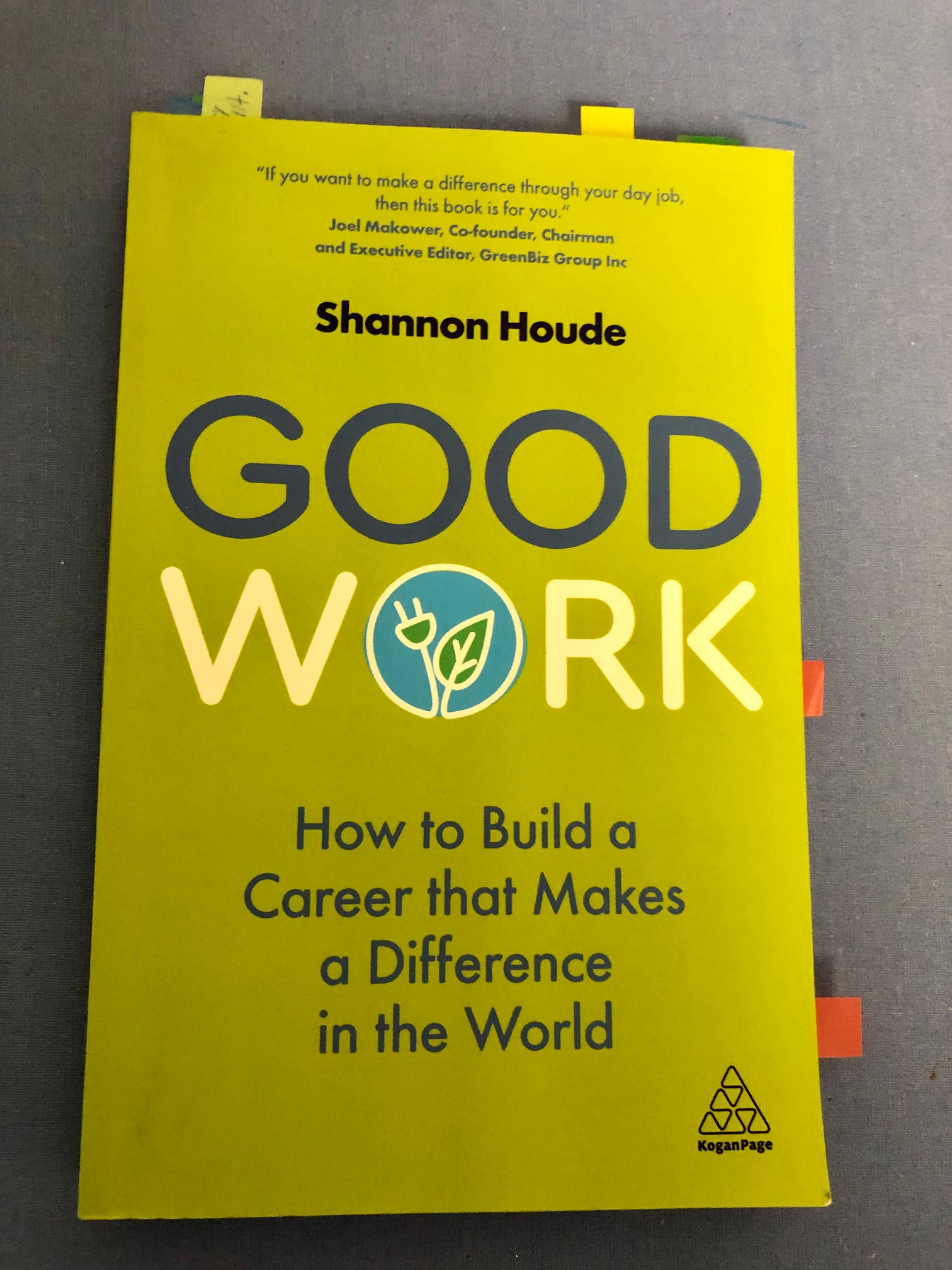
Good Work: How to Build a Career that Makes a Difference in the World By Shannon Houde
This book will give you ideas on how to make your current job more sustainability-focused or reassess and rewrite your resume into finding a career within the field of sustainability.
Any job can be a Nature-Led job and any career can take on issues of sustainability and climate action. You don’t have to throw your existing life in a dumpster and start over. Transition and adapt in a way that works for you. Work with the skillset, networks and opportunities you currently have. Pick up new skills as needed. Turtles can be surprisingly fast when they’re in the their element. Don’t burn yourself out trying to be a hare.
My only gripe about this book is its heavy reliance on using LinkedIn as a tool.

Climate Action Challenge: A Proven Plan For Launching Your Eco-Initiative in 90 Days By Joan Gregerson (And Optional Workbook)
This book gives me so many ideas I can hardly write them down fast enough in my eagerness to get to the next chapter. This book will ask you to build a team in order to succeed in your goal. At first I was intimidated by the idea, but then I thought about all the wonderful people I already network with that I would want to join me and that would be willing to join me. Some of them have already helped me branch out into meeting other ideal candidates. I had so many “coffee dates” in September and October I felt like I was peeing straight caffeine. Then the holidays hit and slowed everything down. Now I need to map out my next steps and proceed.
For four years I’ve tried working with my local City government on issues of Sustainability and Disaster Preparedness and Response only to be ignored. I’m done being nice and asking for permission. I’m fed up with the lack of action and transparency. I’m planning to build a nonprofit organization that applies pressure from the outside forcing them to respond. It seems I’m not the only one unhappy with the performance of my local City Council though. We just had an election in November and nearly every incumbent Council Member was voted out. I will address the new Council Members in an effort to work together, but I’m ready and willing to proceed with or without them. I’m planning to document my successes and failures in hopes that they might help others.
Special Note: I‘m not able to visit each and every person’s blog as often as I would like, but please know that I’m inspired by many of you in a variety of ways! Thank you for being you, for being here and for all the big and little things that you do!


 The Nature-led Life