When I look at the sky or moon, the word transition comes to mind. I think about the many transitions that take place within our world and our individual lives. Death is a shadow to our light. We are of both matter (body) and anti-matter (spirit.)
The sky changes throughout our planetary cycles in a unit of measurement we call days. Yet measures of time, gravity and composition can change vastly on planets different from our own. The movie Interstellar is one of my favorites and a great example of what other worlds could look like. The movie was based on our current understanding of black holes, worm holes and relativity. Dr Kip Thorne Nobel Laurate of Physics in 2017 provided equations and insight as a subject matter expert to bring authenticity to such a brilliant movie.
Real science is not boring. It expands the universes within our minds. In my heart, Pluto will always be a (dwarf) planet and the Apatosaurus will always be a Brontosaurus. The scientific community might change the name of things, but I still know what my favorite dinosaur is.
As the moon dances with the earth, I feel a kinship to all living things. It reminds me that we are not alone and its phases, while often predictable, remind us that change is constant. The presence of the moon can be felt throughout the world in king tides, migrations and the hours of sun in a day. Without it the earth would spin faster, and the days would be shorter. I fear I really wouldn’t get anything done if the days became any shorter!
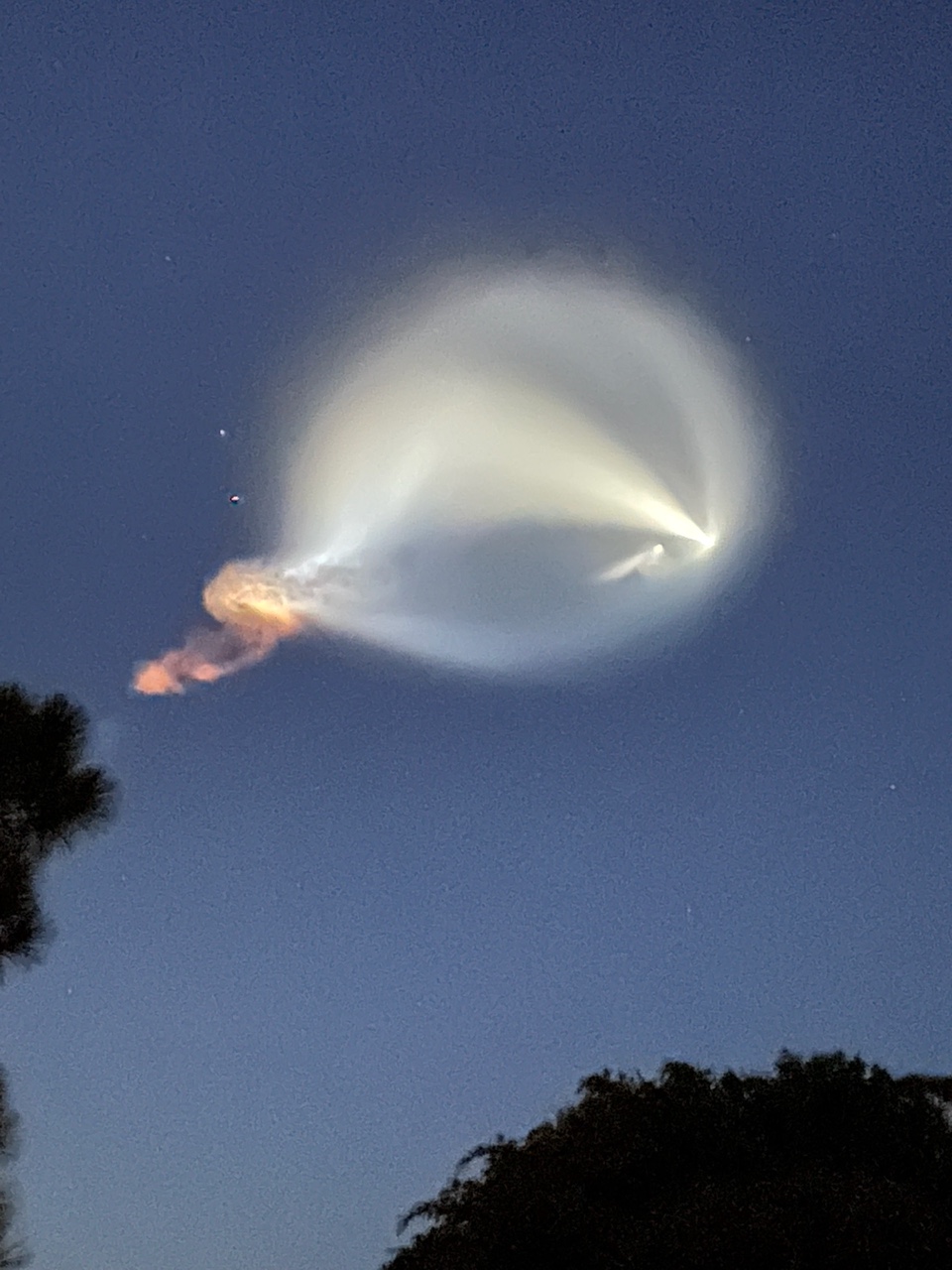
An early morning rocket launch from Cape Canaveral FL USA captured by Lisa Troute in her driveway several miles away.
Thank you!
My many thanks to everyone who submitted photos and those who strongly thought about submitting photos but weren’t able to for one reason or another.
You expand my horizons!
May Submissions – Rocks and Fossils
This nature site is severely lacking in sediment appreciation. Let’s remedy that! Show me your pictures of cool rocks and/or fossils.
Due: April 30th
To be posted on May 1st.
TheFine Print: Photo Submissions Guidelines
Email to: natureledlife@gmail.com, Subject line: Photo Submission for [month] (Multiple months of photos in one email is fine.) Image: Attached as a .JPEG or .PNG file preferred. Captions each picture: Subject in the photo (if known), State/Providence & Country, Date (optional). Your name as you want it to appear, Your blog link (if you have one.)
Feel free to add any interesting notes about a picture. I love interesting stories behind things! Let me know if it’s just for ‘my eyes only’ or if I can share any part of it with your photo. Pictures must be your own or you have permission from the Photographer to share it. All copyrights belong to their respective owners. This is a free, fun, community site about nature. Non-commercial and ad free.
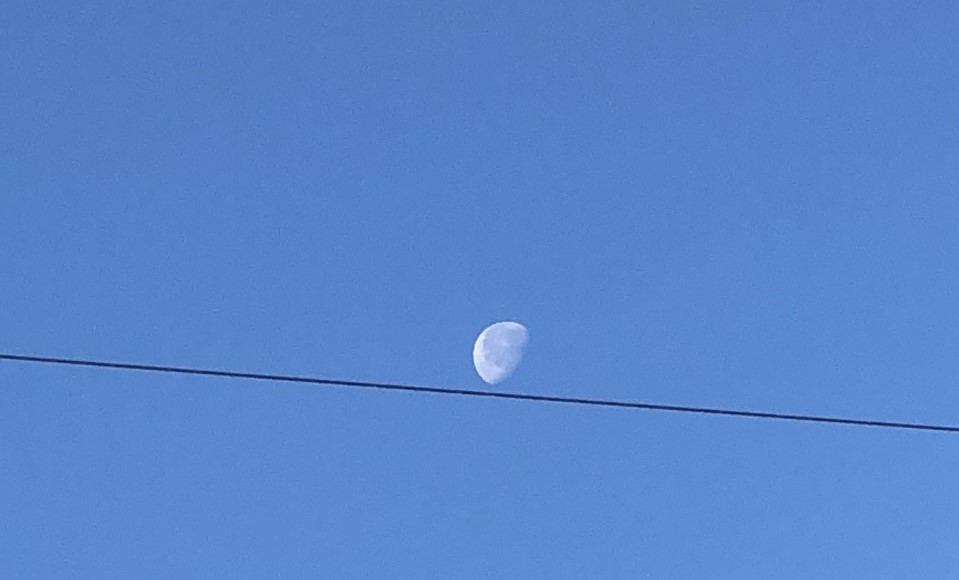
Moon Balance By Melanie Reynolds Washington State, USA
Hello Nature-led friends!
Yes, a late request for photo submissions! I have faith some of our regular people can pull it off and perhaps a few new people are ready to join in the fun too.
Kerfe, our friend in New York, USA had recommended the “sky” as a worthy nature topic for photo submissions and Ms Scarlet from Devon, UK agreed. That’s really all the motivation I needed because taking pictures of the moon during “daylight” hours is one of my favorite things. So, for the month of March please pull out your cameras (or find a previous picture) of the Sky and/or the moon. Any time of day or night. What does the sunrise or sunset look like from your corner of the world? Or maybe you’ve captured some really cool cloud formation or the aurora borealis or stars. When you think about it, there is a lot going on in the sky above us.
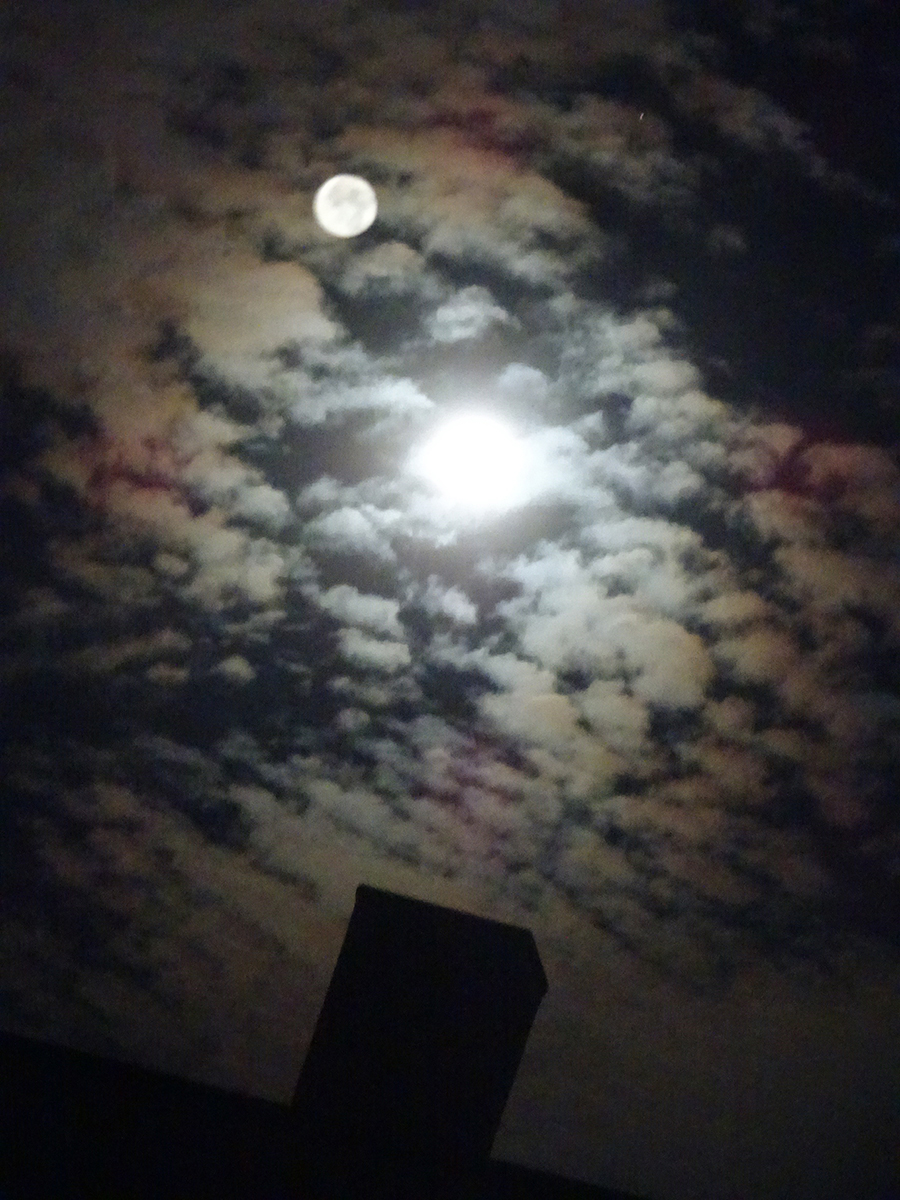
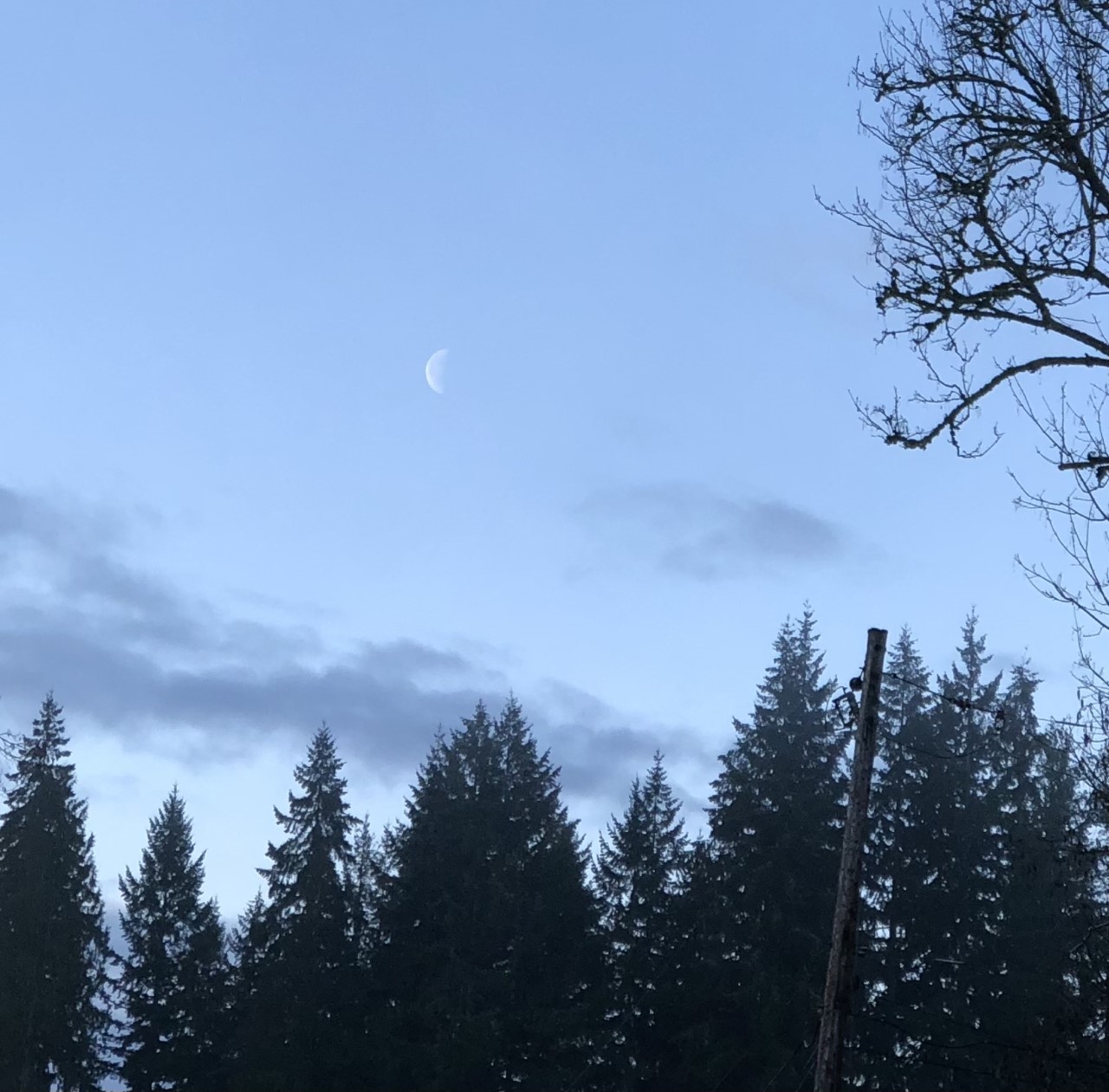
Morning Rise Moon By Melanie Reynolds Washington State, USA (Taken this morning of Mar 15, 2023)
It makes me unreasonably happy to see the moon during the day, which is probably weird, right? I consider the moon a friend of the earth and the creatures upon it, like me. We both hang out in the same little slice of the universe and the moon influences life in both subtle and not so subtle ways just like the people, plants, and animals in our lives.
It has inspired song, words, and behaviors way before the existence of human civilizations. In the presence of the moon, I don’t feel alone. Does that make me a lunatic? In these modern societies in which we live we’re all crazy here, but the moon is not to blame. The moon is a companion who asks nothing of me. It doesn’t sell my personal information or tell me to trade my soul to the devil for cheese. Oh, how I do so love cheese though!
The moon hangs out in that big scary place we simply call “sky.” I find it frightening to think about it too much, all the space beyond the sun and moon, beyond the stratosphere and the clouds. I’ve written about it before in this previous post: https://nature-led.org/2021/01/27/too-much-sky/
Finally, two more pictures of the sky to share with you.
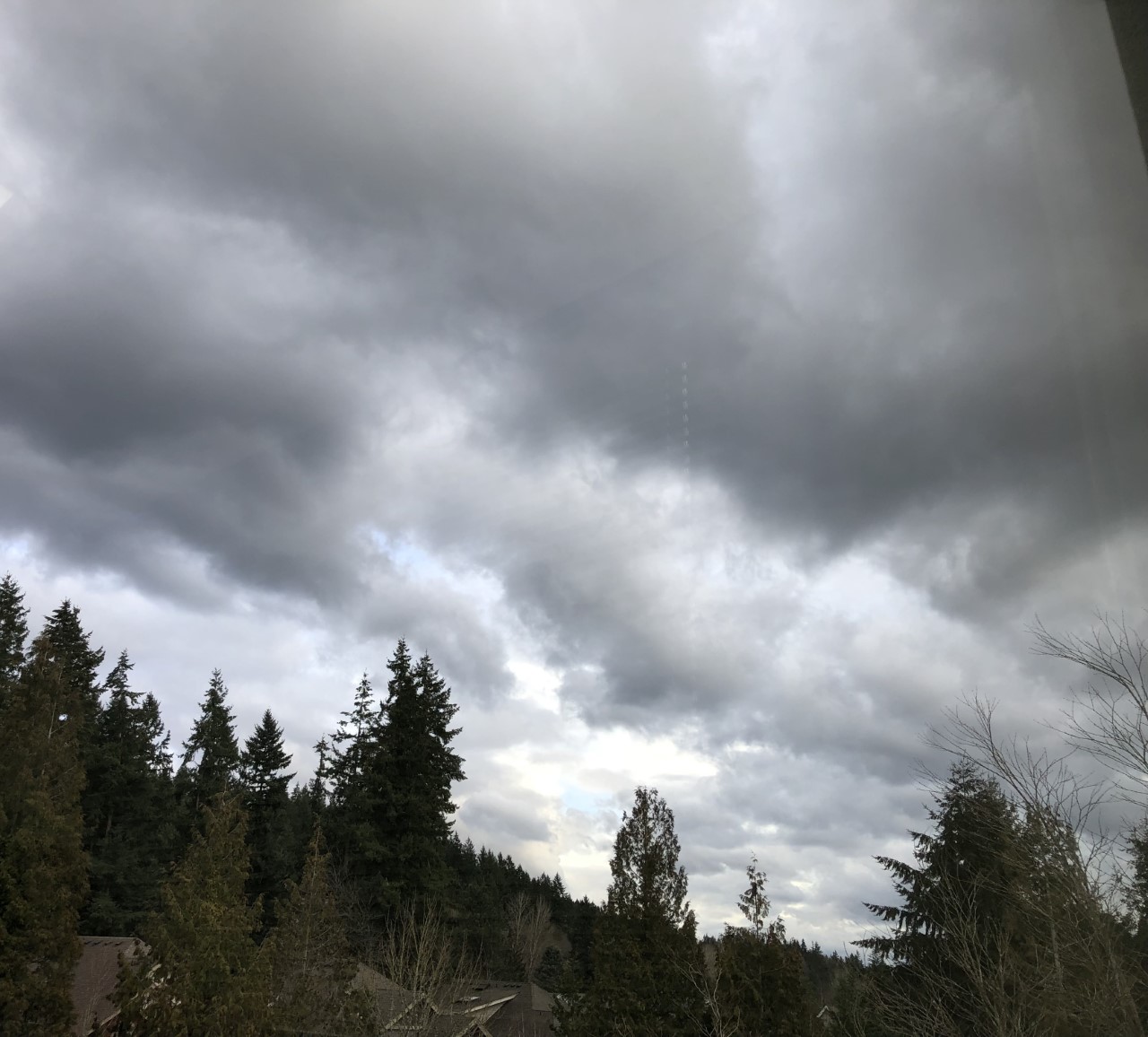
Storm Clouds By Melanie Reynolds Washington State, USA
I took this picture last week, Monday, March 5th, 2023, when we had heavy clouds and strong winds. I think it was a glancing blow from that first atmospheric river that hit California recently.
and this…
A fun picture I took a few summers ago. I texted it to Patricia with the comment: “How pilots double date.” Ha,ha,ha.
Planes Flying Side by Side By Melanie Reynolds Washington State, USA
In the meantime, I’ll figure out the next few months of photo submission requests. Suggestions are always welcome and appreciated!
Submission Guidelines
The Sky and/or the Moon:
Due: March 31st
To be posted on: April 1st (No fooling!)
TheFine Print: Photo Submissions Guidelines
Email to: natureledlife@gmail.com, Subject line: Photo Submission for [month] (Multiple months of photos in one email is fine.) Image: Attached as a .JPEG or .PNG file preferred. Captions each picture: Subject in the photo (if known), State/Providence & Country, Date (optional). Your name as you want it to appear, Your blog link (if you have one.)
Feel free to add any interesting notes about a picture. I love interesting stories behind things! Let me know if it’s just for ‘my eyes only’ or if I can share any part of it with your photo. Pictures must be your own or you have permission from the Photographer to share it. All copyrights belong to their respective owners. This is a free, fun, community site about nature. Non-commercial and ad free.
I’m excited to share with you Mary King’s first post! Mary and I kept finding each other through shared interest groups and mutual friends. We met for breakfast one morning and now I’m happy to call her my friend! I view the act of sustainability as a personal and social journey to help save and restore the Earth’s most precious resources and help minimize the effects of climate change. Right now, I’m currently working on reducing my family’s food waste. I knew this was one of Mary King’s strengths, so I look forward to learning from this post as much as anyone. Thank you, Mary!
As a “Nature-Led Life” reader, you know that the choices we humans make affect the natural world around us. One way to be a Nature-Led food consumer is to use what we take.
We’re all feeling a bit of sticker shock at the grocery checkout counter these days. It’s tempting to buy the cheapest brand of everything, forego organics, and eat whatever canned or packaged goods are on sale. It’s better for your family and the planet to explore ways to get more out of your purchases while actually choosing higher quality.
Carrots in a grocery store By Mary King
Keep in mind as you shop that your price per item may be greater than what the store receipt shows. Shipping, and manufacturing shipping vehicles, will expend fossil fuels and generate waste. Pesticide production and use will pollute water, soil, and air; the abatement will be paid in diseases and in taxes. Lack of product and packaging safety regulations will affect community health, increasing taxes and healthcare costs, as will weak labor standards. Subsidies for conventional agriculture are paid with tax dollars. This is called true cost accounting and while these costs may not be visible, you and future generations are paying them.
Not-so-fun fact: it’s estimated that between 30-40% of food produced in the United States is wasted. That includes spoilage and contamination in shipping and processing, food left unharvested due to labor shortages or overproduction, over-ordering and culling blemished food in retail outlets, and consumers throwing out food. The fossil fuels, labor, packaging, and environmental impact in production are all wasted along with every bit of wasted food, and efforts to mitigate hunger in our country need to be increased. It’s crazy.
Getting your money’s worth out of anything you buy, whether it’s food, clothing, tools or toys, requires summoning your inner pioneer to think creatively and use every bit. Rule number one in frugality is to waste nothing. Maybe that’s a high bar, but a worthy goal. Start your meal planning by shopping your fridge, freezer, pantry, and garden. Try a sheet pan bake of all the odd bits of veg and meat that needs attention.
Eat your cauliflower leaves (use it like cabbage), broccoli stems (peel and slice), squash skin and pumpkin seeds (roast in the oven and season). Greens attached to vegetables, like radishes, beets, carrots, turnips, are usually edible and highly nutritious.
Save clean carrot peels, parsley stems, corn cobs and other trimmings in a jar or freezable bag. When it’s full, make a pot of vegetable broth to use in soups and grain cooking.
Meat bones, even off the plates at the end of dinner, can be similarly saved to make stock, either alone or with the vegetable scraps.
Meat fats rendered in cooking can be strained, poured into a jar, and reused for cooking. Save your olive oil and butter and sauté some vegetables in bacon grease or chicken fat.
Fruit peels contain natural pectin, which can be added to juice as it simmers for jelly and strained out or can be used to make scrap vinegar.
Limp, sad produce, unless it’s moldy or slimy, is perfectly fine for almost any cooking application. Many vegetables that we serve raw in the United States, like radishes and celery, are just as delicious cooked. Chop and freeze if you can’t use it today, and add to your recipes for a nutrition and fiber boost, or add it to your scraps for broth.
Leftover leafy salad? Even if it’s got a light coating of vinaigrette (not coated in mayo-based dressing), it can be chopped and added to soup, your breakfast scramble, tacos, or blended into a dressing or dip.
Citrus rinds are very versatile! Never slice an orange, lemon or lime without grating or peeling the zest and saving it in the fridge or freezer or drying it. Grated zest is that something extra in baked goods, dressings and sauces, while a strip of peel is lovely in your tea, a stir fry, cocktail, or candied. Combine grated citrus rind with some pantry staples to make a safe and naturally fragrant abrasive cleaner.
If you know your household will only consume part of a bread loaf before it’s stale, freeze half as soon as you bring it home, or embrace old bread as a recipe staple, as does most of Europe. Stale bread is essential for French toast, bread pudding, croutons, bruschetta, panzanella, and gives body to pureed soups. It can also be ground up for crumbs and used to coat fried foods, extend ground meat, or become a gratin on a casserole.
You can freeze milk and cheese! You can freeze that half empty container of chicken broth, pesto, tomato sauce, hummus. The freezer should be used to give you a little more time, not as expensive garbage storage. Label what you freeze and keep an inventory taped to the door, with dates, and shop here when you’re cooking.
Small amounts of leftover cooked grains can be used in soups, muffins, one-pan dinners, salads. Mix grains! That ¼ cup of rice will play well with the extra quinoa, oatmeal or even pasta.
Did your child leave a half-eaten apple or banana on her plate? Chop and add to tomorrow’s oatmeal, breakfast muffins or pancakes.
EAT YOUR LEFTOVERS. Incorporate small amounts into new meals, or just set out all the small portions for a smorgasbord of bites. The family member who balks at eating leftovers probably won’t be the wiser if you’ve added some cheese, put it in a pie crust, or blended it in a soup. Bring home and quickly consume your restaurant leftovers, too. They can also be part of creative new dishes.
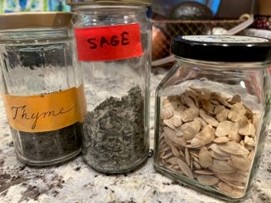
Saving Herbs By Mary King
Shelf stable products are wasted all too often because of confusion about “best by” dates. Canned and dried foods can be safe and delicious for months or years, as long as they’re properly stored.
Do a food waste audit from time to time. Take notes on what goes into the trash or compost for a week or longer. Fine tune your shopping and cooking according to this information. Maybe you can buy less of those ingredients by purchasing unpackaged (two oranges instead of a bag, or a cup of whole wheat flour from the bulk aisle instead of a five-pound bag) or choose foods you prefer to cook and eat. Don’t forget that you can give away edible food in gifting groups or to friends and neighbors. Opened bag of dog food that your pooch hates? Half a birthday cake from a party? Frozen meat that you know you won’t eat? Someone out there can use these.
Learning to preserve foods is a great way to cut down on food bills, because you can buy on sale or in bulk. It does involve investment in tools and time, and it doesn’t necessarily eliminate waste. You don’t need to be a master home economist to waste less food, and you’ll be helping more than your wallet.
What helps you get the most out of your food budget? How do you avoid food waste in your home or at work? Perhaps you’re involved in wider community action around food waste and hunger reduction efforts. We’d love to hear from you.
Mary King is an alumna of the Washington State University Extension Service’s programs in Sustainable Community Stewardship and Master Gardening. As a crafter, cook, gardener, and homemaker she has practiced frugality, reuse, recycling, and creative upcycling for over half a century.







 The Nature-led Life