Snow Prints and Raven Warnings

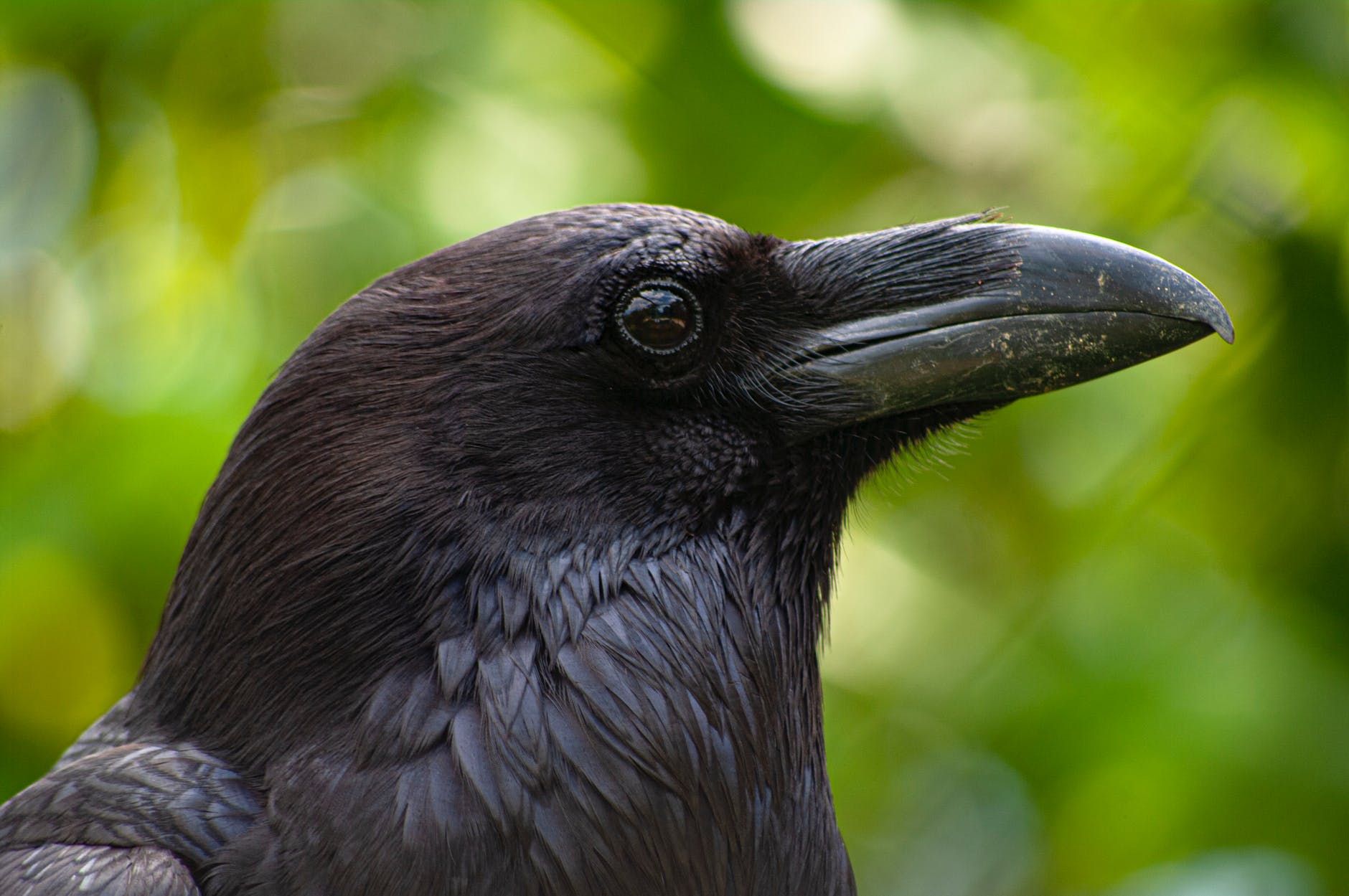
Photo by Mimmo Lusito on Pexels.com

Hello Nature-Led Friends, Thank you for being here! I’m still chewing over my thoughts for the post about Deep Adaptation. I’ve started three versions, but none of them feel quite right.

Last week I was visited by what I like to call an “Uncommon” Raven or Great Mountain Raven, but modern Ornithology doesn’t make this distinction among Ravens. It came down from the mountains to perch at my window. We looked at each other and it made sounds like an animated child. “Hello, old friend.” I said. “Are you the Raven I met before? We watched the sunset from the top of Mount Si and then I walked back down in the dark.”

Here at the lower elevations the Common Ravens are as small as the American Crows. One often needs to look at the tail feathers and beak to tell the difference. Ravens have triangular tail feathers and a thick broad beak (as shown), while Crows have square tail feathers and skinny beaks. To see a Raven such as this is an honor and a blessing. The Raven is an important figure in the stories of the Indigenous Peoples of the Pacific Northwest tribes. My favorite is the Tlingit tribe’s story How Raven Stole the Sun.

Cold Temperatures and Snow were already in the forecast, so I took the visit from Raven as a sign to prepare the landscape for my wildlife friends. I piled up a few extra places with sticks and stones and raked a few leaf piles close to the bushes for extra buffers.

Native Plant Douglas Spirea (Spiraea douglasii) with a log stump border in the snow

The Douglas Spiraea (aka Hardhack) creates thick brush for rabbits and other small creatures to hide in. The stump log border around it provides extra protection from wind-driven snow drifts and creates cavities for insects, garter snakes and salamanders.


Teeny Tiny Squirrel prints
“Doug” Eighth of his/her name the Squirrel


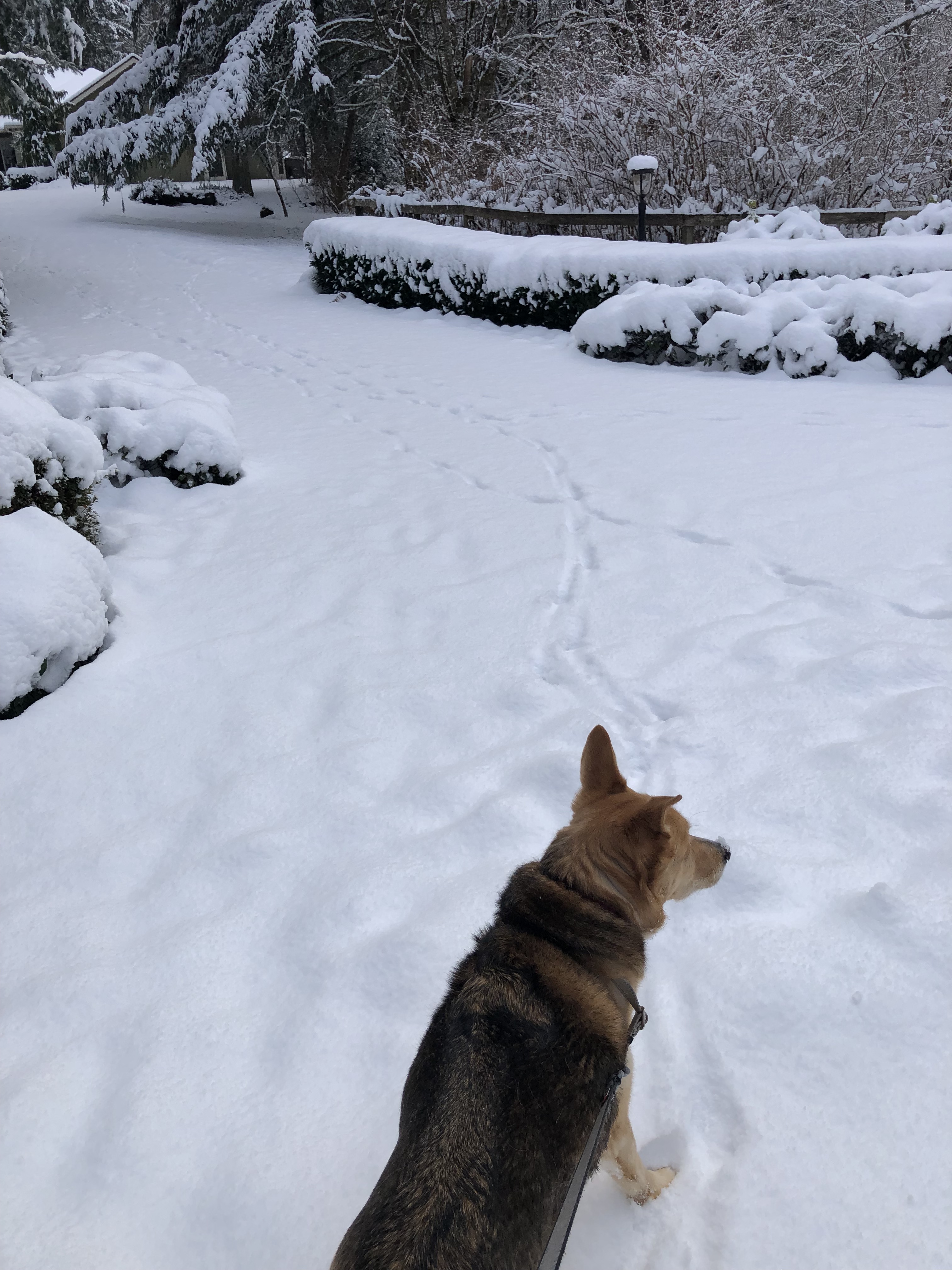
Daisy the Dog, loves to snuffle animal tracks in the snow. These are a pair of coyote tracks.

Winter is mating season for coyotes. They hunt in packs and pairs in search of prey. By the end of January coyote pups will be born. There’s a coyote den in the wetland next to us. I’ve watched six generations of coyotes grow up here. Some people are afraid of coyotes or consider them nuisance animals, but they’ve always been here. This coyote family has lived here longer than I have. My human neighbors often refer to them as “Melanie’s coyotes.” Not because I feed them (I never feed wild animals), but because they hang out in my field so much, even while I’m work out there. These generations were born familiar to my scent. I think they and all the other wildlife around here can smell that I don’t eat meat. They also know I hold no prejudices against them. Each deer, coyote, bobcat, Cooper’s hawk, black bear, etcetera in this neighborhood is an individual to me and not just a product of their species.

“Hey Lady, Are you coming outside?” (Zoomed in so the picture is a bit grainy)

In other local news, some idiot at a tree company ruined a perfectly good Douglas Fir tree on the street behind me. I’m all for a good crown cleanup which involves bringing down large broken branches in a controlled manner and removing a few, A FEW branches for trees close to buildings. Large tree branches that have the potential to fall to the ground and kill people are known locally as “Widowmakers.” In the U.S. Navy, “Widowmakers” is the nickname for submarines. Personally, I find it unattractive when more than five branches are cut from the base to “lift” the tree crown.

My favorite Douglas Fir tree and Doug the squirrel’s home tree. I had it’s crown cleaned up about five years ago because its next to my driveway.

A Healthy Douglas Fir tree _Doug’s Tree
An over-sheared Douglas Fir one street over that now looks like a bottle brush.

I predict this over-sheared fir tree will die from stress and disease within five years. Four of its neighboring trees were removed at the time it was sheared (two weeks ago) and about 30 other trees that had created a large, beautiful stand of trees were removed earlier this year to make way for more housing. Climate Change is death by a thousand cuts to the power of 10, by individual property owners, cities, counties, corporations, states/prefectures and countries.


A Hummingbird Feeder in the winter

The only thing I feed in the winter are the Anna’s Hummingbirds who don’t migrate. I have a few plants that bloom in the winter for food, but not enough yet. I put 10-hour hand warmers held with orange knit socks (formerly my knee-high socks from a ‘Velma’ Scooby Doo costume I did a few years ago.) I bring it in at night, so it doesn’t freeze.

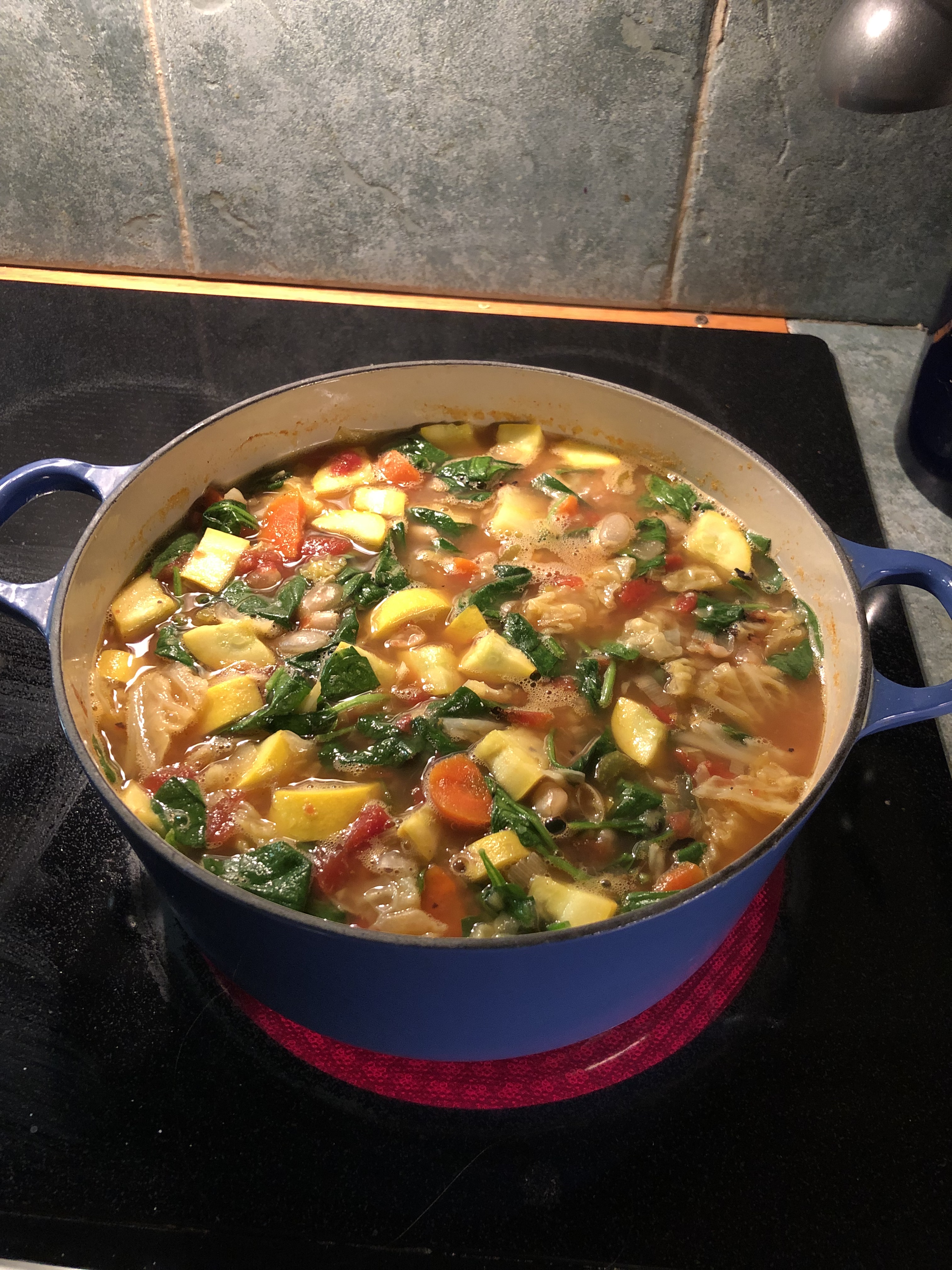
How does one top off a snowy winter’s night at home? With a hearty, rustic vegetable soup of course!
And finally,

Don’t Look Up – A movie on Netflix

Sometimes when we don’t know what else to do in a situation, we laugh about it. Don’t Look Up is a movie where a PhD Candidate and her Professor discover that an asteroid is headed for earth. They give the U.S. President months of warning and time to act, but when there is a potential for money to be made, the plan to blow up the asteroid is scrapped in an effort to mine as many resources as possible and then blow it up, but the plan fails.

It’s a dark comedy and not everyone likes a dark comedy with their existential crisis. I think the critics are missing the point. It’s supposed to be outrageous. It’s supposed to be over the top. Its satire based on our societies worst modern qualities. I’m glad people are talking about it, because so often when I think about the problems in the world it often comes down to greed. Greedy people who profit off the environment, who profit off of racial injustices, who profit off of social-economic unbalances. We could have a better world, but will we? I don’t know. I’m willing to fight until the clock runs out.

It can be so frustrating at times! Here’s a story from August that shows how a big environmental impact plan was effectively sabotaged due to greed and mismanagement in Dubai.

From 1 Million Trees to a Tree Graveyard: How Dubai’s conservation Plans went awry – The Guardian


Additional Links:

All About Birds Common Raven and American Crow Comparison: https://www.allaboutbirds.org/guide/Common_Raven/species-compare/59858041

A brief collection of Raven Tales from Pacific Northwest tribes: http://native-languages.org/legends-raven.htm

Plant Profile: Douglas Spiraea: http://nativeplantspnw.com/douglas-spiraea-spiraea-douglasii/
Fast Company’s: Climate Change Survival Plan

This is not a sponsored post. I’m just genuinely excited about the articles that Fast Company, a magazine & digital media company, has put together on Climate Change. Free! One post in particular really resonated with me to the point where I joked to myself; “Well, I can shut down my blog because someone has written the perfect article about what we can do and how we can do it!”

That would be letting myself off too easily though, wouldn’t it? Many of us need avenues to meet as individuals that help us feel connected and engaged with other people. So I’ll be here, spooling out the best ideas I can find on Nature and Community related subjects.

If you have time, I encourage you to read these articles.

The article I liked the most: https://www.fastcompany.com/90680284/heres-how-to-push-for-action-on-the-climate-crisis

The main landing page to the Fast Company Climate Survival Plan: https://www.fastcompany.com/section/climate-change-survival-plan


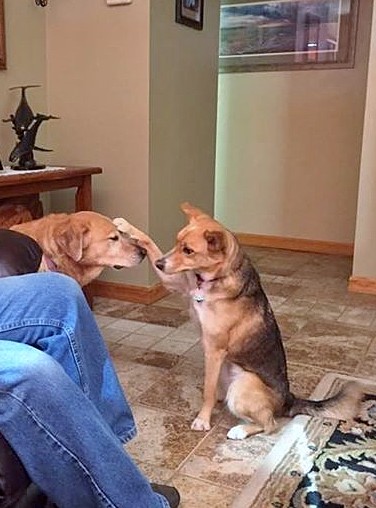
My socially awkward dog attempting to engage in polite dog behavior by offering pets.

Dog pets dog By Melanie Reynolds

It’s only Thursday, but I’ going to start early and wish you all a nice weekend!

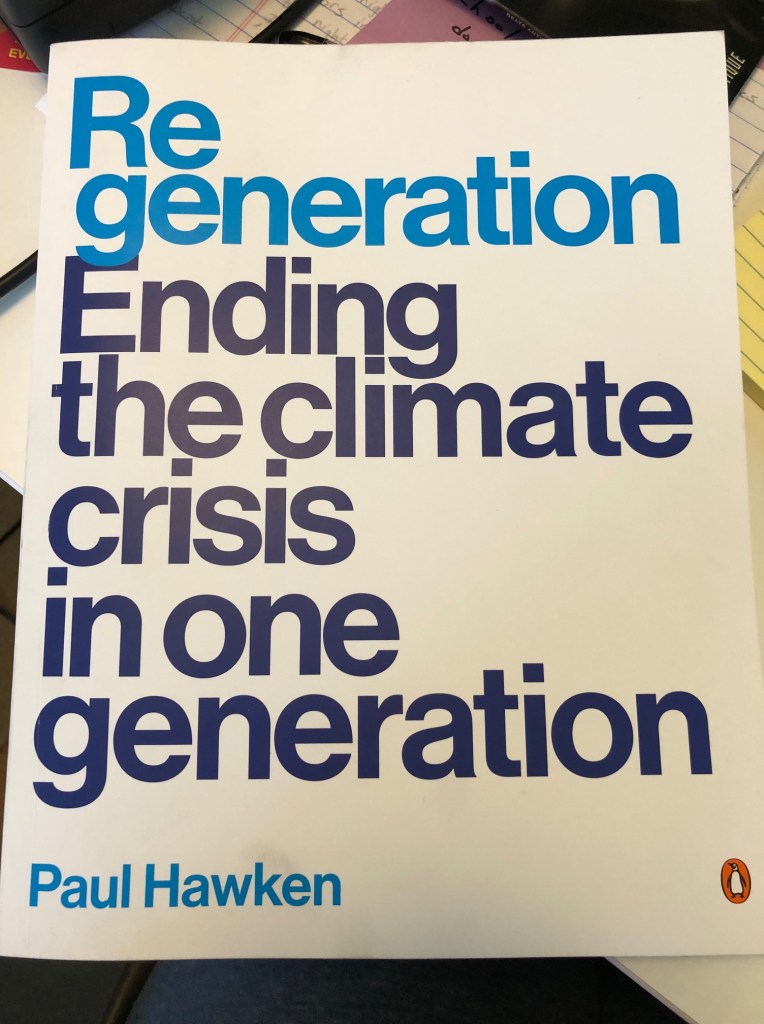
Book Review: Regeneration: Ending the climate crisis in one generation

I picked up this book after reading a review of it, although I would say the review was more about the Author’s body of work more than the book itself. I’m currently in a phase of looking for books and websites that are action-oriented when it comes to climate change and global warming. I know what the problems are. Nearly all of us have some grasp about the issues because it now makes the news on a daily basis. Global Warming and Climate Change have finally become mainstream issues happening now instead something to contemplate in the distant future.

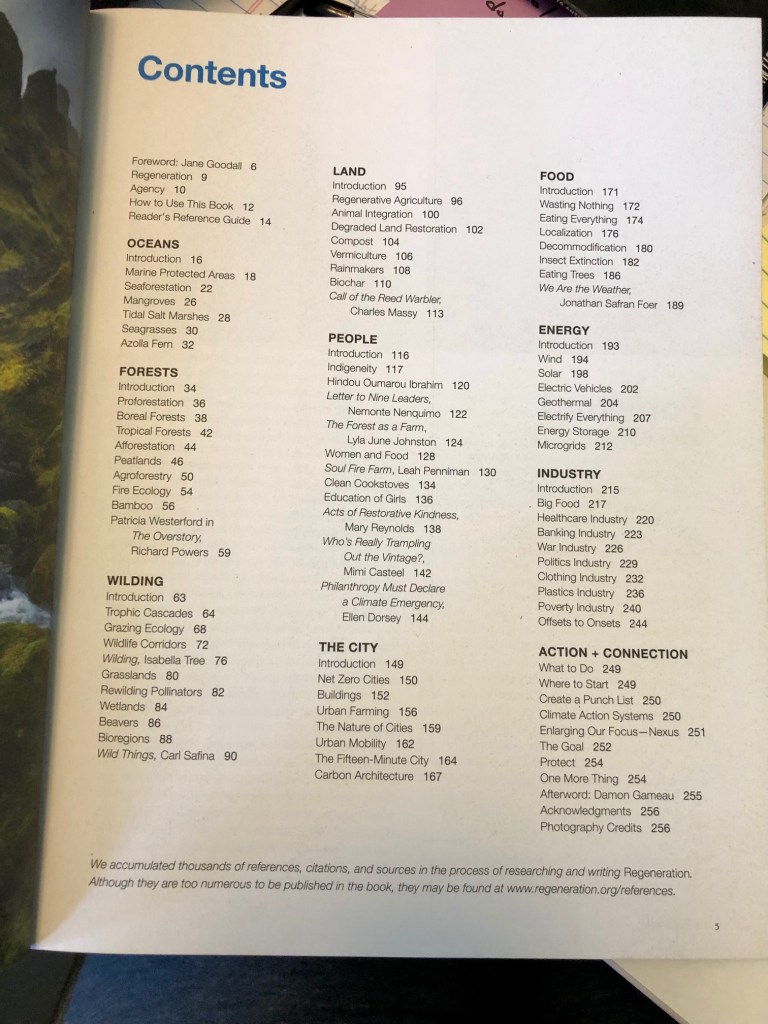
Here are three quick pictures I took of the first three pages. (My apologies for the poor quality on the latter two.) For more and better quality images see the Amazon link below and use the “Look Inside” feature.

From the cover I expected a standard book written by one author, but upon opening the book I find a attribution page similar to what I would normally see as a Certified Technical Writer. This book is essentially a report compiled by subject matter experts for the public as the end user. Traditionally, “white papers” as they’re called, are used as manuals for specific topics or items in government and business. Most white papers are written by science and technology-related businesses to market and educate other businesses and/or government agencies how to use their service or product. For my certification program I wrote a white paper on how to install a living roof system as my final project.

The second page is the table of contents page. I don’t judge a book by its cover, I judge a book by its index and table of contents (TOC) page. This book has no index, so the TOC has to do the work for both. Overall, I give this book an 8/10. In a list at the end of the book they mention the “Azolla Fern” as an important place for carbon sequestering. When I went back to find it in the TOC I didn’t see it, so I went online to understand that it’s an aquatic plant that can cover the surface of ponds, lakes and slow moving rivers. Going back, I now see the plant listed under “Oceans.” After reading the way the topic is covered in the book, “Wilding” or “Food” would have been a better place for it.

What really caught my eye about the contents page is seeing “Poverty Industry” under the Industry heading. I’ve never thought of poverty as an industry. I would have expected to see it under the People heading. After reading the section my first thought is, “How to talk about greed without using the word greed.” If we boil the subject down to its primal essence, aren’t we really talking about greed?

Pro:

Layout – Each topic gets a gorgeous picture representing the topic and about two pages of text on average. Its like a modern, limited encyclopedia of climate issues. This makes it easy to pick up and browse the topics that interest you the most.

Con:

Title – The title implies action items we can do to make a difference in one generation. I was expecting a “how-to” book that tells the reader what they can do to start combating climate change issues now. This is not the heart of the book though. The action section of the book is seven pages and relies heavily on encouraging the reader to visit the website. The website is beautiful and worth a visit.

Ironically, the final paragraph entitled “One more thing” within the Action + Connection Chapter starts with: “It’s not your job to save the planet.” Followed a few sentences later with: “We cannot do this [end the climate crisis} if we believe or assume others will do it for us.”

So we were off the hook, only to be put back on the hook all in the span of a paragraph.

I’m making it my job to help save the planet. I think it should be part of everyone’s job as a human being to do better. I know we’re capable of taking on complex challenges when we work together and put in the effort. I also know I’m not alone in this growing concern and frustration. This blog and so many others are rising up to give a voice to our climate change anxieties and seeking out solutions. We know in our hearts things have to change.

Book Website: Welcome to Regeneration | Project Regeneration

https://www.amazon.com/Regeneration-Ending-Climate-Crisis-Generation/dp/0143136976/ref=sr_1_1?crid=15LGNP2HB0X67&dchild=1&keywords=regeneration+paul+hawken&qid=1633134952&sprefix=Regenerati%2Caps%2C279&sr=8-


If you’ve read the book, what did you think about it?

While my reading list is currently backlogged, I’m always open to recommendations. Is there a book you think I should read?


Thank you for stopping by for a visit!