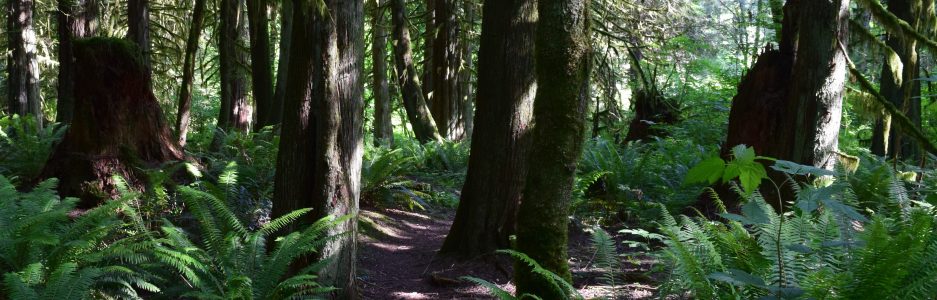
What the trees remember

Photo by Caique Silva on Pexels.com

The day will soon come when my son won’t need me to walk him to school anymore. So last week I worked in one of my mini-nature talks about what the trees remember. I want him to respect the trees as living beings. I want him to recognize their place in the world. Not only as a natural resource from which lumber is made, but that they live and grow and die as we do. They remember the years they had to fight off bugs and diseases. They remember the summers of wildfires where their brethren and maybe they themselves had been burned by fire. The smoke and scars all get trapped up into their growth rings. They bear witness or injury from human historical events as well. Miles of mountain tops from Seattle to the Pacific ocean are barren except for the millions of stumps, like gravestones, that harken the growth of the developing metropolises that became Olympia, Tacoma and Seattle.

Seattle is the original home of the term “skid row.” It was a road or track where logs were pulled down on greased skids towards the sawmill. It also became where the destitute came to live and look for work, especially later during the time of the Great Depression in U.S. (late 1920s and early 1930s.) If you said someone was “on the skids” it meant that they had run out of luck and were sliding into poverty. The term “Skid Row” has since been adopted throughout many English-speaking countries across the world to mean a “poverty-stricken neighborhood.”

During the U.S. Civil War, General Sherman with the Union Army marched from Atlanta to Savannah, Georgia in a campaign called “the march to the sea.” This march was notable for his use of what military agencies call a “scorched earth” policy. It’s as terrible as it sounds. Everything is destroyed in their path. People and animals are killed. Trees, fields, and buildings are burned. Transportation infrastructure such as railroads, roads and bridges are destroyed. For decades after General Sherman’s army had passed burned and living trees alike could be found with railroad ties bent around their trunks in what was called “Sherman’s neckties.”

General Sherman is not alone in employing the “scorched earth” policy, it has been used throughout the world since the beginning of ancient warfare. Many decades later, the Genova Convention of 1977 explicitly calls out for people who are not active participants of a war or conflict to be treated humanely (i.e. not killed). Were I in such a predicament to be facing an army using the scorched earth tactic I would not wait around in hopes they would abide by the conventions.

The threat of global warming in many ways feels like the beginnings of a war to me. The protection of natural resources vs the continuing onslaught of sloppy, lazy, greed. Throughout the U.S. court system corporations have managed to push for themselves the rights of “personhood” by hijacking the 14th Amendment of the U.S. Constitution which was meant to recognize the emancipation of Black Slaves after the U.S. civil war.  

This matters, in that it gives corporations undue agency to act in ways that may be counterintuitive to “the common good” or the will of the people in benefit of their community. I give you these examples based in U.S. History due to my stronger familiarity with it, but I assure you that none of these concepts are unique to the U.S. alone.


If you’re reading this from another country, can you think of any natural landmarks, trees or rocks, that have been marked by a significant historical events in your country? If so, I would love to hear about them!


Have you seen a landscape that’s been mined for heavy metals? Or a river sucked dry, poisoned, or otherwise starved of life? I have. I’ve seen it with my own eyes in the US, Canada, and India. I’ve seen communities of people, fish, animals and plants die by what was done on corporate and government properties, hectares of scorched earth, bled beyond it’s borders. So environmentalists are trying a new tactic to protect what they can by arguing for the personhood of river, lakes, forests and land. After all, if corporations can claim it, why not a river?

We must force governments and corporations to be environmentally responsible now and not just talk about doing it 20 or 30 years from now, by then any such architects of their plans will be retired and happy to let someone else deal with it. Corporations are not held to same level of responsibility as an individual person. If you crash your car into someone house, you don’t get the luxury to do something about it thirty years from now.

To be clear, I’m not anti-business. I recognize that there are several companies that are trying to be partners within the communities where they operate. I applaud them for not waiting 20 to 30 years to make substantial changes. In fact, when I see that a company is committed to making environmentally sustainable practices and not just greenwashing, I make a point to remember them and support them if I can. I’ll also write them an email and say, “As a customer, it makes me very happy to see that you use [carbon-offset shipping] practices and [biodegradable packing materials].” If you’re a business owner, please don’t put it upon your customers to do the right thing. I have a bunch of Styrofoam in my garage that I’ve been saving up for years to make it worth the time and gas to drive it to the special recycling center 45 minutes away.

We need to speak up, as customers, employees, and members of the community when we see thing done right, but also when we see that things could be done better. It’s humbling when you look at a tree several thousand years old and think of all that it has lived through. The civilizations that have come and gone while this tree remained standing. I consider the trees and wild animals in my neighborhood to be members of my community. I do not want to see a grand old tree chopped down and made into toilet paper or shipping boxes.

Related Links:

10 Oldest Trees in the World (Updated 2019)

 Yesler Way: the history & origin of “skid row” | The Filson Journal

 Sherman’s neckties – Wikipedia

The History of Corporate Personhood | Brennan Center for Justice

Common good – Wikipedia

Drought-hit California moves to halt Nestlé from taking millions of gallons of water | California | The Guardian

Uganda joins the rights-of-nature movement but won’t stop oil drilling (msn.com)

20 Firms Are Behind Half Of Globe’s Single-Use Plastic Waste : NPR

Ridgefield NWR

(First published on August 21, 2020 By Dan Nelson aka recreationalnaturalist)

Ridgefield NWR, Carty Unit

I chose the Ridgefield refuge as the subject of my first blog because that was where the seeds were first germinated that eventually produced this recreational naturalist. It was a little over 40 years ago that I went to work there as a member of the YACC (Young Adult Conservation Corps) and met my oldest and best friend Craig Sondergaard, who is the best general naturalist I know, with a library that would be the envy of many a community college biology department, and whom I hope to convince to write a monthly column on ecology for this site. Craig tried to teach me then, and I was a willing student, but due to partying a bit too heartily I lacked the focus, discipline, detail orientation, and mental acuity for the obsession to really bloom, although it did put down roots. 

Not surprisingly there have been changes in the last 40 years here at the Carty Unit of the Ridgefield NWR. For one thing they have built a sturdy new steel and concrete footbridge over the railroad tracks, replacing the one which vibrated and swayed when trains rumbled underneath it, which swaying, especially when exacerbated by their prankster father, was dismaying to my children. One of them has more or less forgiven me for that. 

On my left just after the bridge I pass by a grove of huge Oregon White Oaks (Quercus garryana), trees which were probably impressive already when Lewis and Clark met the Cathlapotle near here in 1805, and under whose indifferent limbs I wedded my second ex-wife. 

Quercus garryana (Oregon White Oak)

Speaking of the Cathlapotle, another big change on the Carty Unit is that they have built a reproduction of a Cathlapotle Plankhouse just north of those oak trees, which is open to the public and well stocked with appropriate informational signs.

From here the trail passes between a pond on your left which is ringed by the ubiquitous Phalaris arundinacea (Reed Canary Grass), and a woodland on your right. I saw the daisylike flowers of Anthemis cotula (Stinking Mayweed), and some stands of Solidago lepida (Western Goldenrod). But no ducks on the pond, nor much of any other birds. That wasn’t particularly surprising though, since it was the middle of the afternoon on an 84* day. 

The right hand side of the trail is a bank of Symphoricarpos albus (Snowberry), winter desperation food for birds and good cover for small mammals, although I didn’t see any. Kind of the essence of good cover, I suppose. It is also the primary larval host of the Snowberry Checkerspot Butterfly, but I didn’t see any of them either. Then the first blooming Anaphilas margaritacea (Pearly Everlasting) I’ve seen this year, a sure sign we are in the dog days of summer.

The biggest change from the point of view of a recreational naturalist is that, in an effort to restore habitat for the Oregon White Oaks, they have cut down many of the conifers, mostly Pseudotsuga menziesii (Douglas Firs), which surrounded the Oaks-to-Wetlands Trail. This process is known as an ‘oak release’, because the faster growing conifers have crowded and shaded the oaks, preventing their growth. No doubt this will pay great habitat dividends in years to come, but for now the area is just a clearcut dominated by stumps and non-native invasive species. 

These situations where a familiar habitat has been denuded or destroyed are always shocking. But I’ve found that (unless it is a lost cause because the powers that be have decreed that that land should grow apartments or strip malls rather than forests and wildflowers) the quicker I can move through the grief to acceptance (a process made much easier in this case by knowing that eventually this would be be restored to some semblance of a native habitat) the sooner I can happily explore what is there now. Because there is always something finding a way to exist there now. 

In this case there is Mycelis murals (Wall Lettuce)Lactuca serriola (Prickly Lettuce), Epilobium ciliatum (Fringed Willowherb)Jacobaea vulgaris (Tansy Ragwort)Cirsium vulgare (Bull Thistle)Cirsium arvense (Canada Thistle)Daucus carota (Queen Anne’s Lace)Lathyrus latifolius (Everlasting Pea)Rumex crispus (Curly Dock)Verbascum thapsus (Wooly Mullein), Rubus bifrons (Himalayan Blackberry), and Dipsacus fullonum (Fuller’s Teasel) amongst the vegetation, which is being visited by a Limenitis lorquini (Lorquin’s Admiral), several unidentified Pieris sp, Ochlodes sylvanoides (Woodland Skippers)Dissosteira carolina (Carolina Grasshoppers)Largus cinctus, and a female Libellula forensis (Eight-spotted Skimmer), plus various unidentified spiders, ants, wasps, bees and flies. Not to mention all of the little living creatures that I couldn’t see.

 For most of my life I’d have looked at this artificial clearing and seen a wasteland. But once I started looking closely at places like this, differentiating the plants, learning some names and a bit of natural history, seeing all of the birds and bugs feeding, breeding, and hunting there, it started to come alive for me, gaining validity as a habitat.

I cross a little footbridge over a tiny watercourse which is choked by the foliage and pretty blossoms of the highly invasive Impatiens capensis (Cape Jewelweed) and Solanum dulcamara (Bitter Nightshade).

Impatiens capensis (Cape Jewelweed)

Near a copse of young oaks I saw a few Robins, and then a slightly larger bird pecking at the ground, which proved to be a Northern Flicker (Colaptes auratus) as it flashed its white rump escaping into the trees. Then a couple of Bombycilla cedar-rum (Cedar Waxwings) flew into a nearby tree, bouncing from limb to limb, their reddish brown crest silhouetted against the pale sky and backlit leaves, with occasional glimpses of their black mask and yellow tail feather tips. 

I love Cedar Waxwings! They are a very animated bird, which makes for difficult photo ops, but they appear to be having fun in a way that is unusual for birds. I’m probably committing the sin of anthropomorphizing here, but they seem to glory in flying pell mell into perches that won’t support their weight and riding them down, like the trees were just random jungle gyms. 

Typical of my attempts to photograph Cedar Waxwings (Bombycilla cedrorum)

As I was rejoining the main trail from which this loop had sprung, much shorter now during the restoration and encompassing far less diversity of habitat than in the ‘old days’ when I worked here or wandered it with my kids, I spoke with a couple who told me that they had spotted an adult and a juvenile Bald Eagle (Haliaeetus leucocephalus) feeding on the carcass of a carp down by the bridge over Gee Creek. So I drifted that way. I missed the feeding and the adult, but with the help of a fellow photographer I finally spotted the mottled form of the juvenile amidst the mottled shadows in the crown of a huge old oak tree. I watched it for awhile, grateful for the recovery of this species, whose population had dwindled to the point that when I worked here in 1980 a Bald Eagle sighting was big news, snapped a few photos and, content, walked back to my van. 

Juvenile Bald Eagle (Haliaeetus leucocephalus)