Book Review: The Well-Tempered City

Hello Nature-Led Friends!

Sometimes life is rough. We just have to do the best we can. Through dark times I have two mantras to help get me through it: “It won’t always be like this.” For better and for worse, change is inevitable. The second thing I remind myself of is “As long as there is another day, it is a chance to make things better.” Sometimes, you just have to put a bad day to rest and start anew the next day. If you are going through tough times right now, believe me when I say that I care about you and that I wish you the best.
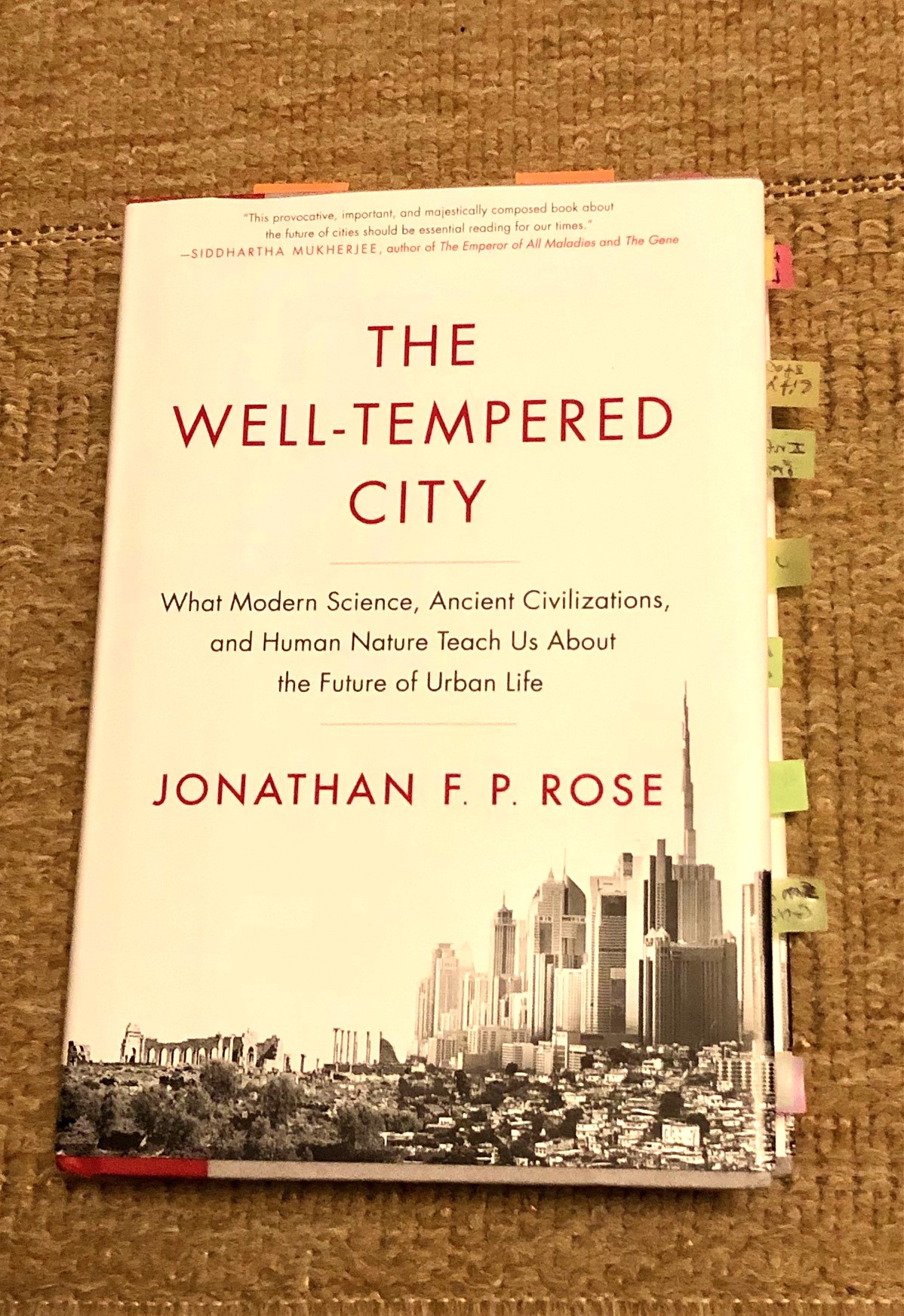

The Well-Tempered City: What Modern Science, Ancient Civilizations, and Human Nature Teach Us About the Future of Urban Life By Jonathan F.P. Rose, Printed 2016

Book Review: The Well-Tempered City: What Modern Science, Ancient Civilizations, and Human Nature Teach Us About the Future of Urban Life by Jonathan F.P. Rose

This book starts with an introduction into what we can learn about ancient civilizations and includes a concept called meh, loosely translated as “an activating energy and the source of rules that guided the spiritual, social and moral basis of [what was] the Ubaid culture” allowing it to become the first society to develop a framework of integrative systems that we now call Urbanism.

I smiled every time I read the word meh, because I have a friend who’s a one-word guy most of the time and that word is “Meh.” Intonation of the word could imply that a proposed idea is good enough that he is willing to do it (i.e. go to a specific restaurant or movie.) He is neither excited nor unexcited about the idea. If you ask him how something was, and he says “Meh.” that usually means it could have been better. If you are fortunate enough to propose an idea that he really likes you are rewarded not with a “Meh.” but with a “Definitely.”

I feel that a lot of urban initiatives these days are met more with the kind of “meh” my friend prefers, a “wait-and-see” energy of approach then an “activating energy” for integrative social rules. Maybe it’s a bit of both. Anyone whose had more than a few rotations around the sun learns to approach things with cautious optimism.


Photo by Pixabay on Pexels.com

The five qualities of a well-tempered city (p.20):

  1. Coherence – an integrated framework that unifies a city governing sections of departments, programs and goals.
  2. Circularity – transforming linear systems into regenerative ones.
  3. Resilience – the ability to navigate forward when stressed.
  4. Community – social networks that strengthen the individual in mind, body, and spirit.
  5. Compassion – creating a healthy balance between individuals and the collective well-being of the community at large.

Folded within these key qualities is how they relate to the nine “C’s” that made early human evolution to civilization possible:

Cognition, cooperation, complexity, culture, calories (food), commerce, control, concentration and connectivity.


Overall, a really good book that offered relative case studies to make each point. I learned so much! It felt like a college course wrapped in a book. I took a lot of notes and tabbed a lot of key sections that pertained to areas I was most interested in as you can tell from the book picture above.

Here are three things I learned about that really interested me:
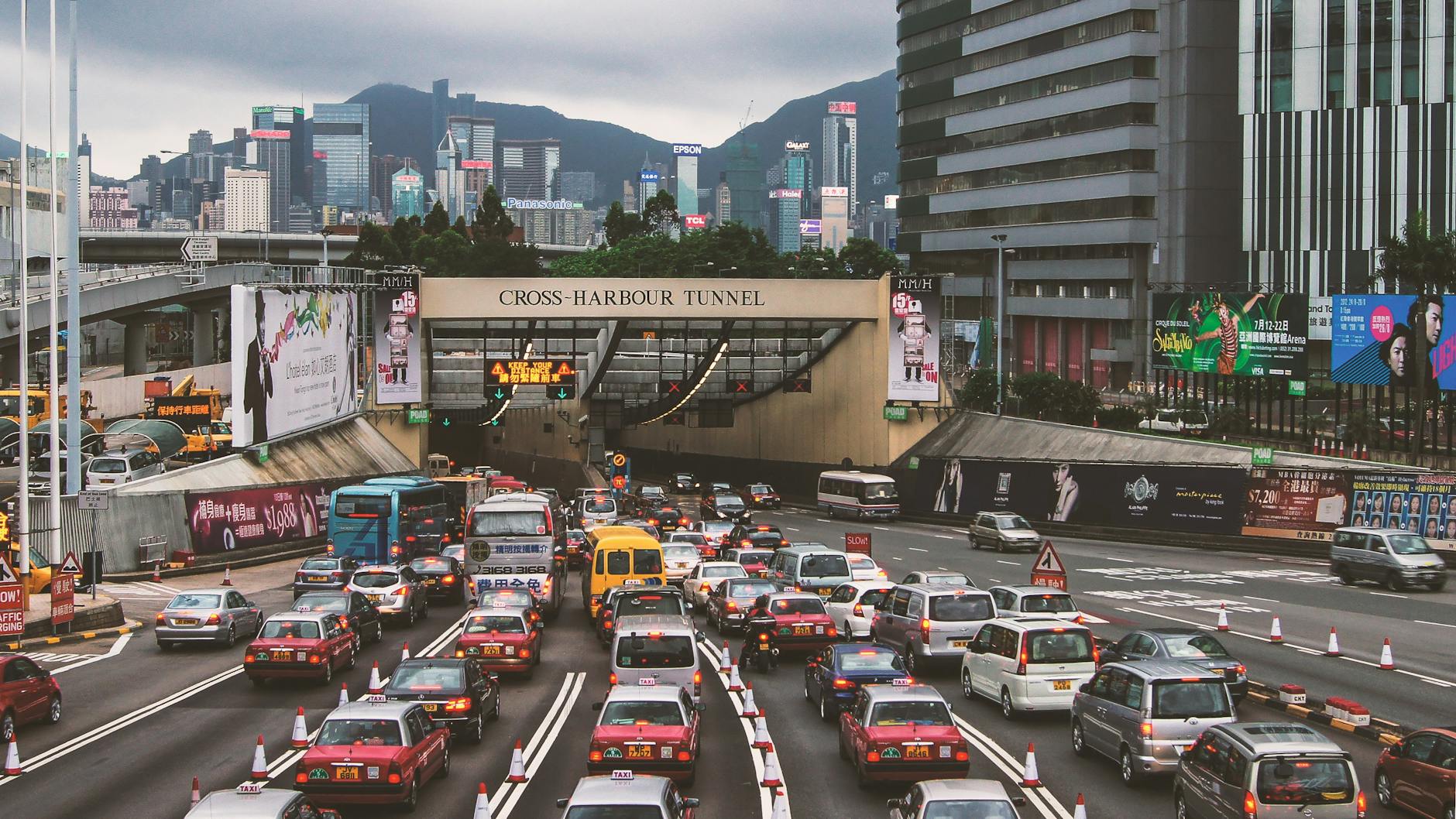

Photo by Pixabay on Pexels.com

The Traffic Paradox (p.235)

More lanes create less efficiency, not more due to the Braess Paradox and the Nash equilibrium theory.

The basis of this is that drivers have a self-serving interest to take the shortest route possible from point A to B until so many people take that route that it is no longer shorter for anyone.

For a three-minute visual explanation of how this works visit this YouTube link: https://youtu.be/O8Wi1ZC_yL8?si=0HUdAC7tfLoHfcZx


This paradox is an excellent reason for why cities need to provide alternate means of transportation for city infrastructure. I’ve never been the kind of person interested in fancy job titles. It was always important to me to find a tolerable job with a tolerable commute. I spent the first half of my working life commuting to jobs that I could do by walking or taking a bus that rivaled or beat the commute time of a single passenger vehicles. Given the option, a safe walking route is always my preferred method of travel. One need not expend a lot of time or money working exercise and fresh air into their day when it’s imbedded into their daily routine. It also increases the opportunity for social interactions outside of school or work.


Photo by Eva Bronzini on Pexels.com

From Entropy to Emergy (p.238)

Eugene Odum and his brother Howard wrote the first Ecology book in 1953 describing ecosystems as communities of organic and inorganic elements. In this kind of closed circular system, the eventual entropy of one thing leads to the emergy or creation of newly stored information. “While entropy is always wearing down a system, emergy helps build it back up.”


Gardeners know this process well by gathering dead plant matter and wood chips to decompose, thereby releasing there nutrients as “newly stored information” in the form of compost to spread around young or existing plants.

Humans have learned to do this with paper products such as cardboard, but we need to do better at incentivizing more circulatory systems that benefit both humans and nature. My personal opinion is that one our biggest failings as modern societies is allowing plastics to be extracted and used so excessively for a lot of things that ultimately end up being cheap pieces of crap that can’t be recycled. The oil and plastics industries have powerful lobbying groups that allow our shared future resources to be exploited for meaningless crap. As a consumer, you speak with your purchasing power. In a market economy founded on supply and demand use your money as your voice wisely. If you don’t like something, make it unprofitable to support. It’s clear we can’t wait for governments to regulate appropriate solutions.


Photo by John Guccione http://www.advergroup.com on Pexels.com

Easterlin Paradox (p.345)

Richard Easterlin a USC Professor wrote “The Economics of Happiness” in 1974 which found that more money increased happiness in those previously in low income or poverty situations, but that more money does not increase happiness for the affluent.


I’ve witnessed this firsthand having grown up low income and later working in an exclusive member-only club where members were required to make no less than $80,000/year (in 1998) and be sponsored by two existing members of the club. I started the job in 1998 at the height of the dotcom bubble in Seattle, WA where tech was making new millionaires seemingly overnight. The “new money” were often young tech entrepreneurs launching their first IPOs and expecting everyone to know who they were and have people cater to their every whim. They were loud, obnoxious and often travel entourages. The “old money” were people who were more often born into wealth. They were polite and reserved. Time was a luxury. If they couldn’t be bothered to wait for your assistance they would come back later or have someone else take care of it on their behalf. They had no need to yell.

The club had hotel rooms, and I worked the front desk. The rooms often sold-out months in advance especially during Huskie football season. I was handing one of our long-time members his morning paper when a young techie came up expecting my full and immediate attention. I asked the long-time member if he needed anything else. The young guy huffed impatiently. I gave him a sharp look and said, “You will wait your turn.” The older guy chuckled, tucked his paper under his arm and told me to have a nice day as he walked away. The young guy didn’t even last a year at the club. The dotcom bubble burst not long after. Nearly every new member that year was purged from the member roles before New Year’s. The young guy had no idea he’d rudely interrupted one of the richest men in the world and one of our longest-standing members.

I’ve had the opportunity to ask multiple people with famous names; “What bothers you most about being rich and famous?” They’ve all said in some variation that it’s hard to trust people. They said that everyone wants or expects something from you all the time. You can go anywhere in the world, but you can’t trust that anyone genuinely cares about you as a person. It seems reasonable to assume then that what you gain in monetary significance can cost you in a kind of spiritual deficit (i.e. honest connections with other people.) Some people aren’t bothered by the tradeoff, but it would bother me.

Final Thoughts:

I definitely recommend this book! There’s really so much to it that what I’ve provided here is only a small sampling. If you’ve read this book, I would love to hear your thoughts on it!


Thank you for visiting!
Firestorm, 1991

When I was sixteen my father and I nearly died in a wildfire.

When I was four, he bought twenty-seven acres outside of town. At night, in a field among the forests, it felt like space could devour you. Very few lights dotted the landscape back then. Now when I go back there are so many lights I can hardly see the stars.

We started in a used single wide trailer. Two years later the concrete was poured and the first timbers went up. My dad worked long hours at a meat packing plant with a 45-mintue commute. I lived in the city with my mom during the week. On the weekends, I was a wild child out at my dad’s house. He bartered and traded for goods and services to get the house built. Family and friends came out to help with whatever skills they could bring to the effort. It created a festive atmosphere having so many people around. My grandpa, my great grandpa, my grandmother, my great aunt and uncle, some family friends and occasionally my childhood friend and her parents too. I loved growing up “under construction.” When the scaffolding went up three stories high, I turned into a monkey. When my grandma would give me food I would stuff it in my pockets or have a sandwich hanging out of my mouth as I scurried up to the highest scaffolding board to eat. I also liked throwing carrot chunks at my older brother, because he was too afraid to climb so high.

One of my favorite family friends was a survivor of Auschwitz. He lost his whole family including a wife. He remarried a fellow survivor after they were freed. That’s all I know of his story. He was a kind, soft-spoken man, and an excellent master bricklayer, just like my great grandfather. Every time I see the bricks in “soldier pattern” (standing vertical) over the main doorway, I think of him. The rest of the house was built of wood.

The house grew and now it’s very large. You might consider it a mansion, one that took nearly forty years to build. Wildfires have come and gone over the years, but they never come close enough for us to really worry, until 1991. What would become locally known as, “Firestorm 1991.” It’s a lot like what the Bootleg fire in Oregon appears to be becoming now, multiple fires driven by high winds.

We got blocked on three sides, one of them curving like a half moon that eventually cutoff our escape route. My Stepmom, Stepsister, and Stepbrother got out in time. My stepsiblings were just little kids at the time. My stepsister cried, begging us to come too. I wanted to go, but I wouldn’t without my dad. I thought if I stayed with him, he would see reason. I thought I could get him to go, for me. By the time I felt I had convinced him it; it was too late to leave. The firefighters had come. They told us to evacuate. They themselves were pulling out and right after they left trees fell as if closing a door behind them.

I filled the bathtub with water, so I felt like I had a choice between burning or drowning. I was angry and sad that we hadn’t left with the rest of the family, but I understood too. I knew how much the house means to my dad. How much it means to me. Many beloved hands shaped the walls, drove the nails, and mudded the cracks in the sheetrock. When I visit, I run my hands along the walls. Hierth, you can never go home.

The night was long. The glow of the fire was so bright when you closed your eyes, you still saw the fire through your eyelids. There was nowhere to hide. We paced around like angry cats. We patrolled the windows as they started turning black with soot. The hose and buckets positioned by the doors. Our water was drawn by a well and the closest fire was nearly upon the pump house. Then the fire turned and battled the other for fuel. They consumed each other before us. There was not enough tinder between the both of them and they burned each other out. I would have cried if I’d had enough moisture left for tears. I thought I might cry table salt instead; my eyes were so crusty.

We survived. The house still stands today. The wood exterior has been covered with stone. The roof has been replaced with tiles. I still can’t help but think of it as a giant brick oven though. I can’t live out there no more. Every year I worry about my dad. Every year I track the fires. I live roughly five hours away, but if I move like a low flying aircraft and I don’t stop to pee, I can make it in three.

I don’t just follow “our fires,” I track everyone’s fires. My own version of Nihilism perhaps, but I also think Fire Science is interesting. Sometimes, I cry tears for others I couldn’t cry for myself. I know their pain. Most recently it was for the people of Lytton, BC.

The problem isn’t just one thing, it’s a multitude of things. Yes, it’s more people moving out to rural areas. Yes, it’s years of suppressing natural fires. It’s over regulated in some ways and under regulated in other ways. It’s bad planning. It’s greed. It’s global warming.

We could be more strategic in how we manage fires and how we plan our communities. The Camp Fire in California in 2018 showed just how dangerous one of our most popular housing development layouts can be. It’s typically a selling feature to live on a dead end street, until you can’t escape in an emergency due to you and your neighbors trying to flee at once creating a chokehold. We have to rebalance and recalibrate, the natural environment with the built environment. We can save ourselves, save the trees, and animal lives with lower intensity fires. Fire isn’t always bad. Regenerative fires help create lower intensity fires and healthier forests and fields for future generations.

Additional Links:

Firestorm 1991 – Aug. 21, 2015 | The Spokesman-Review

‘Most homes’ in Lytton, B.C., destroyed by catastrophic fire, minister says | CBC News (This link includes a video of a guy who describes just how hard it is to make the decision whether to leave or stay during a wildfire. This fire occurred earlier this month at the beginning of July 2021.)

Have you ever been affected by wildfire?

Tiny Forests: Small forests for big impact

Photo by Ryutaro Tsukata on Pexels.com

Every week I read a lot of news stories, predominately on the topics of the Environment, Science and Technology. All this reading interweaves into a tapestry of ideas and inspirations. Last week, I read about how Reddit’s former CEO, Yishan Wong, uprooted his family to follow a dream of environmental restoration in Hawaii, which sparked the research for this week’s focus. I feel like there was another story I read that first mentioned “The Miyawaki Method”, but I’m not sure which one it was now.

The Miyawaki Method creates a dense bio-diverse forest in 20-30 years instead of waiting for the natural cycle to take around 200 years. (It depends on the forest type. This estimation is based off the temperate forests of Japan.)

The first and most important step is the site assessment. Before you send your trees off to college or tell them to reach for the stars, you have to give them a good foundation of the basics, air flow, food and water. Miyawaki’s Method is dependent on the belief of creating “an authentic forest.” The trees, shrubs and other plants should be native to region and native to the microclimate of that region. This requires carefully harvesting seedlings from native flora that may be rare and hard to find.

The seedlings are often grown in various levels of shade to help them establish deep root systems. Once they are ready for planting all the kids are shoved into a small plot, typically no smaller that 30sq meters (about 322.92 sq feet) with one tree per square meter, but at least 60-90 plants in total for the whole space. These plant kids are growing up in a natural world version of an apartment complex.

In the conventional method of planting your trees would all be suburban kids, neatly spaced out with cute little name tags and yet they’d all have a handful of the most common surnames in the country, the Smiths, Johnsons, and Williams of the US. The Rodriguez, Martinez, and Garcías of Colombia. The Sato, Suzuki, and Takahashi of Japan or the Devi, Singh, and Kumar of India. (Search “Most common surname in [Country]” to see what the most common last name is in your country.)

Photo by Artem Beliaikin on Pexels.com

The actual planting of all this flora requires randomly distributing it and not doing it in rows or staggered. Have you ever tried to do something randomly? If at this point in your life you have not discovered that humans are naturally inclined to certain patterns, you will suddenly make this realization when you are told to “randomize” something. I find it an interesting side effect of human adaptation. We’ve worked so hard to organize the world in order to make sense of it that when we are asked to randomize we struggle not to make patterns. In the past I’ve made necklaces and done beadwork. I’ll try to make it random only to discover that the longer I work at it, the more likely a pattern will emerge if I am not paying attention.

Akira Miyawaki came up with his method after studying a concept in Germany called “potential natural vegetation” (or Kuchler Potential vegetation) in the 1960s. The idea is to study what the forest would look like without human interference and try to replicate it. The seeds that are harvested from native plants need to have the qualities of being pioneers and secondary indigenous species with mycorrhization. These are the pathfinders of the indigenous forests trying to regrow in areas that might have once been damaged by fire, flood, or disease.

If you’ve read The Hidden Life of Trees: What They Feel, How They Communicate – Discoveries from a Secret World by Peter Wohlleben (goodreads.com)or watched the episode of “The Magic School Bus Rides Again Season 2 Episode 10 (Tim and the Talking Trees | The Magic School Bus Wiki | Fandom)  then you’ve come to understand the importance of the mycorrhizal (fungus) and soil bacterium.

Did you know that the microbiome of the human gut has it’s own nervous system? It’s called the enteric system. As we learn the importance of what a healthy gut biome means to human health, one could argue that the trees gut biome is found through the soil. Alternately, You’re feeding a forest in your stomach! A micro biome unique to you. You’re a walking terrarium. When we humble ourselves to the possibilities within the natural world and truly set our egos aside, then we can truly learn new things instead of re-creating the same old premises that hold us back. This is how you learn to think in radically different ways.

Mr. Miyawaki has traveled all over the world to create his process in several countries. As the method become more well-known it inspires others to also work towards this goal of restoring the land one tiny forest at a time. One of these people is Subhendu Sharma of India, who created a company called “Afforestt” and speaks on the subject as a TedTalk Fellow. You can find his videos on YouTube. Some are in English and some are in Hindi. I hope that I too can be a part of the Tiny Forest movement in my own region. I would like to see economically depressed neighborhoods in Seattle, Everett and Tacoma be helped and healed instead of continually ignored.

Right now, I live in a very hot housing market as people in the cities try to outrun urban decay, California and whatever else, small living spaces I suspect, noisy neighbors, etc. I live at edge in what is called the “urban-wildlife interface”, it’s the point at which humans and wildlife collide into side by side living. When the new people move in the freak out after the first windstorm and decide that all the trees need to be cut down, because they’re tall and they *might* fall, even though its already been standing there for 80 years. Then they see their wild neighbors and think they should be the ones to move. Just because a black bear walks across your lawn doesn’t make it a “problem” bear. It’s just existing and each new 5-acre, 9-acre, or 60-acre lot of land that gets developed into matchstick houses pushed the animals further into sight and conflict with humans.

This is a battle I’m willing to fight. I think to save my wild neighbors, we need to revitalize the urban cores once again. We must change our urban planning methods built on old premises and build upon new ones inspired by nature. No more redlining. We need to re-create cities where people can thrive and to do that, we need to bring back some of the forest back into the cities with us.

Don’t we all want to live in beautiful and interesting places? Part of what makes a place interesting to me, is the cultural and indigenous heritage of that place, through its land and its people. An authentic forest. An authentic city. An authentic forest city.

Photo by Rachel Xiao on Pexels.com

What do you think?

Links:

Former Reddit CEO’s New Startup Terraformation Raises $30 Million To Restore Forests And Tackle Climate Change (forbes.com)

Akira Miyawaki Official site: Akira Miyawaki | Inventor of Manmade Forest

Shubhendu Sharma, Afforestt Founder and TED Fellow: How to grow your own tiny forest | (ted.com) (video)

UK: Tiny Forest projects launching in Wales: Tiny Forest | Keep Wales Tidy

Potential natural vegetation (PNV) (aka Kuchler potential vegetation): Page translated in English: Potential natural vegetation – Wikipedia, the free encyclopedia (original page in German: Potenzielle natürliche Vegetation – Wikipedia)

A good step-by step outline: How to Build a Forest in your Backyard – The Miyawaki Method – CUTTING EDGE VISIONARIES (cevgroup.org)