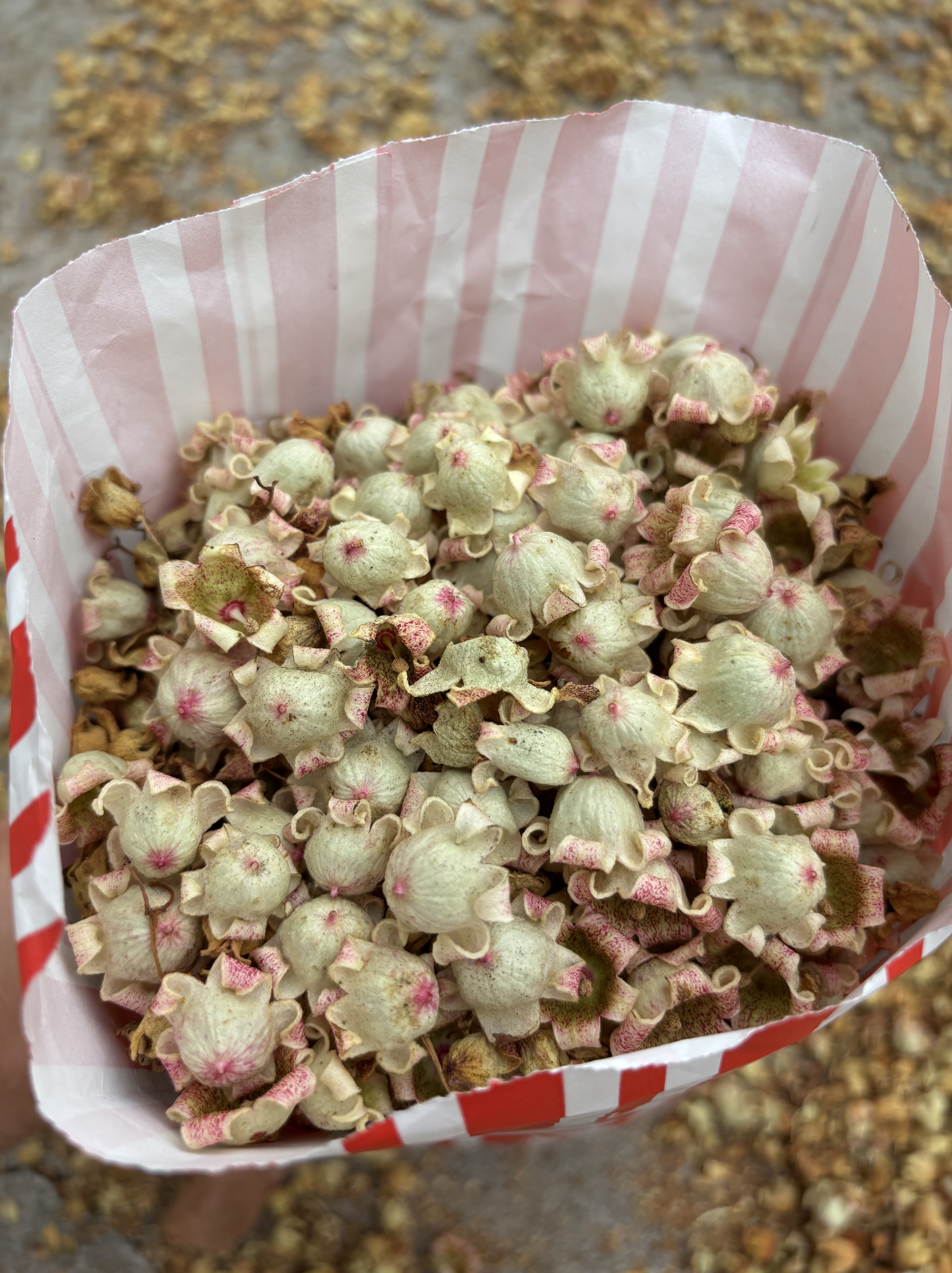
Today my wanderings brought me here, to these flowers scattered across the pavement.
By their shape, their color, and the way they floated in the air before settling on the ground, they looked like an orb of crispetas, pochoclo, or palomitas de maíz—what’s called popcorn in English.
A seed becomes a tree, blooms in spring, and in summer, with the heat, its flowers fall to nourish the earth… and also this existence. Somehow, those flowers stirred a memory and gave me a moment to be grateful and to understand that we, too, are children of corn.
In Colombia, during the power rationing era, we lived in a house with an aunt who was just as much a child as my brother and I were. While my mother and father worked, we fed ourselves, did our homework, and slept until dawn.
As children, we often forgot about keeping schedules or following routines. We knew, of course, the sound of the school bell that signaled a change of activity, but we didn’t manage time. Two hours could pass in a minute, and a fright could last a lifetime. Even now, the dimensions of time sometimes escape comprehension.
We would forget when it was time to eat. The power would simply go out, and in the darkness, we’d remember it was time for dinner. We didn’t have a gas stove or any appliances that worked without electricity. To avoid scolding, we would heat the pot with a candle and prepare our soups there. And we even dared to make popcorn.
My aunt would hide the pots so the adults wouldn’t discover the soot—our secret. One time, we were caught. They were surprised not only by our cleverness in hiding all traces, but also by our courage in cooking with fire. Without realizing it, we were doing pure physics experiments. Innocence and being out of sync with time allowed us to explore and learn.
When my parents separated and everything seemed unstable, popcorn was also a source of sustenance. We’d add sugar, salt, whatever we had. We were little scientists of flavors and moods—mixing, tasting, discovering.
Corn has always fascinated me. How can a single kernel expand to feed humans and animals, and turn into flour, arepas, tamales, lifelines? Long live popcorn, which, in the warmth of a candle, opens its wings to arrive here, blooming, leaping through memories…
The memories of that time are happy. I never felt like we were going hungry or had an unbalanced diet. For us, each day was like being in a great movie. What greater joy is there for a child than to eat something always associated with happiness? We played at tossing it into the air and catching it with our mouths. Getting it right was a celebration.
I don’t know if my mother intended it or if my aunt simply made it because it was the most fun. But that gesture became an anecdote with lasting meaning.
In many ways, I’ve been like that kernel—tiny, naïve, subtle… that upon contact with fire, dances, leaps, expands, and transforms into something wonderful, something that sustains and nourishes other lives.
Thank you, mother and aunt.
Thank you, flowers.
Thank you, corn.
Brachychiton belongs the family Sterculeaceae, and all the species are native to Australia.
 The Nature-led Life
It’s a wonderful story!
LikeLiked by 1 person
Good pic, good story,
LikeLiked by 1 person
Love this memory and the image! Thank you for sharing, Patricia!
LikeLiked by 1 person
What a lovely telling of happy times!
My own “happy corn days” revolve, more, around fresh-picked sweet corn, sometimes taken straight to the kitchen to be cooked, but more often just munched from aboard a log while dangling our dusty feet in the river.
LikeLiked by 1 person
Popcorn is still one of my favorite foods. Thanks for sharing these lovely memories. (K)
LikeLiked by 1 person