How to Save Our Asses in Short Order: Activism, Hacktivism and Activist Investors

Last week was a dark week despite the continual blasting of heat from the sun and bright blue skies, but that’s part of the problem isn’t? If you’re not frying like an egg in one part of the planet, you might be wondering if you have the aptitude for boat building. I couldn’t find any positive environmental-related news last week. Instead, it ended up a long session of what kids these days call “Doom Scrolling.”

Each article making me more angry, sad and frustrated. I’ve always operated in a morally gray area. If you take a psychology class chances are you’ve encountered “the Trolley Problem.” In short, you’re standing at the track switch and you see an out of control trolley going towards five people who are tied up and can’t move. If you flip the switch you can save them, but you’ll kill one person on the other track.
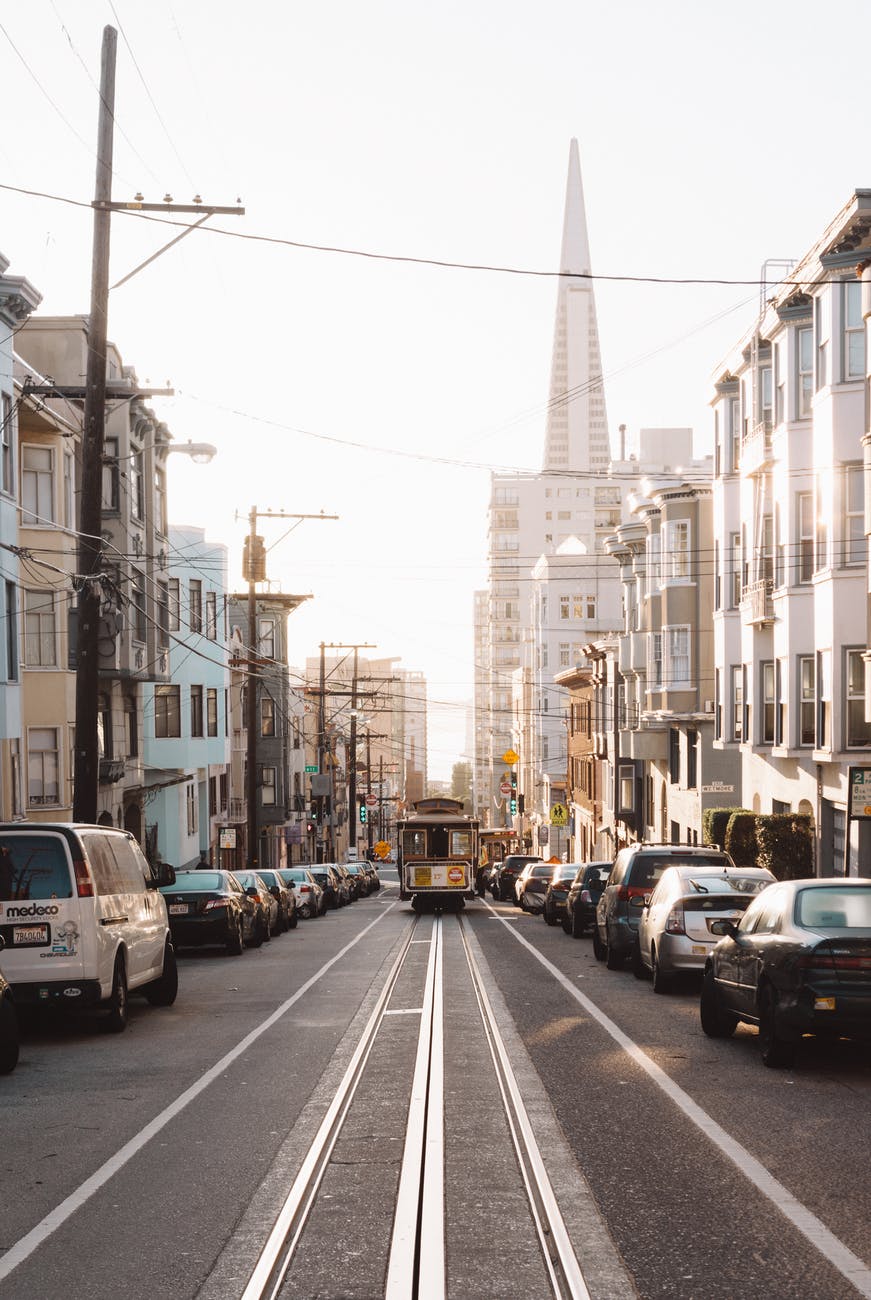
Photo by Alex Azabache on Pexels.com

I’ve always been trained to do the most amount of good with the least amount of damage. I would flip the switch, but I’d also make a run of that one person. We don’t have details on how fast the trolley is going or how far you are, but I’d try to make a run for it anyways. If nothing else, I would serve as a distraction, maybe that helps? Maybe I do get to the person in time and get them completely or mostly off the track. If they lose their leg(s), but keep their life I’d still call that a win. Honestly, this question could have many more variable factors in it, I suggest you not think about it too long unless you’re aiming for a truly depressive state of mind. So why am I bringing it up?

Because maybe if we maintained the flippin’ trolley in the first place we wouldn’t be put in such a moral dilemma! The trolley is our planet. We are already standing at the switch and the track is the degree to which we let human-caused emissions raise the global temperature. We do not all have an equal amount of leverage though. Developed Nations have more leverage, Corporations have more leverage and the Ultra-Rich have more leverage.

We are all beholden to them on if they choose to act on climate change, how they choose to act on climate change and when and how fast they do it. I don’t like them having so much leverage. Do you? I feel that some of these people are so incompetent they’d have such an uncontrolled, oversized trolley taking out all six people and a couple of puppies and kittens to boot!

WHAT CAN WE DO!

We need to pull out our wrenches and chocks (wedges used to prevent vehicles from moving) and get to work. We need to change the system, disrupt the system. Peacefully and strategically. The Ultra-Rich think they can buy up mansions in places like New Zealand and other believed-to-be “climate Havens”, we need to give them some smelling salt to wake the fluff up! There is no safe place from a seriously angry planet.

Money talks, that’s why the Ultra-Rich and everyone else is so keen to hold onto it. So, it was a brilliant maneuver when the activist hedge fund, Engine No.1, secured three seats on Exxon Mobil’s board of directors. First, they had to have enough capital and stakeholder assets to be qualified to make the board. This required convincing a few key stakeholders to back them up, BlackRock and the California State Teacher’s Retirement System. While holding three seats on the board doesn’t give them majority rule on what the oil giant does, they do have an opportunity to present proposals and lean into the idea of working towards renewable energy services.

It’s unfathomable how many opportunities we’ve missed to improve the energy and technology sectors over the decades due to gross misuse of anti-competitive practices within these and other key industries. Certain companies have been buying up patents and smaller “asset companies” for years only to bury them deep in the dark recesses of filing cabinets. Why? Because the patent or intellectual property of that company threatened the profitability of a mega corporation that wasn’t interested in changing its business practices. I can’t give you names or evidence here, because this kind of information gets carefully scrubbed from search engines and this humble web keeper doesn’t have the resources to go picking fights with C Corps right now. 404 – Files not Found.
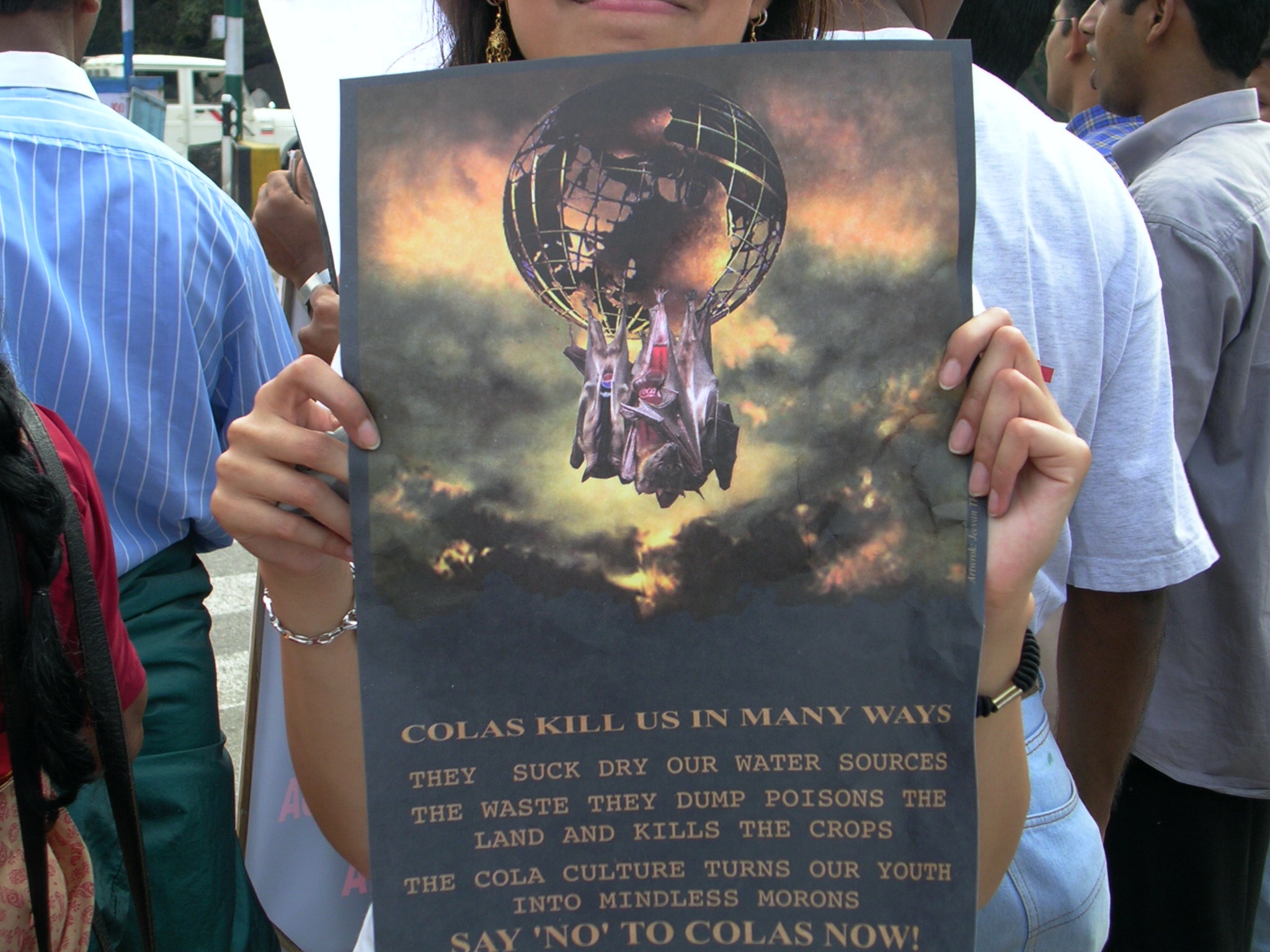
Karnataka Protest Poster, Karnataka Water Rights Coalition, Bengaluru (Bangalore) 2004, Melanie Reynolds

Activism  How do you define Activism? Holding up a sign in protest is only one form of activism. Other ways include using your purchasing power to support companies and organizations that make a commitment to the things you believe in. It can be writing to a company to tell them you like and support their sustainability issues and that you, as a customer, are taking notice. You can also write to companies you won’t support and tell them, why you don’t support them (ie wasteful packaging, high CO2 output.)

Hacktivism You’ve heard of computer hackers and life hacks. Hacking in itself isn’t a bad thing. There used to be a distinction between “Hackers” and “Crackers.” Crackers are typically “the black hats” that want to steal your money or information for takedowns and sabotage. Hackers are testers, they want to find out how things works or test their skills. A “White hat” hacker will find exploits and notifies the appropriate person so it can be fixed. Anyone at any age can be a hacker. Don’t let Hollywood fool you into thinking its just lonely, acne-infested, teenage boys. My Grandma would have been a great hacker! So what’s hacktivism? The “Trolley problem” above as an example: The cracker steals the wheels of the trolley. The Hacker figures out how the trolley works. The White hat Hacker figures out how the trolley works, see that the brake is broken and notify the appropriate authorities. If the hacker also like knots, maybe they could go down and untie those people on the tracks while they’re at it!

Spy vs Spy, MAD Magazine comic strip By Antonio Prohias

Activist Investors Let your money do the talking. Move your assets into ESG (Environmental, Social Governmental) funds or active Sustainability funds. You choose whether to be an active or passive investor. There are a lot of online resources and most of the biggest investment firms now have some sort of ESG portfolio to varying degrees.

I just bought a book fresh of the press that has me really excited about doing this. I’m only in the first chapter so far. Let me know in the comments if you want a book review when I’ve completed it. It’s called “Activate Your Money: Invest to Grow Your Wealth And Build A Better World By Janine Firpo”

Photo by Karolina Grabowska on Pexels.com

Links:

How the Economy Has to Radically Transform to End Fossil Fuels in 20 Years (vice.com) or

The U.N. IPCC climate change report is bleak but hopeful. (slate.com)

Trolley problem – Wikipedia

Exxon Mobil Defeated by Activist Investor Engine No. 1 – The New York Times (nytimes.com)

Secret IRS Files Reveal How Much the Ultrawealthy Gained by Shaping Trump’s “Big, Beautiful Tax Cut” — ProPublica

There’s No Such Thing as a ‘Climate Haven’ – Bloomberg

Yes, the ultra-rich are still buying NZ$80m homes (in case you were wondering) | Stuff.co.nz (May 8,2020)

Silicon Valley Moguls Buying $8 Million Doomsday Bunkers in New Zealand (businessinsider.com) (Sep 6, 2018)

Anti-competitive practices – Wikipedia

How Google Search Results Are Being Manipulated By Shady Online Reputation Consultants (buzzfeednews.com)

https://blog.malwarebytes.com/101/2021/06/white-hat-black-hat-grey-hat-hackers-whats-the-difference/

Adapting to a Hotter World

The heroes in the next chapter of human survival will come from all walks of life and all branches of disciplines. Don’t give up hope just yet, things can still change for the better. When you give up, you’ve already lost. I’ve tracking climate change for over 25 years. While it is a large and complex problem, don’t let the thought of it overwhelm you. Like any large, complex problem we need to break it down into smaller steps. My advice for anything you try to conquer in life, is to take what overwhelms you and break it down into parts you can handle. Also, don’t be afraid to ask for help.

Photo by Scott Webb on Pexels.com

I want to make a bold new suggestion. What if we stop trying to fix our current societies “as is” and break the current schema? These small, fragmented patch jobs spread out across sectors and hindered by greed and red tape could quite possibly doom us all. What if we could build a new interwoven framework to create just, regenerative societies? I really love the idea of a “regenerative society.” To heal ourselves, our communities, and the landscapes in which we reside. How though?

Next time you have the opportunity to let your mind wander, I want you to think about what a regenerative society would look like in your eyes.

Feel free to share your ideas in the comment section below, write your own blog post and let me know about it, or email me. Maybe you will come up with ideas that pertain to the work that you and bring fresh ideas to your business, family, and communities. I hope you get promoted for being such a forward-looking thinker. We need you for the future of humanity. If you’re retired, the good news is, you’re not dead yet and there is still so much that you can do within your community! Depression can strike any age, gender and spiritual belief. I’ve always found that being part of something greater than myself gives me peace, passion and  happiness, even as an introvert. Do what feels comfortable to you.

We’re seeing the effects of drought, heatwaves, flooding, and typhoon damage nearly daily. Trying to manage these events as they happen is nearly impossible. The best strategy is to plan for them in advance, which can be difficult when people are stuck in an “out of sight, out of mind” way of reacting to things. As a disaster preparedness geek, I’m always planning one season ahead. In the summer I prepare for Fall, in the Fall I prepare for the Winter and in the Winter I prepare for Spring. Staying one step ahead helps me save money by buying supplies “out of season” and often with more selection. This also gives me the chance to do some research to make sure that what I think I need and what I actually need are the same thing. Sometimes through my research I discover I don’t need to buy anything at all, just reorganize something I already have. I can often create what I need or find someone in my community to help or trade with.

Photo by Maria Orlova on Pexels.com

How can society benefit from planning ahead?

A lot of the research has already been done. Some it has been lost and needs to be rediscovered and/or embraced by a larger segment of the population. Serious mistakes have been made in the past, both on a human rights level and an environmental level. Here in the U.S. there is an urgency to help Indigenous Americans reclaim their lands and rights that were stolen during decades of genocide. The restoration of these lands and rights could help all of us benefit from nearly forgotten practices of land management that are only now being given serious consideration and rigorous academic studies that they deserve.

Photo by Pixabay on Pexels.com

Looking beyond national borders also gives us ideas about what works in other areas of the world. The current trend in environmental articles last week have been two-fold. Several articles talk about how trees are important to relieving the “heat island effect” in cities. Once again we see disparities of who gets trees in their neighborhoods, which often tend to be pre-dominantly White, upper class neighborhoods. The trees themselves did not ask to be objectified as status symbols for wealth. Its class systems and social hierarchies who has decided who gets to benefit from nature. I’ll state the obvious, this practice needs to be abolished. Trees and plants for all!

The second common thread of environmental articles these last few weeks had to do with white paint. Famous pictures from Greece, especially from the Cyclades islands depict white building with blue domes. While this white paint is derived from mined gypsum, scientists are exploring other ways to benefit from the properties of the white paint for broader use without having to mine it. One study is focusing on the properties of a beetle, Lepidiota stigma. I believe if we can understand how this works at a molecular level, we can come up with eco-friendly paint formulas in various colors.

Photo by Raquel Costa on Pexels.com

This week I’m researching “Tiny Forests” for next weeks post. Stay tuned. Have a safe and comfortable rest of your week!

Tree Equity Score highlights lack of cover in low-income areas (fastcompany.com)

How cities can avoid ‘green gentrification’ and make urban forests accessible (theconversation.com)

In Cleveland, Better Housing Is Climate Justice : NPR

This whiter than white paint cools buildings (fastcompany.com)

Lighter pavement really does cool cities when it’s done right (theconversation.com)

Why shade trees are hard to find in redlined neighborhoods (nationalgeographic.com)

Heatwave, Restoration and battling Tansy Ragwort

I was working on a different post for this week, but I’m going to save it for next week. Right now I want to tell you about the last few days. I was fortunate to be way up north this weekend in Blaine, Washington. My reservation was made two months ago, but it was the most comfortable place in Washington state to ride out the heatwave. All the talk around here has been about the great Pacific Northwest heatwave and the collapse of a twelve-story building in Surf City, Florida. Both have resulted in a tragic loss of life and are harbingers of things to come. What can climate scientists say? We thought we had more time. We don’t.

Blaine is the last city on I-5 before you reach the Canadian border. Some lucky people living in Blaine have a gorgeous view of Vancouver, B.C.’s skyline! It’s right there, so close! I’d intended to get you a cool picture to prove it, but there was a milkshake incident. I was not the one wearing the milkshake, but let’s just say someone squeezed their plastic cup too hard. Right now, the border between U.S. and Canada is closed. A lot of us on both sides of the border are not happy about it. I miss my British Columbia people and the closure has kept friends separated from their families.

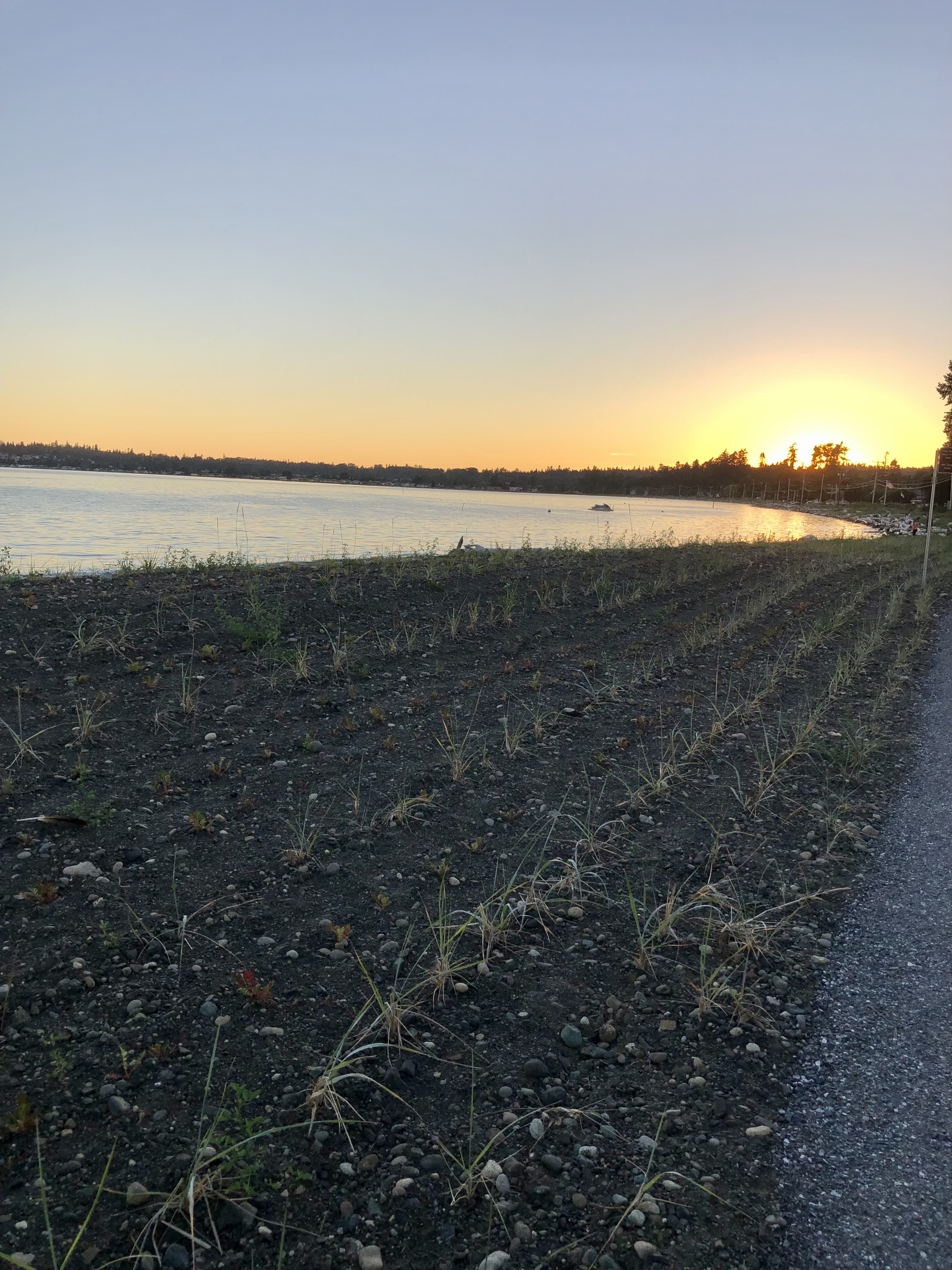
Here’s a picture of a shore habitat restoration project in Birch Bay. Behind it is the sun frying Vancouver, B.C. just a wee bit longer before it calls it a day. Shoreline restoration is important for many reasons. It provides habitat, helps reduce wind-driven erosion and tidal erosion during storms and high tides, in particular, “King tides” which is a non-scientific name for an exceptionally high tide that happens a few times a year.

Shore Restoration Birch Bay

Today was the first day the Pacific Northwest (PNW) got back down to cooler temperatures, though still above average for this time of year. I took the opportunity to work in the yard. There is so much work to be done! It’s a full-time job creating my own “learn as I go” habitat restoration project on 1.39 acres (0.56 hectare). I’ve tried to find experts in the field to help guide me to know avail. I often find that I end up teaching them instead of the other way around. There is a very deep pain etched in this land. It belonged to the Coast Salish tribes before the government of White colonists started dividing it up to be sold and owned.

To conquer and “civilize” the land, non-indigenous plants and crops were brought in, mostly from Europe and Asia. These are the weeds that I now fight today. Some of these plants became very invasive, some of the others were kind and play well with others, not dominating the landscape, like people or words are sometime inclined to do. Still more of them came generations later both intentionally and unintentionally through livestock manure, soil, or other secondary means.

I‘m not alone in my effort to reclaim the native plants that have been trampled on and abused. The stories of these plants are the stories of the indigenous people, who have also been trampled on and abused. They want to heal, they want to restore, and I want to help. We can’t erase the past, we can’t ignore what has already been done, but we can still work together to preserve what’s left.

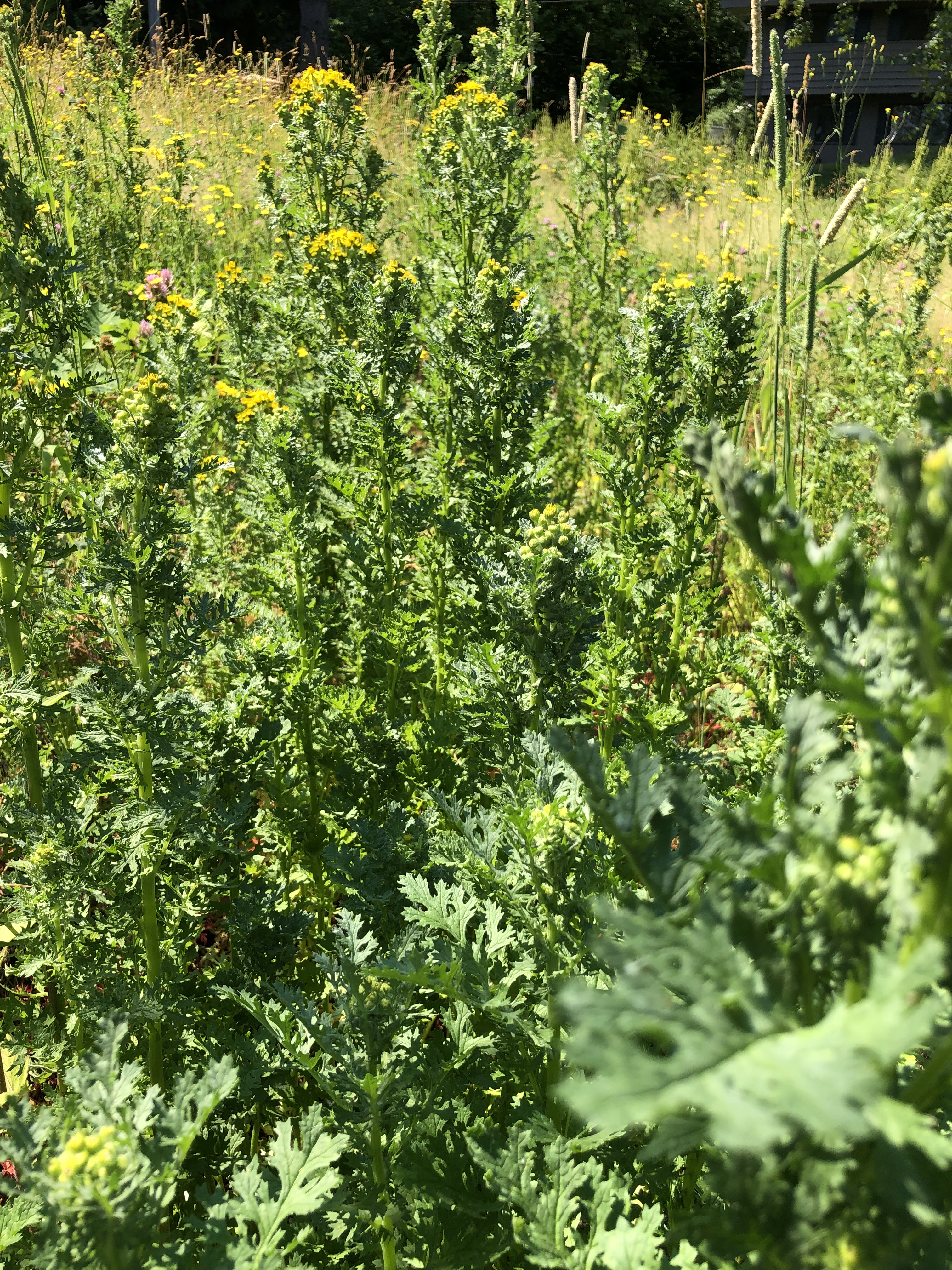
Tansy Ragwort

The recent heat wave has invigorated the tansy ragwort (Senecio jacobaea) a highly toxic, Class B noxious weed that is threatening to take over my field of restoration. It so terrible that it has to go in the garbage and can’t go in the compost if its got a head on it. So today, in the sun I tried to remove as much as I could. I’ll be back at it again tomorrow, but its already filled up two garbage bags. That’s going to cost me extra in disposal fees. I just can’t let it go to seed though, so in desperation I’ve decided to go with the Queen of Hearts* advice and it’s “Off with their heads!” Then I can circle back around and pull it out from the roots with slightly less urgency.

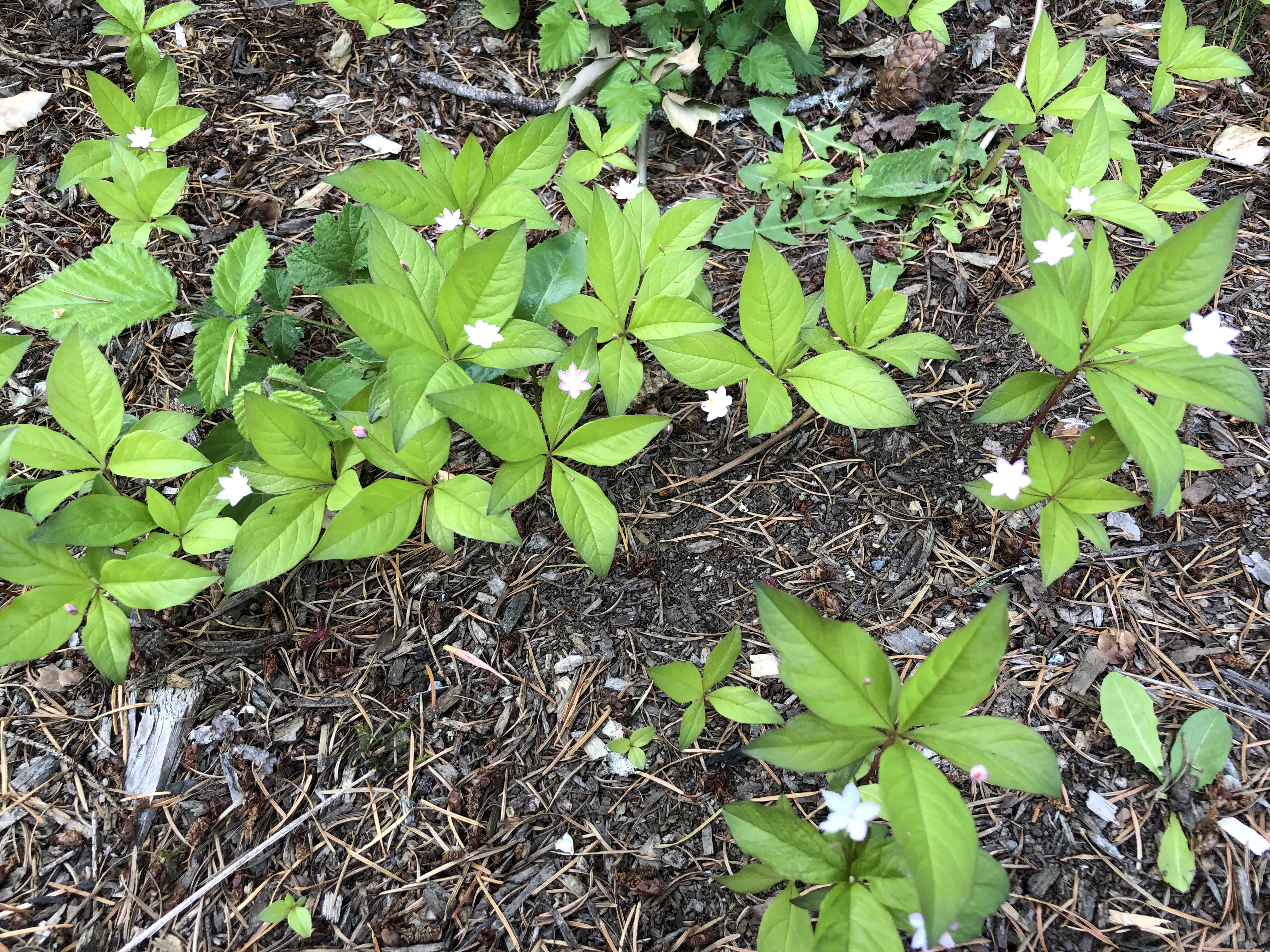
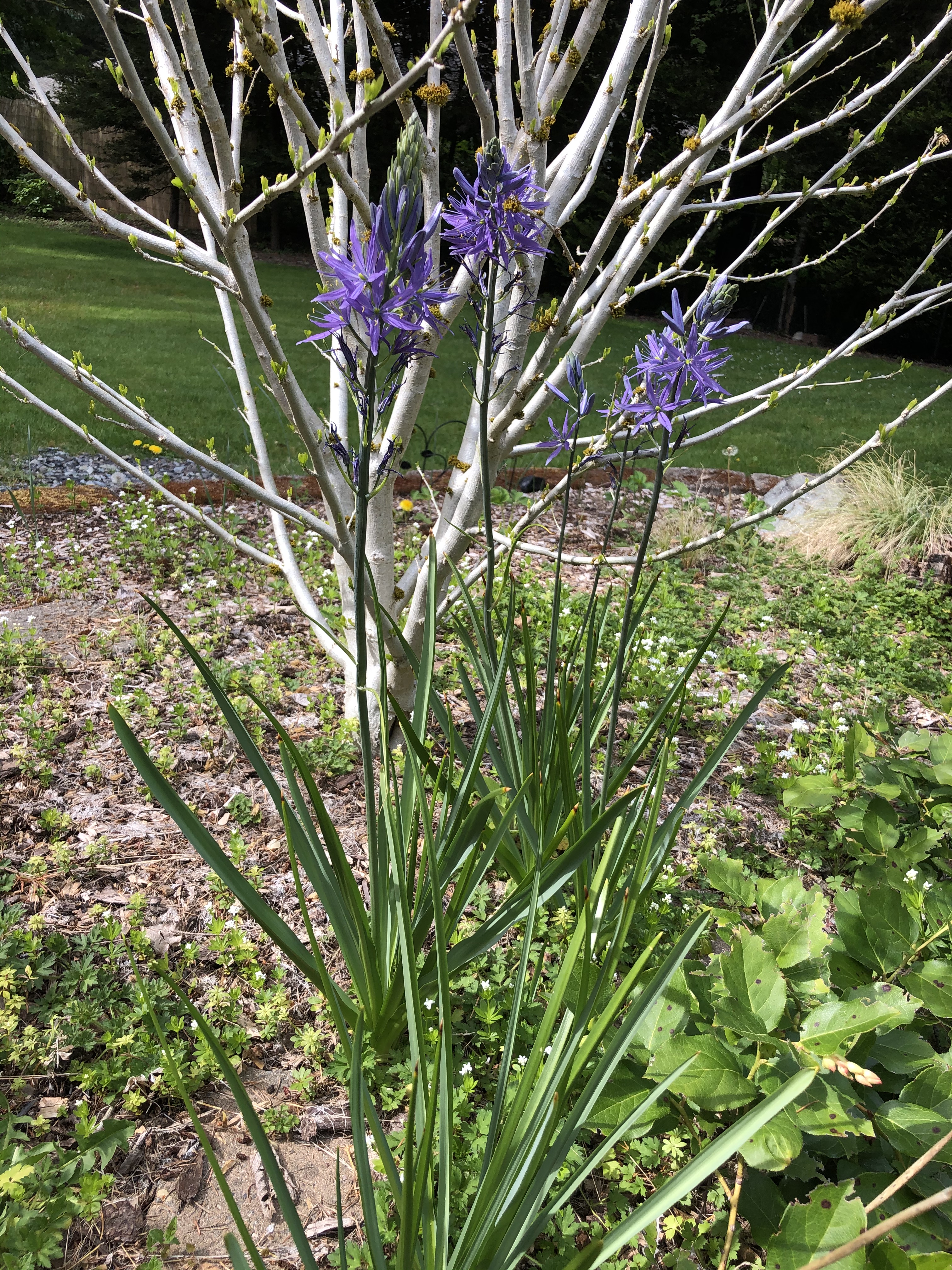
I know my wars are frequently invisible and never shall I see a parade for my efforts, but this is important, even in small ways. On days when I feel like giving up and moving to a condo in the city, I take a walk and more often that not find a new native friend to greet me. My greatest successes so far has been the return of Western Starflowers and a few Great Camas.

Western Starflower
Great Camas


What is a King Tide? (noaa.gov)

Tansy Ragwort (Senecio jacobaea) – King County Noxious Weed Alert (wa.gov)

Western starflower; Indian potato: Trientalis latifolia – Native Plant Guide (kingcounty.gov)

Great camas (Camassia leichtlinii ssp. suksdorfii) Plant Guide (usda.gov)

*The Queen of Hearts is a fictional character from the book Alice In Wonderland By Lewis Carroll.