Hello Nature-Led Friends!
Right now, I feel overwhelmed by a lot of things honestly. This website has been accessed and likely scrapped by AI without permission or acknowledgement like millions of other websites. Our words and pictures stolen without opt in, consent or recognition.
If a human looked at our monthly challenges and used them to become a better artist by referencing them only to become better at say “drawing moss” or “drawing a camellia” that’s fair use. I’ve never had a problem with that. AI, however, puts us all in a blender and spits out an amalgamation of our written words and images with no context and no soul. People profit off of AI-generated theft, but not the creators whose works and words and thoughts were stolen to to make the LLM (large language models) learn for the profit of Tech companies and scammers. One can hardly tell the difference between the two these days.
The artist community is in turmoil. We’ve never had our works stolen at such a vast magnitude before. While I would love to have illustrated art go with my stories, I’m not going to do it by using AI. I couldn’t expect a visual artist to respect my writing if I was using AI art and I wouldn’t respect them for using AI to do the writing for them. Artists are notorious for having to struggle to survive in Western societies to make art and it’s never been fair. Creation is often at its best when it seeks collaboration with other human artists, that’s how communities are born
Many of us are in a depressive state. Why bother? If our work it just going to get stolen why should we bother creating at all? Society seems fine with the novelty of regurgitated AI slop so far. If society sees no problem with using AI over humans, in the most fundamental act of being human why should we feed the machine?
We tell our stories through writing, performance and visuals to connect with other humans on a sacred level. It’s how we reach out with our spirit to see and be seen. We use art to better understand ourselves and the world around us. It is culture. It is the foundation of how we communicate who we are as a people. In many cultures textiles aren’t just made as clothes to be worn but to signify where you are from. You can tell who someone’s people are by the colors and the patterns used in different regions of Latin America or SE Asia, for example.
If you think societies are too big to fail, the Romans would like to have a word with you. All we have left is what we leave behind; writing, sculptures, textiles, metal works, pottery etc. Why have we lost so many Indigenous societies to time? Because they shared their history, traditions and culture through an oral tradition. When no one was left to speak the language, to tell the story, the spirit of that nations people died. The art, if not passed down, absorbs back into the landscape.
As I’ve been turning inward lately to focus on nurturing the natural world and people around me, I’ve also been reading a lot, mostly fiction and short stories. I’m a little burnt out on most Nonfiction at the moment, unless it’s told from a personal perspective.
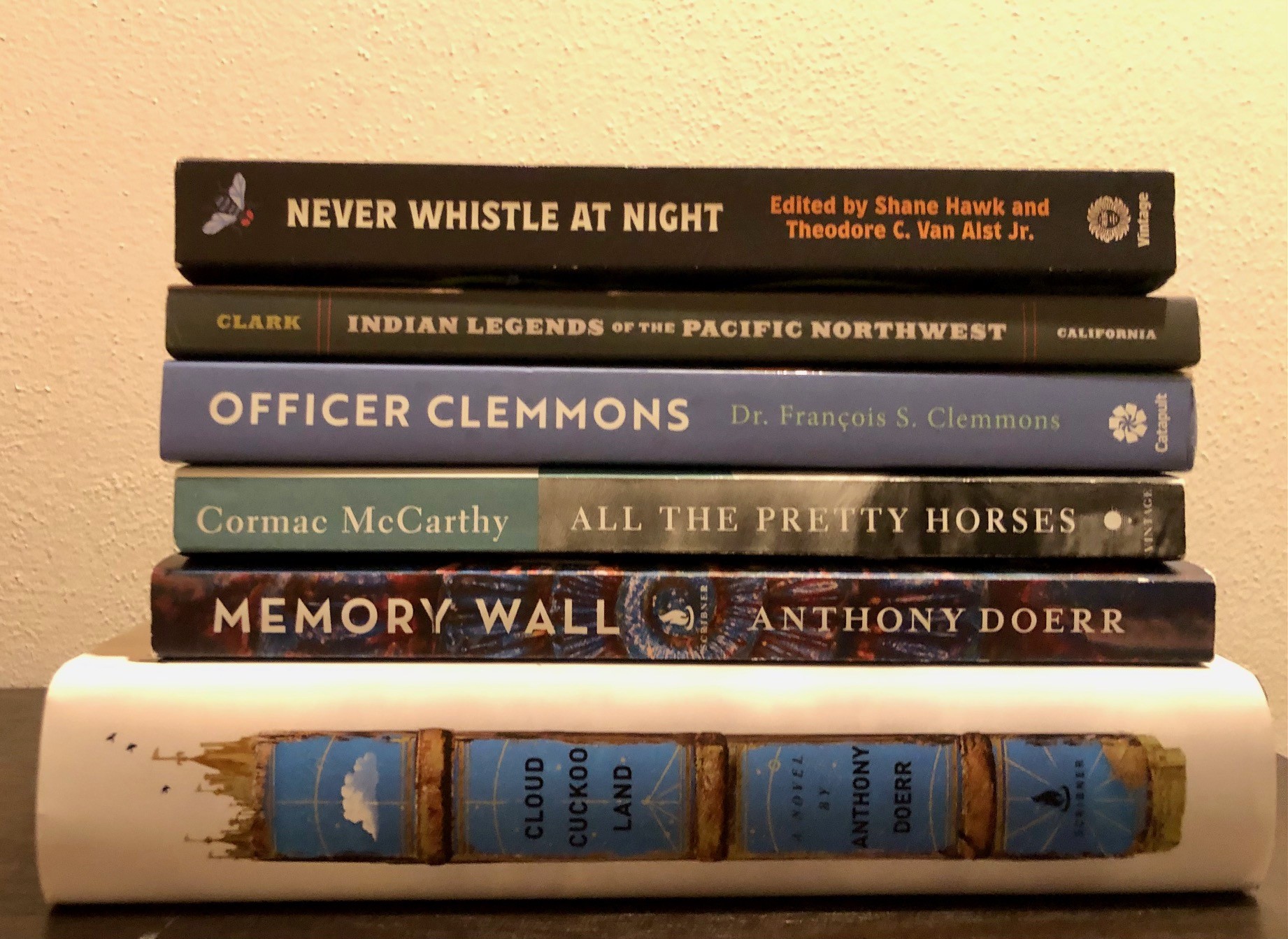
Fiction currently read
Cloud Cuckoo Land by Anthony Doerr
The Memory Wall (A collection of stories) By Anthony Doerr
All The Pretty Horses by Cormac McCarthy
And my favorite so far this year:
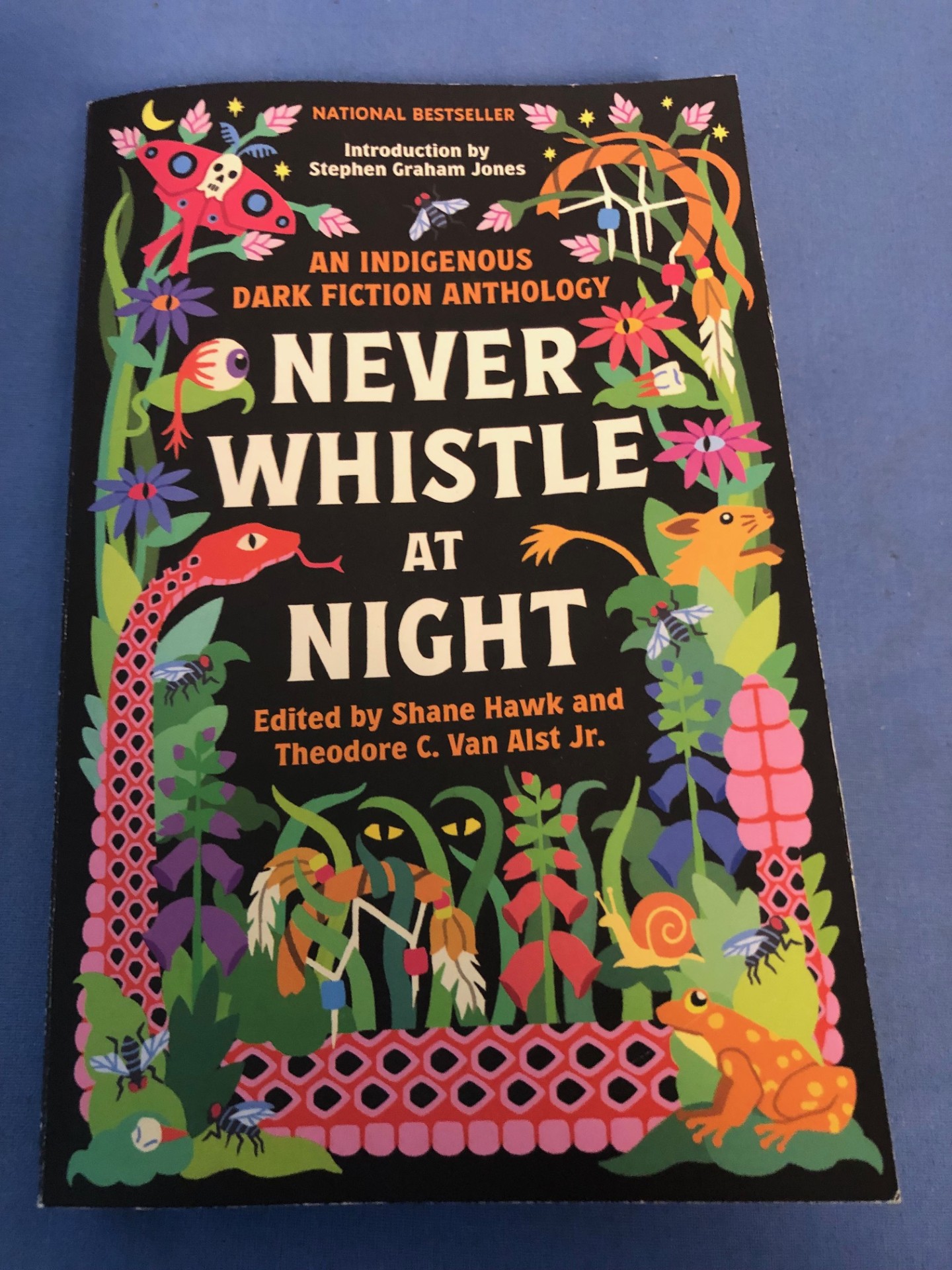
Never Whistle at Night (An Indigenous Dark Fiction Anthology) Edited by Shane Hawk and Theodore C. Van Alst Jr.
As a collected work from various authors some spoke to me more than others, but several of these stories will stay with me a long time. I never thought I liked horror, but the truth is, I like horror/suspense with something to say. Stories that make us face uncomfortable truths are important to our understanding of the world around us. I’m not interested in blood and violence for the sake of graphic shock value. Some of these stories will leave you disturbed, I think, in a meaningful way.
Nonfiction Narratives currently read
Officer Clemmons, A Memoir by Dr Francois S. Clemmons
Dr. Clemmons shares his personal story on what it was like to grow up as a young, gay Black man in the 1940s. His personal account adds depth, flavor, and emotion to a time and lived experience that I will never know personally. The U.S. could really use Fred Roger’s clarity and grace right now.
Hillbilly Elegy by J.D. Vance
I started with an open mind. I read the introduction and the first two chapters and learned all I needed to know about the author. No stories of hunting and fishing, swimming in a crik (creek), driving a tractor, cuttin’ trees, or community coming together during a great storm or tragedy. Instead, you get him making assumptions and passing judgement on people around him to justify that he’s better than they are.
What upset me the most is his account of walking down the street with his cousin and seeing a house and the eyes of suspicious children peeking from windows and a summation of their father, true or not, that he was an addict spending all his money on his drugs/alcohol and not his family. This is what Mr. Vance uses to launch into a manifesto on his opinion (peppered with statistics so you think he’s smart ‘cause that’s what they taught him to do at that fancy Ivy league school he graduated from) so he can tell you, the reader, what’s wrong with working class, rural Americans.
He didn’t talk to those kids; he didn’t talk to the dad. He built a narrative at their expense to write a book to further his reputation outside of Appalachia for money, praise and political opportunity. The worst kind of theft among people who may have little in terms of material value. He as no right to give a elegy on people he never bothered to really get to know.
Indian Legends of the Pacific Northwest by Ella E. Clark
There’s a right way to share someone else’s story. It starts with permission whenever possible. If permission isn’t possible (i.e. they’re dead and necromancy isn’t within your ability) then with acknowledgement up front that you feel that this person’s story is important and worth remembering and why it’s important to you.
We can argue whether a White person had the right to collect the stories of indigenous people back in 1953, but what if Ella E. Clark hadn’t chosen to do so out of her own interest to learn indigenous peoples’ stories? Would these stories have been lost to the indigenous youth of today or is there an indigenous historian I’m not aware of that has collected similar stories into one book? These stories were gathered from living Elders who were in their eighties and nineties at the time that they told them. Some of the stories come from even earlier origins as relayed to anthropologists and government employees either by the people themselves or by pioneers who had become familiar with their indigenous neighbors.
The introduction is respectful and gives credit where credit is due. There is extensive notetaking and what I really like the most is the brief introduction to the storyteller and something unique about them. Each storyteller of the oral tradition is also a performer. I’ve heard multiple tellings of the story “Raven Steals the Sun” and each version varies a little by who’s telling it. Storytelling is both a gift and an art form.
Alternative story forms, a side note:
I once saw a one-woman Noh play when I was in high school Creative Writing class. I was really skeptical that one person could hold my attention for two hours in such a way, but the whole class was meeting after school hours to attend the small performance and there would be dinner at a nice restaurant afterwards, so I thought it was worth giving it a try. I’m so glad I did! I’ve never seen anything like it and I think about it often. She would quick-change characters on the spot by simple props. Hair up with glasses is one character. A shawl about her shoulders and a cane is another character. Just one prop and a change in mannerisms introduced a new character and it was fascinating to watch. I was riveted by the whole thing, the quick change is part of the performance. Even after the show when we had the opportunity to talk to her and thank her for her performance I was left to wonder which version of her were we talking too. Since then, I’ve always seen people as multi-dimensional. Some have more versions of themselves than others.
The Japanese have always had an understanding of the public face/private face. The version strangers see and the version our family and friends see. This takes me to the thought of the masks made by war veterans during an experimental art therapy program that started around 2015. It encourages soldiers dealing with post-traumatic stress to paint a mask in an attempt to help them verbalize their traumatic experiences. The resulting mask is not the point, but the context of the themes that arise from it. (Links to stories about the Veterans and their masks. Military Veteran Project News – Military Veteran Project, Healing Soldiers | National Geographic, Behind the Mask – Art, Healing and Self-Discovery (A UK project story)
Wherever you are, I hope you are well! Get outside, read books, eat well, and make time for the people and things that matter to you! My fellow creators will not stop creating, we will just need to be more mindful about how we create, why we create and who we are creating it for. I’ve just started exploring growing Bonsai trees and reading How to be a Craftivist: The Art of Gentle Protest By Sarah P. Corbett.

What are you currently learning about or reading? I genuinely want to know!
In Memoriam:
My Uncle Rich passed yesterday morning. He’s free now from the excruciating pain of cancer and for that I’m grateful, but I’ll miss the timbre of his voice, abundant empathy, hearty laugh, warm bear hugs and beautiful smile.
I’ve been listening to this song a lot lately…(Arcane is an anime based off a video game.)
Ref A: 2A398833CE0A4E2BAF9AFDD723E49412 Ref B: STBEDGE0208 Ref C: 2021-07-28T03:10:42Z


 The Nature-led Life